• HOME
  • NEWS
  • EXPLORE
    • CAREER
      • Companies
      • Jobs
    • EVENTS
    • iGEM
      • News
      • Team
    • PHOTOS
    • VIDEO
    • WIKI
  • BLOG
  • COMMUNITY
    • FACEBOOK
    • INSTAGRAM
    • TWITTER
Monday, December 22, 2025
BIOENGINEER.ORG
No Result
View All Result
  • Login
  • HOME
  • NEWS
  • EXPLORE
    • CAREER
      • Companies
      • Jobs
        • Lecturer
        • PhD Studentship
        • Postdoc
        • Research Assistant
    • EVENTS
    • iGEM
      • News
      • Team
    • PHOTOS
    • VIDEO
    • WIKI
  • BLOG
  • COMMUNITY
    • FACEBOOK
    • INSTAGRAM
    • TWITTER
  • HOME
  • NEWS
  • EXPLORE
    • CAREER
      • Companies
      • Jobs
        • Lecturer
        • PhD Studentship
        • Postdoc
        • Research Assistant
    • EVENTS
    • iGEM
      • News
      • Team
    • PHOTOS
    • VIDEO
    • WIKI
  • BLOG
  • COMMUNITY
    • FACEBOOK
    • INSTAGRAM
    • TWITTER
No Result
View All Result
Bioengineer.org
No Result
View All Result
Home NEWS Science News Biology

Researchers discover a new and unique class of carbohydrate receptors

Bioengineer by Bioengineer
July 30, 2020
in Biology
Reading Time: 2 mins read
0
IMAGE
Share on FacebookShare on TwitterShare on LinkedinShare on RedditShare on Telegram

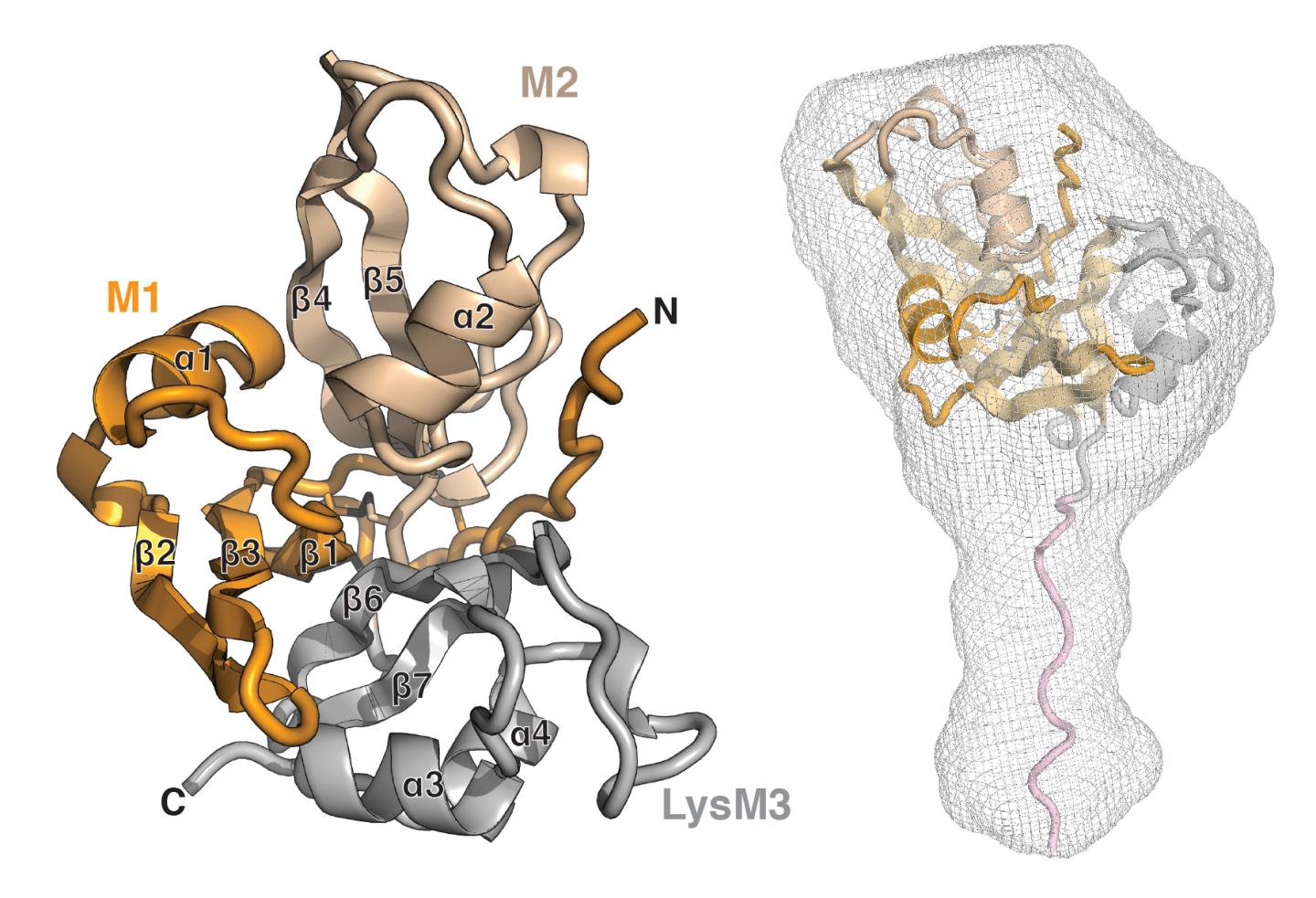
IMAGE

Credit: Kasper Røjkjær Andersen

Exopolysaccharides (EPS) are surface-exposed carbohydrates that surround and protect bacteria and are involved in biofilm formation, cell-to-cell interactions, immune evasion, and pathogenesis. The structures and compositions of EPS synthesized by different bacteria are highly diverse and therefore a molecular fingerprint.

EPS also plays an important role for bacterial colonization and symbiosis with plants. Nitrogen-fixing soil bacteria (rhizobia) are recognized on the basis of their EPS when colonizing plant roots, judged compatible or incompatible by their legume host and allowed or denied access accordingly. The single-pass transmembrane Exopolysaccharide receptor 3 (EPR3) is responsible for monitoring EPS.

“To gain a deeper understanding of the function of this receptor, we needed to know what it looks like”, says Jaslyn Wong, who conducted this research at Aarhus University. Unfortunately, attempts to determine the structure of the ligand-binding portion of EPR3 remained unsuccessful for years, but a breakthrough was finally achieved by using llama-derived nanobodies to obtain a crystal of the receptor.

The structure revealed that EPR3 stands out from other members of the so-called LysM receptor kinases. EPR3 deviates in its ligand-binding domain from the canonical members of this receptor family and has a fold that is unique and novel for carbohydrate binding proteins.

“This is a good example of how a structure changes our view on the biology”, says Kasper Røjkjær Andersen. “We are now able to demonstrate the existence of a completely new and structurally unique class of carbohydrate receptors and find that this class is conserved in the entire plant kingdom. We did not know this before we obtained the structure and this opens for a lot of exciting biology to understand the role of the receptor”.

Jaslyn Wong adds: “Research on EPS receptors is still in its infancy, and I am excited about how this knowledge could be used and its potential implications on shaping microbiota for more sustainable agriculture”.

###

DOI: 10.1038/s41467-020-17568-9

For further information, please contact

Assistant professor Kasper Røjkjær Andersen

Department of Molecular Biology and Genetics

Aarhus University, Denmark

[email protected]

Media Contact
Kasper Røjkjær Andersen
[email protected]

Original Source

https://mbg.au.dk/en/news-and-events/news-item/artikel/researchers-discover-a-new-and-unique-class-of-carbohydrate-receptors/

Related Journal Article

http://dx.doi.org/10.1038/s41467-020-17568-9

Tags: Agricultural Production/EconomicsBiochemistryBiologyBiotechnologyMicrobiologyMolecular Biology
Share12Tweet8Share2ShareShareShare2

Related Posts

blank

Enhancing Rabbit Growth: Acoustic and Bioactive Supplement Synergy

December 22, 2025
Silencing SlERF.F5 Enhances Stress Tolerance in Tomato

Silencing SlERF.F5 Enhances Stress Tolerance in Tomato

December 22, 2025

Comprehensive Analysis of DOF Gene Family in Pea

December 22, 2025

Engineering Microbes for Sustainable Microplastic Breakdown

December 22, 2025
Please login to join discussion

POPULAR NEWS

  • Nurses’ Views on Online Learning: Effects on Performance

    Nurses’ Views on Online Learning: Effects on Performance

    70 shares
    Share 28 Tweet 18
  • NSF funds machine-learning research at UNO and UNL to study energy requirements of walking in older adults

    71 shares
    Share 28 Tweet 18
  • Unraveling Levofloxacin’s Impact on Brain Function

    54 shares
    Share 22 Tweet 14
  • Exploring Audiology Accessibility in Johannesburg, South Africa

    51 shares
    Share 20 Tweet 13

About

BIOENGINEER.ORG

We bring you the latest biotechnology news from best research centers and universities around the world. Check our website.

Follow us

Recent News

Metabolic Effects of Prolonged CPAP in Preemies

Transforming Lab Reports: AI Takes the Lead

Core Competencies of OR Nurses in Maritime Emergencies

Subscribe to Blog via Email

Enter your email address to subscribe to this blog and receive notifications of new posts by email.

Join 70 other subscribers
  • Contact Us

Bioengineer.org © Copyright 2023 All Rights Reserved.

Welcome Back!

Login to your account below

Forgotten Password?

Retrieve your password

Please enter your username or email address to reset your password.

Log In
No Result
View All Result
  • Homepages
    • Home Page 1
    • Home Page 2
  • News
  • National
  • Business
  • Health
  • Lifestyle
  • Science

Bioengineer.org © Copyright 2023 All Rights Reserved.