Loss of cycads from natural habitats may create detrimental ripple effects for other organisms
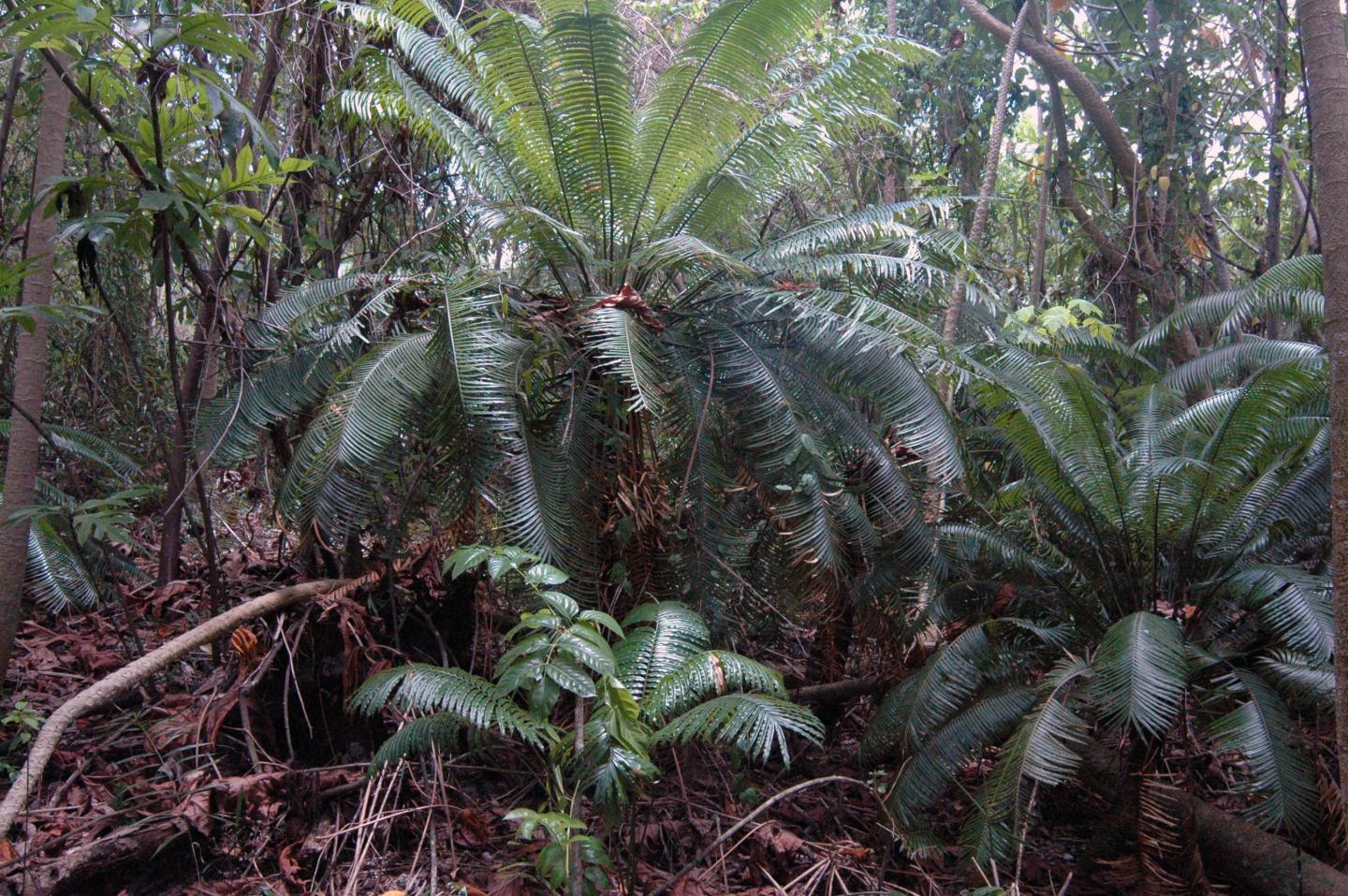
Credit: University of Guam
A study published in the June 2020 edition of the peer-reviewed journal Horticulturae shows that cycads, which are in decline and among the world’s most threatened group of plants, provide an important service to their neighboring organisms. The study, completed by researchers from the Western Pacific Tropical Research Center at the University of Guam and the Montgomery Botanical Center in Miami, found that at least two cycad species share nitrogen and carbon through the soil, thereby creating habitable environments for other organisms.
“The new knowledge from this study shows how loss of cycad plants from natural habitats may create detrimental ripple effects that negatively influence the other organisms that evolved to depend on their ecosystem services,” said Patrick Griffith, executive director of the Montgomery Botanical Center.
Cycad plants host nitrogen-fixing cyanobacteria within specialized roots. The tiny microbes willingly share the newly acquired nitrogen with their hosts as their contribution to a symbiosis that benefits both organisms.
Research teams at the University of Guam have long been studying the nutrient relations of Cycas micronesica throughout its endemic range, according to Adrian Ares, associate director of the Western Pacific Tropical Research Center.
“This unique arborescent cycad species is of cultural and ecological importance, and the findings illuminate new knowledge about the ecosystem services that are provided by the plant,” Ares said.
The study focused on the concentrations in soil of three elements that impact the growth and development of living organisms. In soils nearby the cycad plants, nitrogen and carbon increased to concentrations that exceeded those of soils that were distant from the plants. In contrast, phosphorus concentrations were depleted in the soils nearby the cycad plants when compared to the distant soils.
“In addition to the direct contributions of carbon and nitrogen to the bulk soils, the chemical changes imposed by the cycad plants created niche habitats that increased spatial heterogeneity in the native forests,” Ares said, adding that ecosystems with high biodiversity are generally more resistant to damage by threats and more resilient after the negative impacts.
The niche spaces created by the cycad plants provide the soil food web with a microhabitat that differs from the surrounding forest soils. These soils imprinted by the cycad plants benefit the organisms that exploit spaces characterized by greater nitrogen levels relative to phosphorus and greater carbon levels relative to phosphorus. Scientists call these elemental relationships “stoichiometry,” and much has been studied about the importance of these relationships to organismal health and productivity.
The model cycad plants that were employed for the study included two of the cycad species that are native to the United States.
“This study was apropos because the Montgomery Botanical Center is positioned within Zamia integrifolia habitat in Miami, Fla., and the Western Pacific Tropical Research Center is within Cycas micronesica habitat in Mangilao, Guam,” Griffith said.
The Florida species is the only cycad species that is native to the continental United States, and the Guam species is the only Cycas species native to the United States.
“Both research teams were gratified to successfully answer questions that were asked of the botanical denizens that have long resided in the respective local forests,” Griffith said.
###
Further Reading: Marler, T.E. and M. Calonje. 2020. Two cycad species affect the carbon, nitrogen, and phosphorus content of soils. Horticulturae 6:24. DOI 10.3390/horticulturae6020024.
Media Contact
Olympia Terral
[email protected]
Related Journal Article
http://dx.