• HOME
  • NEWS
  • EXPLORE
    • CAREER
      • Companies
      • Jobs
    • EVENTS
    • iGEM
      • News
      • Team
    • PHOTOS
    • VIDEO
    • WIKI
  • BLOG
  • COMMUNITY
    • FACEBOOK
    • INSTAGRAM
    • TWITTER
Saturday, February 7, 2026
BIOENGINEER.ORG
No Result
View All Result
  • Login
  • HOME
  • NEWS
  • EXPLORE
    • CAREER
      • Companies
      • Jobs
        • Lecturer
        • PhD Studentship
        • Postdoc
        • Research Assistant
    • EVENTS
    • iGEM
      • News
      • Team
    • PHOTOS
    • VIDEO
    • WIKI
  • BLOG
  • COMMUNITY
    • FACEBOOK
    • INSTAGRAM
    • TWITTER
  • HOME
  • NEWS
  • EXPLORE
    • CAREER
      • Companies
      • Jobs
        • Lecturer
        • PhD Studentship
        • Postdoc
        • Research Assistant
    • EVENTS
    • iGEM
      • News
      • Team
    • PHOTOS
    • VIDEO
    • WIKI
  • BLOG
  • COMMUNITY
    • FACEBOOK
    • INSTAGRAM
    • TWITTER
No Result
View All Result
Bioengineer.org
No Result
View All Result
Home NEWS Science News Biology

Weather-based decisions may reduce fungicide sprays on table beets

Bioengineer by Bioengineer
July 22, 2020
in Biology
Reading Time: 2 mins read
0
IMAGE
Share on FacebookShare on TwitterShare on LinkedinShare on RedditShare on Telegram

IMAGE

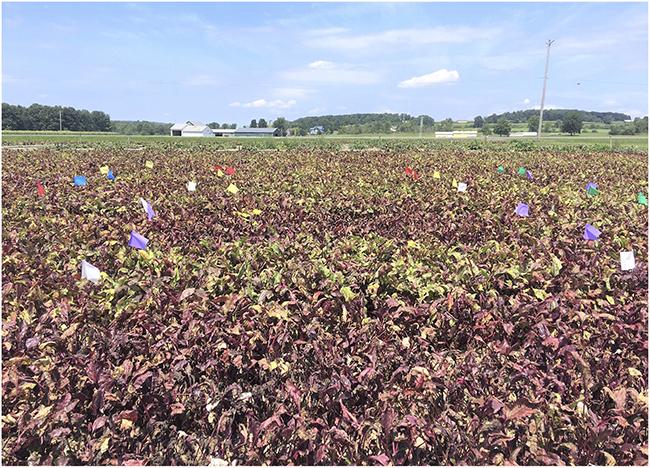
Credit: Sarah J. Pethybridge, Sandeep Sharma, Zachariah Hansen, Julie R. Kikkert, Daniel L. Olmstead, and Linda E. Hanson

A plant pathologist at Cornell University, Sarah J. Pethybridge supplies New York vegetable growers with the information they need to control soilborne diseases and adopt effective management strategies. She crafts her research around conversations with table beet growers about productivity issues in the field. These growers continuously expressed frustration with maintaining healthy foliage.

Cercospora leaf spot (CLS), which appears as small gray to black-colored lesions on leaves, is the dominant disease affecting table beet foliage in New York. CLS epidemics occur annually and can lead to defoliation and significant crop loss as healthy leaves are important to facilitate harvest by top-pulling.

Growers control CLS using fungicides. Through current management practices, growers begin spraying fungicides once they see one lesion per leaf then continue applying fungicides on a calendar basis.

Pethybridge and her team conducted a study to examine the efficacy of this treatment using three different fungicides and assessed the potential of using a risk-based model to improve fungicide timings. They found that two of the fungicides significantly improved CLS control if treatment was applied before the pathogen was present while the third fungicide worked best based on the current treatment model. Moreover, application of the first two fungicides were reduced from three to two using a weather-based risk model.

“This shows there is an opportunity to reduce spray frequency by scheduling on weather-based risk rather than calendar applications,” Pethybridge explained. “But different fungicides vary in the optimal risk threshold. The action thresholds and risk thresholds need to be assessed for each fungicide to be used for optimal disease management, but there are opportunities for improving disease control and reducing fungicide use with these tactics.”

Use of a weather-based decision support system to schedule fungicides for the control of CLS in table beet reduces unnecessary expense to the grower and unnecessary exposure of a fungal population to single-site modes of action posing a high risk of resistance development. For more information, read “Optimizing Cercospora Leaf Spot Control in Table Beet Using Action Thresholds and Disease Forecasting” in Plant Disease.

###

Media Contact
Ashley Bergman Carlin
[email protected]

Related Journal Article

http://dx.doi.org/10.1094/PDIS-02-20-0246-RE

Tags: Agricultural Production/EconomicsAgricultureBiologyEcology/EnvironmentFood/Food ScienceMycologyPlant Sciences
Share12Tweet8Share2ShareShareShare2

Related Posts

Florida Cane Toad: Complex Spread and Selective Evolution

Florida Cane Toad: Complex Spread and Selective Evolution

February 7, 2026
New Study Uncovers Mechanism Behind Burn Pit Particulate Matter–Induced Lung Inflammation

New Study Uncovers Mechanism Behind Burn Pit Particulate Matter–Induced Lung Inflammation

February 6, 2026

DeepBlastoid: Advancing Automated and Efficient Evaluation of Human Blastoids with Deep Learning

February 6, 2026

Navigating the Gut: The Role of Formic Acid in the Microbiome

February 6, 2026
Please login to join discussion

POPULAR NEWS

  • Robotic Ureteral Reconstruction: A Novel Approach

    Robotic Ureteral Reconstruction: A Novel Approach

    82 shares
    Share 33 Tweet 21
  • Digital Privacy: Health Data Control in Incarceration

    63 shares
    Share 25 Tweet 16
  • Study Reveals Lipid Accumulation in ME/CFS Cells

    57 shares
    Share 23 Tweet 14
  • Breakthrough in RNA Research Accelerates Medical Innovations Timeline

    53 shares
    Share 21 Tweet 13

About

We bring you the latest biotechnology news from best research centers and universities around the world. Check our website.

Follow us

Recent News

Barriers and Boosters of Seniors’ Physical Activity in Karachi

Evaluating Pediatric Emergency Care Quality in Ethiopia

TPMT Expression Predictions Linked to Azathioprine Side Effects

Subscribe to Blog via Email

Enter your email address to subscribe to this blog and receive notifications of new posts by email.

Join 73 other subscribers
  • Contact Us

Bioengineer.org © Copyright 2023 All Rights Reserved.

Welcome Back!

Login to your account below

Forgotten Password?

Retrieve your password

Please enter your username or email address to reset your password.

Log In
No Result
View All Result
  • Homepages
    • Home Page 1
    • Home Page 2
  • News
  • National
  • Business
  • Health
  • Lifestyle
  • Science

Bioengineer.org © Copyright 2023 All Rights Reserved.