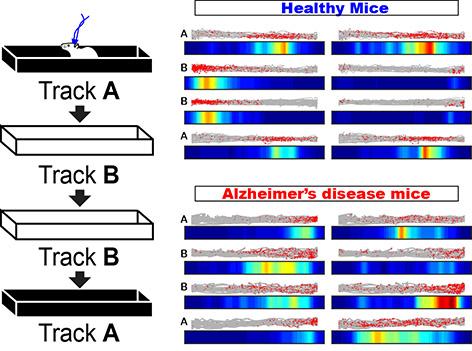
Credit: UCI School of Medicine
Irvine, CA – July 21, 2020 – Patients with Alzheimer’s disease frequently suffer from spatial memory loss, such as no recognition of where they are, and forgetting where they put their belongings. They often show a wandering symptom, which is also a feature of spatial memory impairment. Until now, the brain network mechanism that causes spatial memory impairment had been unclear.
Published today in Neuron, the study titled, “Disrupted place cell remapping and impaired grid cells in a knockin model of Alzheimer’s disease,” reveals how the normal brain network function of hippocampus cells which works to discriminate a distinct spatial environment in a process called “remapping,” was disrupted in Alzheimer’s disease. The study, done Alzheimer’s disease model mice, found that this disruption of hippocampus is most likely caused by the activity impairment of the entorhinal cortex, a brain region that supplies information to the hippocampus.
“We recorded the brain cell activity in the hippocampus, which is the memory center of the brain, responsible for spatial memory, among other things,” said Kei Igarashi, PhD, an assistant professor in the Department of Anatomy & Neurobiology at the University of California, Irvine School of Medicine. “Our findings could lead to the development of a method to reactivate brain activity of the entorhinal cortex, which may help establish new treatments for preventing the progression of spatial memory impairment in Alzheimer’s disease patients.”
Igarashi has been studying brain network mechanisms for Alzheimer’s disease since he started his lab in 2016. “Our memory comes from activities of the brain network. To find out the cure for memory impairment in Alzheimer’s disease, we need to understand how the network function is impaired,” he said.
Igarashi is 2019 New Vision Research and BrightFocus Foundation award recipient. The first author on this study, Heechul Jun, is a MD/PhD student in the UCI Medical Scientist Training Program.
According to the Alzheimer’s Association, there are an estimated 5.8 million Americans living with Alzheimer’s disease. By 2050, that number is expected to increase to 13.8 million people. Spatial memory impairment, such as wandering behavior, is one of the most troublesome symptoms in Alzheimer’s disease, and it occurs in more than 60 percent of Alzheimer’s patients. Despite recent molecular and cellular findings in Alzheimer’s research, it is still largely unclear how deterioration of brain circuit function causes spatial memory loss.
###
This study was supported by research grants from the National Institutes of Health, BrightFocus Foundation, Alzheimer’s Association, Brain Research Foundation, Donors Cure Foundation, Japan Science and Technology Agency and Whitehall Foundation.
About the UCI School of Medicine
Each year, the UCI School of Medicine educates more than 400 medical students, and nearly 150 doctoral and master’s students. More than 700 residents and fellows are trained at UCI Medical Center and affiliated institutions. The School of Medicine offers an MD; a dual MD/PhD medical scientist training program; and PhDs and master’s degrees in anatomy and neurobiology, biomedical sciences, genetic counseling, epidemiology, environmental health sciences, pathology, pharmacology, physiology and biophysics, and translational sciences. Medical students also may pursue an MD/MBA, an MD/master’s in public health, or an MD/master’s degree through one of three mission-based programs: the Health Education to Advance Leaders in Integrative Medicine (HEAL-IM), the Leadership Education to Advance Diversity-African, Black and Caribbean (LEAD-ABC), and the Program in Medical Education for the Latino Community (PRIME-LC). The UCI School of Medicine is accredited by the Liaison Committee on Medical Accreditation and ranks among the top 50 nationwide for research. For more information, visit som.uci.edu.
Media Contact
Anne Warde
[email protected]
Original Source
https:/
Related Journal Article
http://dx.