• HOME
  • NEWS
  • EXPLORE
    • CAREER
      • Companies
      • Jobs
    • EVENTS
    • iGEM
      • News
      • Team
    • PHOTOS
    • VIDEO
    • WIKI
  • BLOG
  • COMMUNITY
    • FACEBOOK
    • INSTAGRAM
    • TWITTER
Saturday, May 16, 2026
BIOENGINEER.ORG
No Result
View All Result
  • Login
  • HOME
  • NEWS
  • EXPLORE
    • CAREER
      • Companies
      • Jobs
        • Lecturer
        • PhD Studentship
        • Postdoc
        • Research Assistant
    • EVENTS
    • iGEM
      • News
      • Team
    • PHOTOS
    • VIDEO
    • WIKI
  • BLOG
  • COMMUNITY
    • FACEBOOK
    • INSTAGRAM
    • TWITTER
  • HOME
  • NEWS
  • EXPLORE
    • CAREER
      • Companies
      • Jobs
        • Lecturer
        • PhD Studentship
        • Postdoc
        • Research Assistant
    • EVENTS
    • iGEM
      • News
      • Team
    • PHOTOS
    • VIDEO
    • WIKI
  • BLOG
  • COMMUNITY
    • FACEBOOK
    • INSTAGRAM
    • TWITTER
No Result
View All Result
Bioengineer.org
No Result
View All Result
Home NEWS Science News Biology

Site-directed mutagenesis in wheat via haploid induction by maize

Bioengineer by Bioengineer
July 21, 2020
in Biology
Reading Time: 2 mins read
0
IMAGE
Share on FacebookShare on TwitterShare on LinkedinShare on RedditShare on Telegram

IMAGE

Credit: IPK

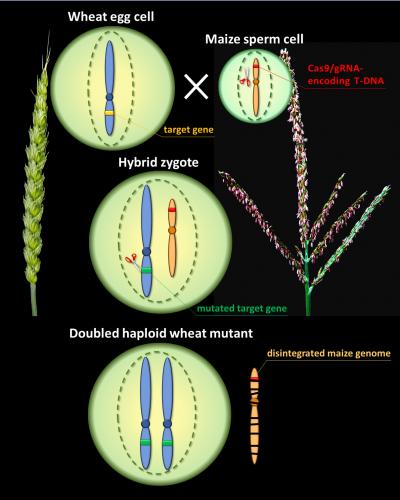
A new study (Budhagatapalli et al., 2020), which has recently been published in the Plant Biotechnology Journal, demonstrates how site-directed mutagenesis can be achieved in virtually any wheat germplasm of choice by intergeneric pollination of wheat with cas9/guide-RNA (gRNA)-transgenic maize.

For exemplification of this principle, new allelic variants were generated for the wheat genes BRASSINOSTEROID-INSENSITIVE 1 (BRI1) and SEMIDWARF 1 (SD1) which are involved in the regulation of the agronomically important trait plant height.

In total, 15 independent target gene-specific mutants were identified out of 174 wheat plants. Mutants were obtained in six wheat backgrounds, including the three spring-type common wheats BW, W5 and K15, the winter-type bread wheat S96, as well as the two durum wheats D6 and D7. Mutations were found in all three genomic target motifs addressed. None of the 15 mutants carried any transgene. The efficiency in mutant plant formation ranged from 3.6% to 50%.

“The major advances achieved in the present study include (1) much reduced genotype dependence, (2) the opportunity of creating a whole variety of wheat plants carrying different allelic variants of the target gene using just one cas9/gRNA-transgenic maize plant as well as (3) the production of target gene-specific mutants that are instantly true-breeding and generally free of any transgenes”, says Dr. Nagaveni Budhagatapalli who played a key role in the study conducted at the Leibniz Institute of Plant Genetics and Crop Plant Research (IPK) Gatersleben.

However, there is still room for increasing the efficiency of this approach, e.g. by stronger Cas9 and gRNA expression at the relevant timepoint or by the development of improved protocols for in planta production of doubled haploids.

###

Media Contact
Dr. Jochen Kumlehn
[email protected]

Related Journal Article

http://dx.doi.org/10.1111/pbi.13415

Tags: BiologyCell BiologyGenesPlant Sciences
Share12Tweet8Share2ShareShareShare2

Related Posts

Uncovering C. elegans Immunity via Genetic Screens — Biology

Uncovering C. elegans Immunity via Genetic Screens

May 16, 2026
Single mother must adapt swiftly — the survival of her colony depends on it — Biology

Single mother must adapt swiftly — the survival of her colony depends on it

May 15, 2026

Why Are Nearly Everyone Right-Handed? It Might Be Linked to How We Learned to Walk

May 15, 2026

Excessive Neuronal Activity Initiates Severe Autoimmune Brain Disorder

May 15, 2026
Please login to join discussion

POPULAR NEWS

  • Research Indicates Potential Connection Between Prenatal Medication Exposure and Elevated Autism Risk

    844 shares
    Share 338 Tweet 211
  • New Study Reveals Plants Can Detect the Sound of Rain

    730 shares
    Share 291 Tweet 182
  • Salmonella Haem Blocks Macrophages, Boosts Infection

    62 shares
    Share 25 Tweet 16
  • Breastmilk Balances E. coli and Beneficial Bacteria in Infant Gut Microbiomes

    58 shares
    Share 23 Tweet 15

About

We bring you the latest biotechnology news from best research centers and universities around the world. Check our website.

Follow us

Recent News

Uncovering C. elegans Immunity via Genetic Screens

Congenital Heart Disease’s Lasting Impact on Brain Health

Metabolic Stress Worsens Parkinson’s via Mitochondrial Ferroptosis

Subscribe to Blog via Email

Enter your email address to subscribe to this blog and receive notifications of new posts by email.

Join 82 other subscribers
  • Contact Us

Bioengineer.org © Copyright 2023 All Rights Reserved.

Welcome Back!

Login to your account below

Forgotten Password?

Retrieve your password

Please enter your username or email address to reset your password.

Log In
No Result
View All Result
  • Homepages
    • Home Page 1
    • Home Page 2
  • News
  • National
  • Business
  • Health
  • Lifestyle
  • Science

Bioengineer.org © Copyright 2023 All Rights Reserved.