• HOME
  • NEWS
  • EXPLORE
    • CAREER
      • Companies
      • Jobs
    • EVENTS
    • iGEM
      • News
      • Team
    • PHOTOS
    • VIDEO
    • WIKI
  • BLOG
  • COMMUNITY
    • FACEBOOK
    • INSTAGRAM
    • TWITTER
Thursday, July 16, 2026
BIOENGINEER.ORG
No Result
View All Result
  • Login
  • HOME
  • NEWS
  • EXPLORE
    • CAREER
      • Companies
      • Jobs
        • Lecturer
        • PhD Studentship
        • Postdoc
        • Research Assistant
    • EVENTS
    • iGEM
      • News
      • Team
    • PHOTOS
    • VIDEO
    • WIKI
  • BLOG
  • COMMUNITY
    • FACEBOOK
    • INSTAGRAM
    • TWITTER
  • HOME
  • NEWS
  • EXPLORE
    • CAREER
      • Companies
      • Jobs
        • Lecturer
        • PhD Studentship
        • Postdoc
        • Research Assistant
    • EVENTS
    • iGEM
      • News
      • Team
    • PHOTOS
    • VIDEO
    • WIKI
  • BLOG
  • COMMUNITY
    • FACEBOOK
    • INSTAGRAM
    • TWITTER
No Result
View All Result
Bioengineer.org
No Result
View All Result
Home NEWS Science News Chemistry

Li-ions transport across electrolytes and SEI like beads passing through a Galton Board

Bioengineer by Bioengineer
July 21, 2020
in Chemistry
Reading Time: 2 mins read
0
IMAGE
Share on FacebookShare on TwitterShare on LinkedinShare on RedditShare on Telegram

IMAGE

Credit: ©Science China Press

The kinetics of Li-ions transport across the electrolyte and the SEI is usually the rate-determining step in the Li plating-stripping process. Before electroplating on the anode surface, Li-ions migrate from a cathode to an anode through pores in a separator that is filled with electrolytes. The Li metal surface facing the pores in the separator becomes enriched with Li-ions due to their accumulation inside the pores. Thus, the fresh Li metal selectively deposits on these regions with a higher concentration of Li-ions, forming an uneven Li metal surface, as well as dendritic Li growth.

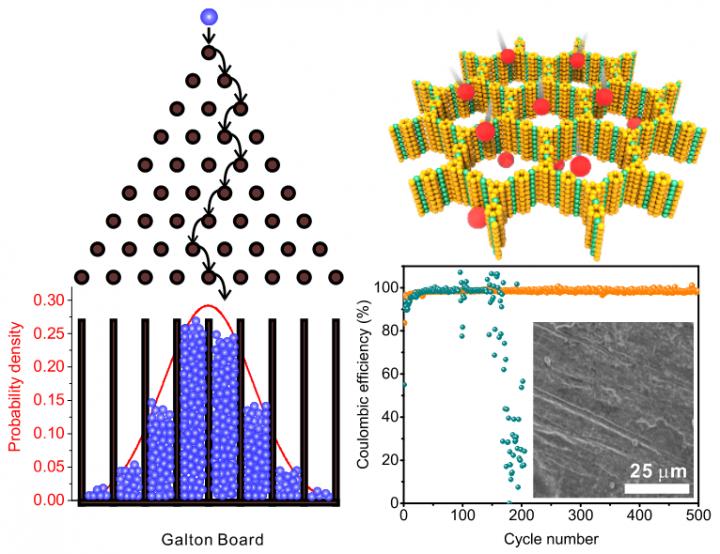
Recently, the research group of Professor Hengxing Ji of the University of Science and Technology of China presents a coating layer formed by COF-LZU1 particles on a commercial polypropylene (PP) separator to redistribute the Li-ions passing through the PP pores.

The interlayer comprises closely packed particles of a Schiff-base covalent organic framework (COF) COF-LZU1, which is an electronic insulator with a high chemical and thermal stability containing well-aligned channels of ~1.8 nm in diameter. The nanochannels in the COF-LZU1 particles in the coating layer hinder the migration of anions between the electrodes, leading to a high Li-ion transference number of 0.77±0.01, which has long been considered to increase the energy efficiency of Li batteries.

In addition, Li-ions move through the COF-LZU1 layer, analogous to beads passing through a Galton Board. This process, for a large number of beads, statistically approximates the normal distribution. In this regard, the COF-LZU1 layer serves to effectively redistribute the Li-ions that pass through the pores of the commercial separator so as to yield a uniform distribution, which can transform the mossy or dendritic Li to a smooth Li deposition, rendering improved battery performances. The mechanism of the behaviors of the COF-LZU1 layer can be extended to different types of porous materials to regulate ion distributions in different energy storage or conversion systems.

###

See the article: Xie H, Hao Q, Jin H, Xie S, Sun Z, Ye Y, Zhang C, Wang D, Ji H, Wan L-J. Redistribution of Li-ions using covalent organic frameworks towards dendrite-free lithium anodes: a mechanism based on a Galton Board. Sci. China Chem., 2020, DOI:10.1007/s11426-020-9796-9.

https://doi.org/10.1007/s11426-020-9796-9

Media Contact
Hengxing Ji
[email protected]

Related Journal Article

http://dx.doi.org/10.1007/s11426-020-9796-9

Tags: Chemistry/Physics/Materials Sciences
Share12Tweet8Share2ShareShareShare2

Related Posts

Scientists Identify Invisible Early Indicators of Skin Aging

Scientists Identify Invisible Early Indicators of Skin Aging

July 16, 2026
Roadmap Outlines Self-Powered Tactile Sensors for Robots and Wearable Devices

Roadmap Outlines Self-Powered Tactile Sensors for Robots and Wearable Devices

July 16, 2026

AI and Quantum Chemistry Reveal Dual-Modulated Catalysts for Next-Gen Fuel Cells

July 16, 2026

Bioinspired Hierarchical Hydrogel Electrolyte Enables Ultralong-Life Flexible Zinc Batteries

July 16, 2026
Please login to join discussion

POPULAR NEWS

  • New Drug Candidate Developed at McMaster Shows Potential for Treating Brain Cancer

    58 shares
    Share 23 Tweet 15
  • Scientists Overcome Antimicrobial Resistance in Bacteria Linked to Cystic Fibrosis

    42 shares
    Share 17 Tweet 11
  • Porcine Heart Transplant

    50 shares
    Share 20 Tweet 13
  • A varied menu

    51 shares
    Share 22 Tweet 12

About

We bring you the latest biotechnology news from best research centers and universities around the world. Check our website.

Follow us

Recent News

Programming Fracture Resistance in Metamaterials through Elastic Instability Design

Scientists Identify Invisible Early Indicators of Skin Aging

More Smokers Purchase Illicit Tobacco, Report Finds

Subscribe to Blog via Email

Enter your email address to subscribe to this blog and receive notifications of new posts by email.

Join 85 other subscribers
  • Contact Us

Bioengineer.org © Copyright 2023 All Rights Reserved.

Welcome Back!

Login to your account below

Forgotten Password?

Retrieve your password

Please enter your username or email address to reset your password.

Log In
No Result
View All Result
  • Homepages
    • Home Page 1
    • Home Page 2
  • News
  • National
  • Business
  • Health
  • Lifestyle
  • Science

Bioengineer.org © Copyright 2023 All Rights Reserved.