Credit: Author
In a paper published in NANO, a group of researchers from Jiangsu University of Technology, China have developed novel Cu2O-Mn3O4-NiO ternary nanocomposites by electrostatic spinning technology, which improved the performance of supercapacitors electrode materials.
Supercapacitors feature high power density, long cycle life and present increasing significance as advanced energy storage devices. Nanomaterials and their composites are recognized as optimal candidates for energy materials because of their ease in charge conduction mechanisms, reduced dimensions and the effect of surface properties on their behavior provide better interfaces and chemical reaction rates.
However, the preparation of electrode materials is a key point affecting the performance of supercapacitors. When compared with other methods for fabricating nanofibers, electrospinning has attracted more and more attention because of its single steps and cost-effectiveness. Electrospinning metal oxide fibers is a promising method for generating composite nanofibers with a high specific surface area, high crystallinity, and an increased number of active sites. The resultant nanofibers are ideal for energy storage applications because the nanofibrous surface morphology provides a path for electron transport, which improves the energy storage capacity of the metal oxide.
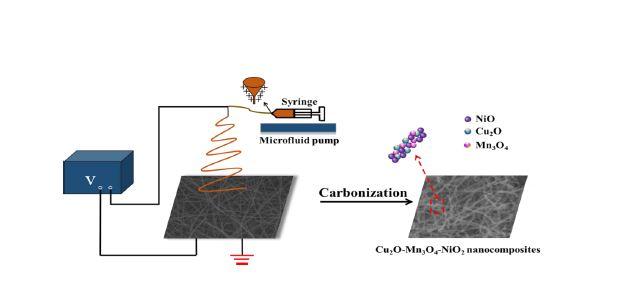
In this work, the obtained nanocomposites (Cu2O-Mn3O4-NiO) are an ordered arrangement of metal oxide particles (10 nm), with the shape like bead-chain. The acquired Cu2O-Mn3O4-NiO ternary nanocomposites were used as electrode materials to manufacture a supercapacitor. Electrochemical tests showed that the synthesis of nanocomposites made electrode materials had good electrochemical performance in 6 mol/L KOH electrolyte. The results showed that at a scan rate of 5 mV/s, the specific capacitance of Cu2O-Mn3O4-NiO had a larger specific capacitance of 1306 F/g than NiO, Cu2O-NiO and Mn3O4-NiO. This ternary nanocomposites improved the electrochemical performance of electrode materials and can be used for efficient supercapacitors.
The successfully synthesized Cu2O-Mn3O4-NiO nanocomposites by electrospinning is adaptable for large and industrial scale production. The structural characterization and composition analysis explained the excellent behavior of Cu2O-Mn3O4-NiO. Due to the chemical reactions and hence strong interaction between the functional groups and electrolyte ions, Cu2O-Mn3O4-NiO nanocomposites exhibited outstanding electrochemical performance in terms of high specific capacitance and capacitance retention.
This work was supported by Postgraduate Research & Practice Innovation Program of Jiangsu Province (20820111964-SJCX19-0754) and (20820111950-SJCX19-0740), National Natural Science Foundation of China (grant no. 31800495), Natural Science Foundation of Jiangsu Province (grant no. BK20181040).
###
Additional co-authors of the paper are Chunyong Zhang, Li Shu, Linna Huang, Jianning Li, Hengfei Qin from Jiangsu University of Technology. Corresponding author for this study is Chunyong Zhang ([email protected]).
For more insight into the research described, readers are invited to access the paper on NANO.
IMAGE
Caption: A schematic diagram of Cu2O-Mn3O4-NiO ternary nanocomposites preparation process. Compared with the traditional hydrothermal method, the materials prepared by electrospinning are nanostructure, which improved the electron transport capacity and the energy storage capacity of metal oxide. The acquired Cu2O-Mn3O4-NiO ternary nanocomposites were arranged in orderly metallic nanostructures, which should be one of interest for the development of supercapacitors electrode materials.
NANO is an international peer-reviewed monthly journal for nanoscience and nanotechnology that presents forefront fundamental research and new emerging topics. It features timely scientific reports of new results and technical breakthroughs and publishes interesting review articles about recent hot issues.
About World Scientific Publishing Co.
World Scientific Publishing is a leading independent publisher of books and journals for the scholarly, research, professional and educational communities. The company publishes about 600 books annually and about 140 journals in various fields. World Scientific collaborates with prestigious organizations like the Nobel Foundation and US National Academies Press to bring high quality academic and professional content to researchers and academics worldwide. To find out more about World Scientific, please visit http://www.
For more information, contact Tay Yu Shan at [email protected].
Media Contact
Yu Shan Tay
[email protected]
Original Source
http://www.
Related Journal Article
http://dx.