• HOME
  • NEWS
  • EXPLORE
    • CAREER
      • Companies
      • Jobs
    • EVENTS
    • iGEM
      • News
      • Team
    • PHOTOS
    • VIDEO
    • WIKI
  • BLOG
  • COMMUNITY
    • FACEBOOK
    • INSTAGRAM
    • TWITTER
Monday, January 19, 2026
BIOENGINEER.ORG
No Result
View All Result
  • Login
  • HOME
  • NEWS
  • EXPLORE
    • CAREER
      • Companies
      • Jobs
        • Lecturer
        • PhD Studentship
        • Postdoc
        • Research Assistant
    • EVENTS
    • iGEM
      • News
      • Team
    • PHOTOS
    • VIDEO
    • WIKI
  • BLOG
  • COMMUNITY
    • FACEBOOK
    • INSTAGRAM
    • TWITTER
  • HOME
  • NEWS
  • EXPLORE
    • CAREER
      • Companies
      • Jobs
        • Lecturer
        • PhD Studentship
        • Postdoc
        • Research Assistant
    • EVENTS
    • iGEM
      • News
      • Team
    • PHOTOS
    • VIDEO
    • WIKI
  • BLOG
  • COMMUNITY
    • FACEBOOK
    • INSTAGRAM
    • TWITTER
No Result
View All Result
Bioengineer.org
No Result
View All Result
Home NEWS Science News Chemistry

Chemical thermometers take temperature to the nanometric scale

Bioengineer by Bioengineer
July 17, 2020
in Chemistry
Reading Time: 2 mins read
0
IMAGE
Share on FacebookShare on TwitterShare on LinkedinShare on RedditShare on Telegram

IMAGE

Credit: Ridier et al.

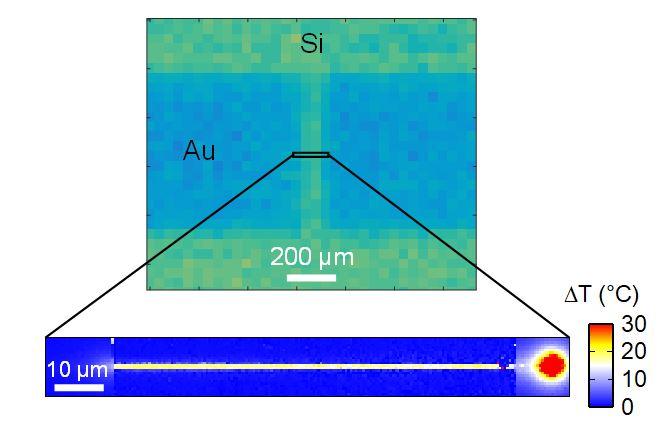
The miniaturisation of electronic components coupled with their increasing integration density has considerably expanded heat flows, which can lead to overheating. But how to measure these nanometric events when conventional solutions such as infrared thermography cannot go below a micrometre (1,000 times bigger than a nanometre)?

A research team bringing together scientists from two CNRS laboratories, the Coordination Chemistry Laboratory and the Laboratory for Analysis and Architecture of Systems, has proposed doing so by using the bistability properties of a family of chemical compounds known as spin-crossover (SCO) molecules. They exist into two electronic states with different physical properties, and can switch from one to the other when they absorb or lose energy. For instance, some of them change colour depending on the temperature.

Once deposited in the form of a film on an electronic component, the optical properties of SCO molecules change depending on the temperature, enabling this chemical thermometer to establish a nanometric-scale thermal map of the surface of microelectronic circuits. However, the primary feat of these SCO molecular films is actually their unique stability: the properties of the molecules remain unchanged, even after more than 10 million thermal cycles under ambient air and high temperatures (up to 230°C).

This innovation* overcomes the primary hurdle for SCO molecules, namely their fatigability, or the fact that their properties are often altered after multiple transitions from one electronic state to another. It could soon be used in the microelectronics industry to probe local thermal processes, and to thereby improve the design of future devices.

###

Note

*- It was granted patent protection on 1 October 2019 (patent no. FR1910886)

Media Contact
Francois Maginiot
[email protected]

Related Journal Article

http://dx.doi.org/10.1038/s41467-020-17362-7

Tags: Chemistry/Physics/Materials SciencesMaterials
Share12Tweet8Share2ShareShareShare2

Related Posts

Creating Synthetic Protein-Binding DNA Systems in Cells

January 17, 2026
blank

Chiral Catalysis Powers Rotary Molecular Motors

January 16, 2026

Selective GlcNAc to GalNAc Epimerization via Kinetic Control

January 15, 2026

Thermal [2+2] Cycloaddition Builds Gem-Difluoro Bicycloalkanes

January 13, 2026
Please login to join discussion

POPULAR NEWS

  • Enhancing Spiritual Care Education in Nursing Programs

    155 shares
    Share 62 Tweet 39
  • PTSD, Depression, Anxiety in Childhood Cancer Survivors, Parents

    148 shares
    Share 59 Tweet 37
  • Robotic Ureteral Reconstruction: A Novel Approach

    78 shares
    Share 31 Tweet 20
  • Study Reveals Lipid Accumulation in ME/CFS Cells

    54 shares
    Share 22 Tweet 14

About

We bring you the latest biotechnology news from best research centers and universities around the world. Check our website.

Follow us

Recent News

Hybrid Rocket Fuel: PVC/DBP Combustion Efficiency Insights

Liver and Gut: Key Players in Cholesterol Balance

AI Agents Transforming Cancer Research and Treatment

Subscribe to Blog via Email

Enter your email address to subscribe to this blog and receive notifications of new posts by email.

Join 71 other subscribers
  • Contact Us

Bioengineer.org © Copyright 2023 All Rights Reserved.

Welcome Back!

Login to your account below

Forgotten Password?

Retrieve your password

Please enter your username or email address to reset your password.

Log In
No Result
View All Result
  • Homepages
    • Home Page 1
    • Home Page 2
  • News
  • National
  • Business
  • Health
  • Lifestyle
  • Science

Bioengineer.org © Copyright 2023 All Rights Reserved.