In a neutral situation pigs turn to humans, initiating interactions as much as dogs do. But in a problem solving situation the two species behave differently.
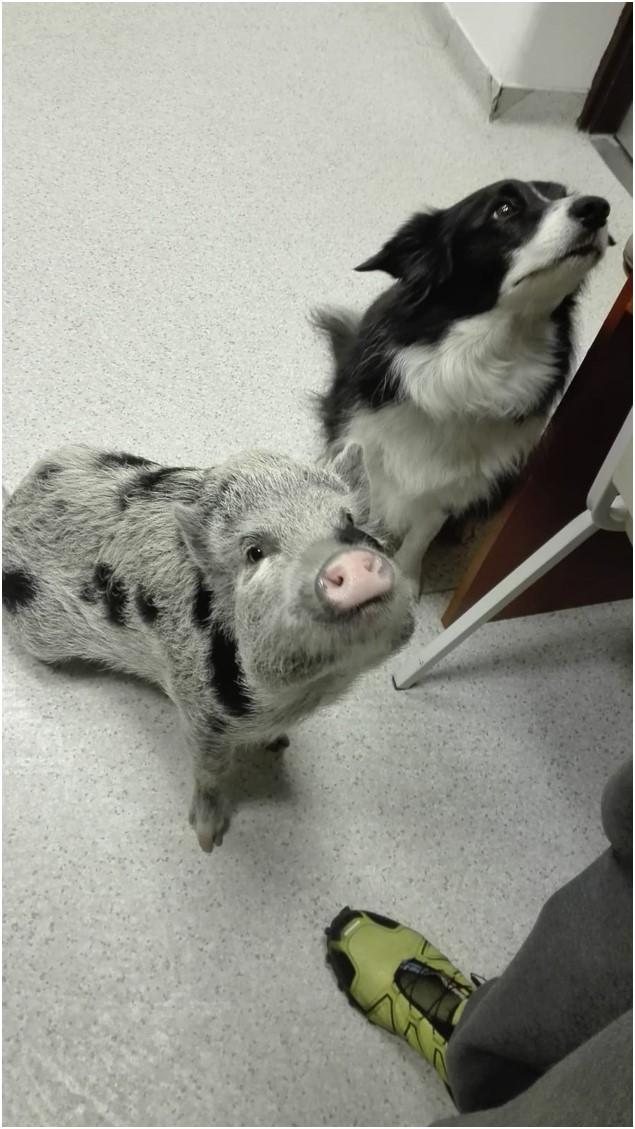
Credit: Eotvos Lorand University / Paula Perez
Researchers of the MTA-ELTE ‘Lendület’ Neuroethology of Communication Research Group at the Department of Ethology at the Faculty of Science, Eötvös Loránd University, Budapest (ELTE) compared human-oriented communicative behaviours of young miniature pigs and dogs kept as companion animals. They found that in a neutral situation pigs turn to humans, initiating interactions as much as dogs do. But in a problem solving situation the two species behave differently: whereas pigs keep trying to solve the task on their own, dogs often stop trying alone and display human-oriented communicative behaviours. Natural differences between pigs and dogs prevail despite similar socialization if an exciting challenge comes, the research suggests. The study is published in Animal Cognition.
Dogs are known to look at humans in a problem-solving context to establish joint attention and initiate communicative interactions, already from an early age. Is it really dogs’ specialty, or would other companion animals do the same? “Similarly socialized wolves and cats communicate less with humans than dogs in the same problem-solving context, but maybe it is because wolves are not domesticated, and cats are not a social species. So we designed a study to compare dogs’ behaviour with that of another domestic and social species, the pig” – explains PhD student Paula Pérez.
The miniature variant of the domestic pig is a popular companion animal occupying a similar “social niche” in the human families as the family dog. “We launched the Family Pig Project in 2017 at the Department of Ethology, Budapest. The animals are raised in a similar environment as family dogs, providing the basis for unique comparative investigations between the two species” – says Attila Andics, principal investigator of the MTA-ELTE ‘Lendület’ Neuroethology of Communication Research Group.
“We used the so called ‘Unsolvable task paradigm’, where the animal first faces a problem that he can solve, in our case an easy-to-open box with food inside. After some trials, the problem becomes unsolvable because the box is securely closed” – adds Pérez. “When the box was first in the room without food in it, pigs and dogs performed similar human-oriented behaviours” – says Linda Gerencsér, research fellow at the Research Group. “The differences appeared when we put food in the box and opening it became an exciting challenge. Pigs were faster than dogs already in solving the task and getting the reward, perhaps due to their better manipulative capacities. Then, when the task became unsolvable, dogs turned to the humans more than before. In contrast, pigs performed less human-oriented behaviours, but they were more persistent than dogs in trying to solve the task, which may reflect their predisposition to solve problems independently.”
The study is the first to compare family dogs and pigs in a problem-solving situation. “The similarities that we found between the two species point to their similar capacities for engaging in communicative interactions with humans” – notes Pérez. “However, species-specific predispositions might be responsible for the found differences. Dogs are naturally more dependent on and cooperative with humans. This explains their unique success in interacting with us.”
###
Video abstract about the research:
https:/
This study was published on the 17th of July in Animal Cognition titled “Who turns to the human? Companion pigs’ and dogs’ behaviour in the unsolvable task paradigm”, written by Paula Pérez Fraga, Linda Gerencsér, Melinda Lovas, Dóra Újváry and Attila Andics. This research was funded by the National Research, Development and Innovation Office, the Hungarian Academy of Sciences (Lendület Program) and the Eötvös Loránd University (ELTE).
Media Contact
Sara Bohm
[email protected]
Original Source
http://doi.
Related Journal Article
http://dx.