• HOME
  • NEWS
  • EXPLORE
    • CAREER
      • Companies
      • Jobs
    • EVENTS
    • iGEM
      • News
      • Team
    • PHOTOS
    • VIDEO
    • WIKI
  • BLOG
  • COMMUNITY
    • FACEBOOK
    • INSTAGRAM
    • TWITTER
Friday, March 27, 2026
BIOENGINEER.ORG
No Result
View All Result
  • Login
  • HOME
  • NEWS
  • EXPLORE
    • CAREER
      • Companies
      • Jobs
        • Lecturer
        • PhD Studentship
        • Postdoc
        • Research Assistant
    • EVENTS
    • iGEM
      • News
      • Team
    • PHOTOS
    • VIDEO
    • WIKI
  • BLOG
  • COMMUNITY
    • FACEBOOK
    • INSTAGRAM
    • TWITTER
  • HOME
  • NEWS
  • EXPLORE
    • CAREER
      • Companies
      • Jobs
        • Lecturer
        • PhD Studentship
        • Postdoc
        • Research Assistant
    • EVENTS
    • iGEM
      • News
      • Team
    • PHOTOS
    • VIDEO
    • WIKI
  • BLOG
  • COMMUNITY
    • FACEBOOK
    • INSTAGRAM
    • TWITTER
No Result
View All Result
Bioengineer.org
No Result
View All Result
Home NEWS Science News

Over $10 million awarded to Penn State for energy center

Bioengineer by Bioengineer
July 16, 2020
in Science News
Reading Time: 2 mins read
0
IMAGE
Share on FacebookShare on TwitterShare on LinkedinShare on RedditShare on Telegram

IMAGE

Credit: SIRO, Penn State

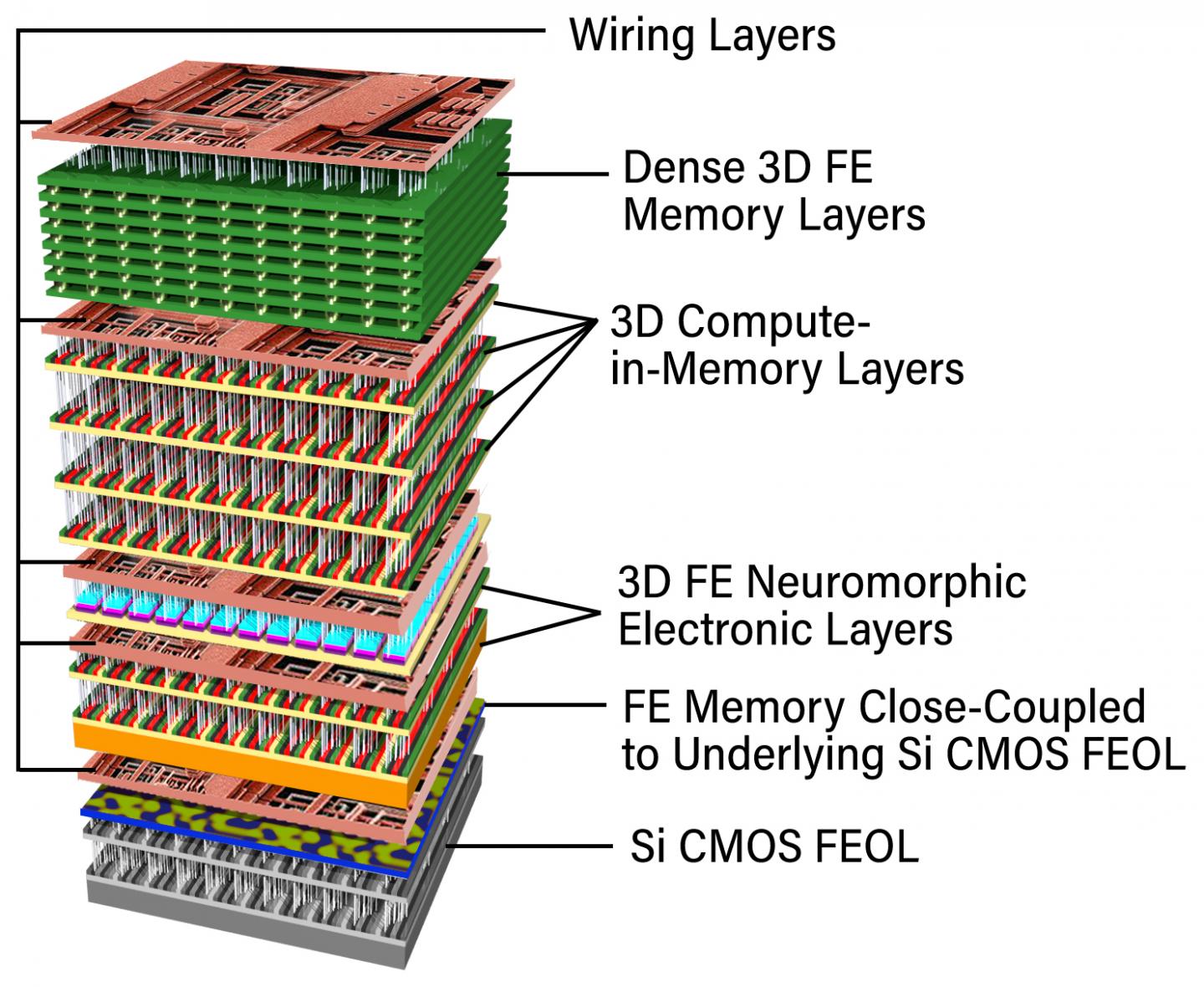
Penn State will receive more than $10 million from the U.S. Department of Energy as an Energy Frontier Research Center Award. This is one of 10 awards announced in 2020, and the second EFRC awarded to Penn State researchers.

This large center grant will focus on 3D ferroelectric microelectronics, according to principal investigator Susan Trolier-McKinstry, Evan Pugh University Professor and the Steward S. Flaschen Professor of Ceramic Science and Engineering, and Professor of Electrical Engineering.

“If you look at modern electronics, the memory is separate from the chip performing computation,” she said. “It is a time and energy bottleneck getting the data back and forth between the processor and the memory.”

The von Neumann bottleneck posits that the speed and efficiency of computation is limited by the time it takes to transfer data between chips, and in the meantime the much faster computational chip remains idle. The goal of this project is to prepare materials that will serve as memory to stack in the third dimension above the processor chip enabling seamless communication between memory and computation to mitigate this bottleneck.

The breakthrough technology, she says, is their ability to prepare the ferroelectric memory materials at very low temperatures. Previously, it was not possible to stack memory on the processor chip because the interconnects on the processor chip could not take temperatures higher than 400 degrees C. Without being able to lay the ferroelectric material down at a lower temperature, it is not possible to put memory on top of computational logic on the same chip.

The research in the center will focus on discovery of new ferroelectric materials, probing the origins of ferroelectricity, developing tools to control the functional properties, growing tailored ferroelectrics at low temperatures, integrating the new materials into a variety of memory devices, and developing processes that allow these materials to be stacked in 3D memory arrays.

Along with Trolier-McKinstry, who is the new center’s director, others in the leadership team include associate director Vijay Narayanan, Robert Noll Chair Professor of Computer Science and Engineering and Electrical Engineering, and thrust leaders Jon-Paul Maria, professor of materials science and engineering, and Tom Jackson, Robert E. Kirby Chair Professor of Electrical Engineering. Other Penn State faculty include Saptarshi Das, Engineering Science and Mechanics; Nasim Alem, Venkat Gopalan, Roman Engel-Herbert, Ismaila Dabo and Shashank Priya, all from Materials Science and Engineering; Abhronil Sengupta from the Department of Electrical Engineering and Computer Science; and Qi Li and Ying Liu from the Department of Physics.

Other institutional partners are Sandia National Laboratory, Oak Ridge National Laboratory, Purdue University, University of Pennsylvania and University of Virginia.

The four-year grant begins Aug. 1 and is funded at between $10 million and $15 million with possibility of renewal. The other EFRC, the Center for Lignocellulose Structure and Formation, was renewed for an additional four years in 2018.

###

Media Contact
A’ndrea Elyse Messer
[email protected]

Tags: Electrical Engineering/ElectronicsHardwareTechnology/Engineering/Computer Science
Share12Tweet8Share2ShareShareShare2

Related Posts

Starburst Winds Drain Supernova Energy Quickly

Starburst Winds Drain Supernova Energy Quickly

March 26, 2026
Decoding the Phosphorus Puzzle: How Microplastics and Hydrochar Transform Nutrient Dynamics in Rice Paddies

Decoding the Phosphorus Puzzle: How Microplastics and Hydrochar Transform Nutrient Dynamics in Rice Paddies

March 26, 2026

Microtubules Found to Actively Ensure Accurate Chromosome Distribution During Cell Division

March 25, 2026

Aversive Learning Hijacks Brain Sugar Sensor

March 25, 2026
Please login to join discussion

POPULAR NEWS

  • blank

    Revolutionary AI Model Enhances Precision in Detecting Food Contamination

    96 shares
    Share 38 Tweet 24
  • Imagine a Social Media Feed That Challenges Your Views Instead of Reinforcing Them

    1003 shares
    Share 397 Tweet 248
  • Uncovering Functions of Cavernous Malformation Proteins in Organoids

    54 shares
    Share 22 Tweet 14
  • Promising Outcomes from First Clinical Trials of Gene Regulation in Epilepsy

    51 shares
    Share 20 Tweet 13

About

We bring you the latest biotechnology news from best research centers and universities around the world. Check our website.

Follow us

Recent News

In-Sensor Cryptography Links Physical Process to Digital Identity

Can Psychosocial Factors Influence Cancer Risk?

Depression Factors in Elderly: Pre vs. Post-COVID Analysis

Subscribe to Blog via Email

Success! An email was just sent to confirm your subscription. Please find the email now and click 'Confirm' to start subscribing.

Join 78 other subscribers
  • Contact Us

Bioengineer.org © Copyright 2023 All Rights Reserved.

Welcome Back!

Login to your account below

Forgotten Password?

Retrieve your password

Please enter your username or email address to reset your password.

Log In
No Result
View All Result
  • Homepages
    • Home Page 1
    • Home Page 2
  • News
  • National
  • Business
  • Health
  • Lifestyle
  • Science

Bioengineer.org © Copyright 2023 All Rights Reserved.