• HOME
  • NEWS
  • EXPLORE
    • CAREER
      • Companies
      • Jobs
    • EVENTS
    • iGEM
      • News
      • Team
    • PHOTOS
    • VIDEO
    • WIKI
  • BLOG
  • COMMUNITY
    • FACEBOOK
    • INSTAGRAM
    • TWITTER
Friday, March 27, 2026
BIOENGINEER.ORG
No Result
View All Result
  • Login
  • HOME
  • NEWS
  • EXPLORE
    • CAREER
      • Companies
      • Jobs
        • Lecturer
        • PhD Studentship
        • Postdoc
        • Research Assistant
    • EVENTS
    • iGEM
      • News
      • Team
    • PHOTOS
    • VIDEO
    • WIKI
  • BLOG
  • COMMUNITY
    • FACEBOOK
    • INSTAGRAM
    • TWITTER
  • HOME
  • NEWS
  • EXPLORE
    • CAREER
      • Companies
      • Jobs
        • Lecturer
        • PhD Studentship
        • Postdoc
        • Research Assistant
    • EVENTS
    • iGEM
      • News
      • Team
    • PHOTOS
    • VIDEO
    • WIKI
  • BLOG
  • COMMUNITY
    • FACEBOOK
    • INSTAGRAM
    • TWITTER
No Result
View All Result
Bioengineer.org
No Result
View All Result
Home NEWS Science News

Machining the heart: New predictor for helping to beat chronic heart failure

Bioengineer by Bioengineer
July 16, 2020
in Science News
Reading Time: 2 mins read
0
IMAGE
Share on FacebookShare on TwitterShare on LinkedinShare on RedditShare on Telegram

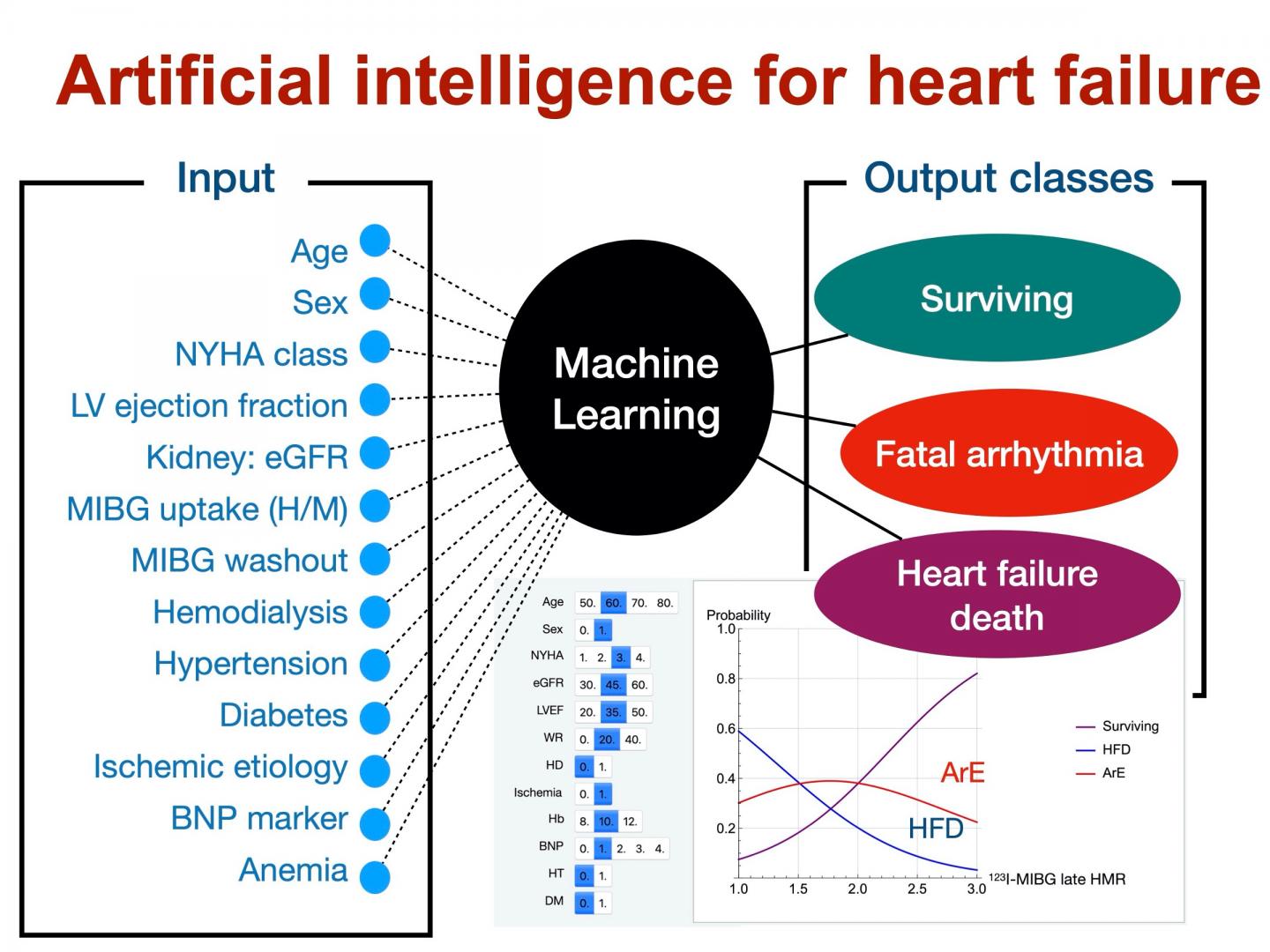
Researchers from Kanazawa University use machine learning to help guide patient care for chronic heart failure
IMAGE

Credit: Kanazawa University

Kanazawa, Japan – Tens of millions of people worldwide have chronic heart failure, and only a little over half of them survive 5 years beyond their diagnosis. Now, researchers from Japan are helping doctors to assign patients into groups based on their specific needs, to improve medical outcomes.

In a study recently published in the Journal of Nuclear Cardiology, researchers from Kanazawa University have used computer science to disentangle patients most at risk of sudden arrhythmic cardiac death from patients most at risk of heart failure death.

Doctors have many methods at their disposal for diagnosing chronic heart failure. However, there’s a need to better identify what treatment to pursue, in accordance with the risks of each approach. When combined with conventional clinical tests, a molecule known as iodine-123 labelled MIBG can help discriminate between high-risk and low-risk patients. However, there is no way to assess the risk of arrhythmic death separately from the risk of heart failure death, something the researchers at Kanazawa University aimed to address.

“We used artificial intelligence to show that numerous variables work in synergy to better predict chronic heart failure outcomes,” explains lead author of the study Kenichi Nakajima. “Neither variable, in and of itself, is quite up to the task.”

To do this, the researchers examined the medical records of 526 patients with chronic heart failure and who underwent consecutive iodine-123-MIBG imaging and standard clinical testing. Conventional medical care proceeded as normal after imaging.

“The results were clear,” says Nakajima. “Heart failure death was most common in older adult patients with very low MIBG activity, worse New York Heart Association class, and comorbidities.”

Furthermore, arrhythmia was most common in younger patients with moderately low iodine-123-MIBG activity and less serious heart failure. Doctors can use the Kanazawa University researchers’ results to tailor medical care; for example, the type of implantable defibrillator most likely to meet the needs of the patient.

“It’s important to note that our results need to be confirmed in a larger study,” explains Nakajima. “In particular, the arrhythmia outcomes were perhaps too infrequent to be clinically reliable.”

Given that chronic heart failure is a global problem that frequently kills within a few years after diagnosis, if not treated appropriately, it’s essential to start the most appropriate medical care as soon as possible. With a reliable test that predicts which patients most likely need which treatments, a greater number of patients are likely to live longer.

###

Media Contact
Tomoya Sato
[email protected]

Original Source

https://doi.org/10.1007/s12350-020-02173-6

Related Journal Article

http://dx.doi.org/10.1007/s12350-020-02173-6

Tags: CardiologyDiagnosticsHealth CareMedicine/HealthRobotry/Artificial Intelligence
Share12Tweet8Share2ShareShareShare2

Related Posts

In-Sensor Cryptography Links Physical Process to Digital Identity

In-Sensor Cryptography Links Physical Process to Digital Identity

March 25, 2026

Can Psychosocial Factors Influence Cancer Risk?

March 23, 2026

Depression Factors in Elderly: Pre vs. Post-COVID Analysis

March 23, 2026

Hidden Health Crises Among US and UK Volunteers in Ukraine Uncovered in New Study

March 23, 2026
Please login to join discussion

POPULAR NEWS

  • blank

    Revolutionary AI Model Enhances Precision in Detecting Food Contamination

    96 shares
    Share 38 Tweet 24
  • Imagine a Social Media Feed That Challenges Your Views Instead of Reinforcing Them

    1003 shares
    Share 397 Tweet 248
  • Uncovering Functions of Cavernous Malformation Proteins in Organoids

    54 shares
    Share 22 Tweet 14
  • Promising Outcomes from First Clinical Trials of Gene Regulation in Epilepsy

    51 shares
    Share 20 Tweet 13

About

We bring you the latest biotechnology news from best research centers and universities around the world. Check our website.

Follow us

Recent News

In-Sensor Cryptography Links Physical Process to Digital Identity

Can Psychosocial Factors Influence Cancer Risk?

Depression Factors in Elderly: Pre vs. Post-COVID Analysis

Subscribe to Blog via Email

Enter your email address to subscribe to this blog and receive notifications of new posts by email.

Join 78 other subscribers
  • Contact Us

Bioengineer.org © Copyright 2023 All Rights Reserved.

Welcome Back!

Login to your account below

Forgotten Password?

Retrieve your password

Please enter your username or email address to reset your password.

Log In
No Result
View All Result
  • Homepages
    • Home Page 1
    • Home Page 2
  • News
  • National
  • Business
  • Health
  • Lifestyle
  • Science

Bioengineer.org © Copyright 2023 All Rights Reserved.