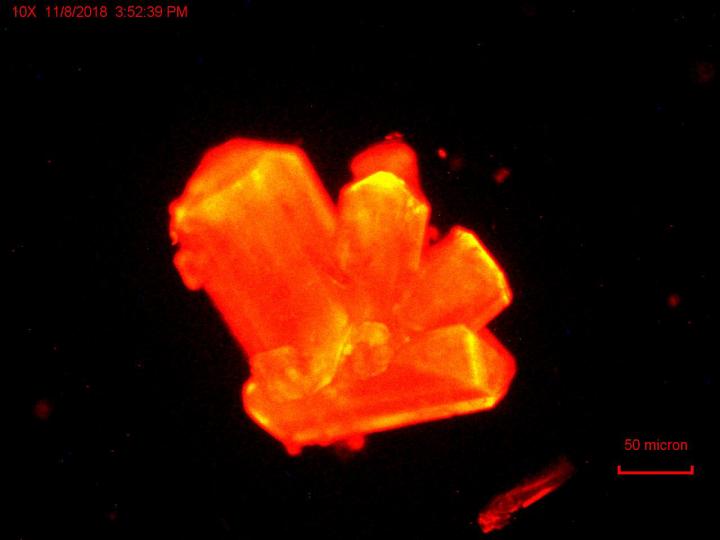
Credit: Courtesy of Thomas Albrecht-Schmitt / Nature
TALLAHASSEE, Fla. — New research shows that one of the heaviest known elements can be manipulated to a greater degree than previously thought, potentially paving the way for new strategies to recycle nuclear fuel and better long-term storage of radioactive elements.
An international team of researchers has demonstrated how curium — element 96 in the periodic table and one of the last that can be seen with the naked eye — responds to the application of high pressure created by squeezing a sample between two diamonds.
Led by Florida State University Professor Thomas Albrecht-Schmitt and collaborators at the University at Buffalo and Aachen University, the team found that the behavior of curium’s outer electrons — which influence its ability to bond with other elements — can be altered by shortening the distance between it and surrounding lighter atoms. The findings are published in the journal Nature.
“This was not anticipated because the chemistry of curium makes it resistant to these types of changes,” said Albrecht-Schmitt, the Gregory R. Choppin Professor of Chemistry at Florida State University. “In short, it is quite inert.”
Although only certain curium compounds exhibited changes, it was still interesting to scientists because curium is normally completely resistant to having its properties altered.
In addition to Albrecht-Schmitt, the study was led by University at Buffalo chemistry professors Jochen Autschbach and Eva Zurek as well as Manfred Speldrich, a researcher at Aachen University in Germany.
Albrecht-Schmitt’s work is part of his lab’s overall mission to better understand the heavier, or actinide, elements at the bottom of the periodic table. In 2016, he received $10 million from the Department of Energy to form the Center for Actinide Science and Technology to focus on accelerating scientific efforts to clean up nuclear waste.
Despite their presence on the periodic table, the heavier elements still largely remain a mystery to scientists, particularly compared to lighter elements like oxygen or nitrogen.
“It’s an exciting experiment that showed that we have much greater control of the chemistry of these difficult to control elements than previously thought,” Albrecht-Schmitt said.
“The curium(3+) ion we studied has a half-filled outer electron shell that is very difficult to engage in chemical bonding,” said Autschbach, Larkin Professor of Chemistry at the University at Buffalo. “An integrated experimental and theoretical approach showed that the application of high pressure to a crystal containing curium(3+), along with sulfur-organic and ammonium ions, causes the outer shell of curium to participate in covalent chemical bonding with sulfur. This finding may help guide new ways of studying the mysterious behavior of chemically resistant actinide shells.”
Autschbach’s group at the University at Buffalo carried out calculations that helped to explain what happened during the high-pressure experiments, revealing details about how curium behaves when compounds containing the element are squeezed between diamonds. Zurek’s team laid the foundation for these computations by determining the crystal structures of the compounds under high pressure.
“Under pressure chemical compounds and materials can behave completely differently than they do at atmospheric conditions, making the discoveries in high-pressure research so exciting,” Zurek said.
Greater understanding of heavier elements opens the door to additional strategies to control chemical separation used in nuclear recycling and in designing resilient materials for long-term storage of radioactive elements, Albrecht-Schmitt said. The research team believes the results they achieved related to curium will translate to other heavy elements as well.
The team plans to follow this work by designing similar experiments for heavier elements such as californium and einsteinium, where the effects of the pressure could be even greater than what they have found for curium.
###
This research was funded by the U.S. Department of Energy, with additional support from the U.S. National Science Foundation.
Media Contact
Bill Wellock
[email protected]
Related Journal Article
http://dx.