• HOME
  • NEWS
  • EXPLORE
    • CAREER
      • Companies
      • Jobs
    • EVENTS
    • iGEM
      • News
      • Team
    • PHOTOS
    • VIDEO
    • WIKI
  • BLOG
  • COMMUNITY
    • FACEBOOK
    • INSTAGRAM
    • TWITTER
Saturday, December 20, 2025
BIOENGINEER.ORG
No Result
View All Result
  • Login
  • HOME
  • NEWS
  • EXPLORE
    • CAREER
      • Companies
      • Jobs
        • Lecturer
        • PhD Studentship
        • Postdoc
        • Research Assistant
    • EVENTS
    • iGEM
      • News
      • Team
    • PHOTOS
    • VIDEO
    • WIKI
  • BLOG
  • COMMUNITY
    • FACEBOOK
    • INSTAGRAM
    • TWITTER
  • HOME
  • NEWS
  • EXPLORE
    • CAREER
      • Companies
      • Jobs
        • Lecturer
        • PhD Studentship
        • Postdoc
        • Research Assistant
    • EVENTS
    • iGEM
      • News
      • Team
    • PHOTOS
    • VIDEO
    • WIKI
  • BLOG
  • COMMUNITY
    • FACEBOOK
    • INSTAGRAM
    • TWITTER
No Result
View All Result
Bioengineer.org
No Result
View All Result
Home NEWS Science News Chemistry

Hammer-on technique for atomic vibrations in a crystal

Bioengineer by Bioengineer
July 14, 2020
in Chemistry
Reading Time: 3 mins read
0
IMAGE
Share on FacebookShare on TwitterShare on LinkedinShare on RedditShare on Telegram

IMAGE

Credit: MBI

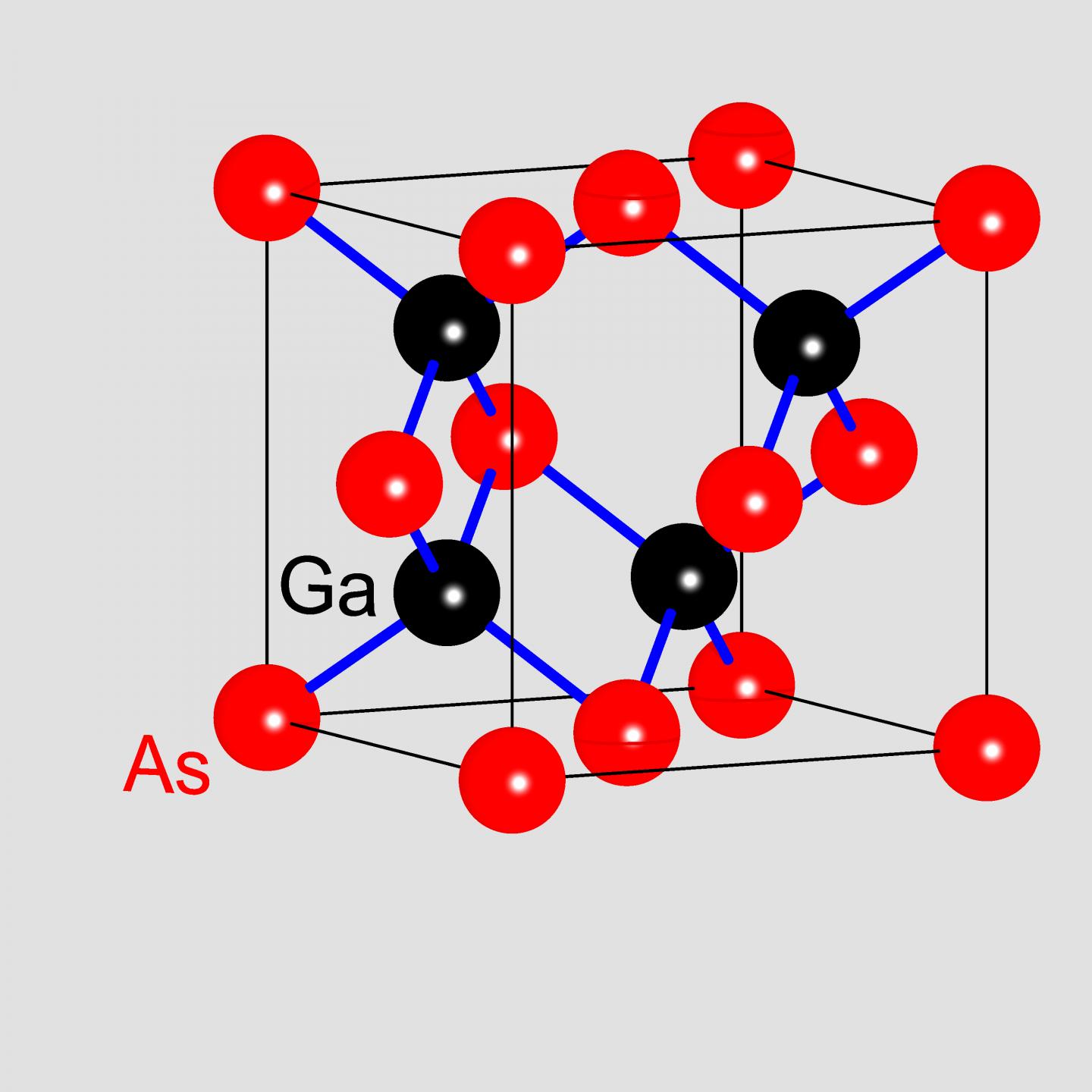
Vibrations of atoms in a crystal of the semiconductor gallium arsenide (GaAs) are impulsively shifted to a higher frequency by an optically excited electric current. The related change in the spatial distribution of charge between gallium and arsenic atoms acts back on their motions via electric interactions.

To hammer-on a guitar, a technique deployed by many rock guitarists, means to shorten a vibrating string quickly with a second finger and, thus, switch to a higher tone. This technique allows for faster playing and legato, a smoother linking of subsequent tones. Researchers from Berlin and Paris have now demonstrated a hammer-on analogue in crystals by switching the frequency of atomic motions with an impulsively generated electric current. As they report in the most recent issue of the journal Physical Review Letters, an electric current generated by femtosecond optical excitation shifts particular lattice vibrations, the transverse optical (TO) phonons, to a higher frequency.

The crystal lattice of GaAs consists of a regular arrangement of gallium and arsenic atoms (Fig. 1) held together by covalent chemical bonds. The atoms in the lattice can undergo a variety of vibrations, among them the TO phonon with a frequency of 8 THz = 8 000 000 000 000 vibrations per second. The electron density on the arsenic atoms is somewhat higher than on the gallium atoms, leading to a local electric dipole moment and making the crystal lattice electrically polar. This property makes the vibrational motion susceptible to electric forces.

In the experiments, a first femtosecond optical pulse launches a TO phonon oscillation, which is disturbed by a second pulse exciting electrons from the valence to the conduction band of the semiconductor. This excitation is connected with a shift of local charge, i.e., a so-called electric shift current. The shift current enhances the electron density on the gallium atoms. This change in the crystal’s electron distribution leads to a transient electric polarization, which generates an electric force and, thus, acts back on the TO phonon motion. As a result, the TO phonon frequency in the excited crystal changes by a small amount.

The measurement of the tiny phonon frequency shift represents a big experimental challenge. In the present study, the TO phonon oscillation was mapped in real-time via the THz wave radiated from the oscillating phonon dipole moment. The THz wave was measured in amplitude and phase with extremely high precision (Fig. 2). The radiated THz wave displays a frequency up-shift after the second pulse has interacted with the sample. The frequency shift is obvious from the slightly shorter oscillation period of the THz wave (red trace in Fig. 2) compared to the case without the second pulse (black trace). The up-shift of the TO phonon frequency has a value of 100 GHz or approximately 1 percent of the initial frequency. An analysis of the experimental results shows that one photo-excited electron in a crystal volume of 20 000 GaAs unit cells induces the one-percent frequency up shift.

The change of TO phonon frequency observed here for the first time should also occur in a wider range of semiconductors with a polar lattice and in ferroelectric materials.

###

Media Contact
Dr. Michael Woerner
[email protected]

Original Source

https://www.fv-berlin.de/en/info-for/the-media-and-public/news/hammer-on-wie-man-atome-schneller-schwingen-laesst

Related Journal Article

http://dx.doi.org/10.1103/PhysRevLett.125.027401

Tags: Chemistry/Physics/Materials SciencesMaterialsOpticsSuperconductors/Semiconductors
Share12Tweet8Share2ShareShareShare2

Related Posts

Cutting Electrolyte Reduction Boosts High-Energy Battery Performance

Cutting Electrolyte Reduction Boosts High-Energy Battery Performance

December 19, 2025
Microenvironment Shapes Gold-Catalysed CO2 Electroreduction

Microenvironment Shapes Gold-Catalysed CO2 Electroreduction

December 11, 2025

Photoswitchable Olefins Enable Controlled Polymerization

December 11, 2025

Cation Hydration Entropy Controls Chloride Ion Diffusion

December 10, 2025
Please login to join discussion

POPULAR NEWS

  • Nurses’ Views on Online Learning: Effects on Performance

    Nurses’ Views on Online Learning: Effects on Performance

    70 shares
    Share 28 Tweet 18
  • NSF funds machine-learning research at UNO and UNL to study energy requirements of walking in older adults

    70 shares
    Share 28 Tweet 18
  • Unraveling Levofloxacin’s Impact on Brain Function

    53 shares
    Share 21 Tweet 13
  • Exploring Audiology Accessibility in Johannesburg, South Africa

    51 shares
    Share 20 Tweet 13

About

We bring you the latest biotechnology news from best research centers and universities around the world. Check our website.

Follow us

Recent News

Assessing the K-NHSPSC: Korean Patient Safety Culture Insights

Spot Urine CA 19-9: New Insights in Pediatric Hydronephrosis

Discharge Choices for Elderly Surgical Patients Explored

Subscribe to Blog via Email

Enter your email address to subscribe to this blog and receive notifications of new posts by email.

Join 70 other subscribers
  • Contact Us

Bioengineer.org © Copyright 2023 All Rights Reserved.

Welcome Back!

Login to your account below

Forgotten Password?

Retrieve your password

Please enter your username or email address to reset your password.

Log In
No Result
View All Result
  • Homepages
    • Home Page 1
    • Home Page 2
  • News
  • National
  • Business
  • Health
  • Lifestyle
  • Science

Bioengineer.org © Copyright 2023 All Rights Reserved.