• HOME
  • NEWS
  • EXPLORE
    • CAREER
      • Companies
      • Jobs
    • EVENTS
    • iGEM
      • News
      • Team
    • PHOTOS
    • VIDEO
    • WIKI
  • BLOG
  • COMMUNITY
    • FACEBOOK
    • INSTAGRAM
    • TWITTER
Saturday, February 7, 2026
BIOENGINEER.ORG
No Result
View All Result
  • Login
  • HOME
  • NEWS
  • EXPLORE
    • CAREER
      • Companies
      • Jobs
        • Lecturer
        • PhD Studentship
        • Postdoc
        • Research Assistant
    • EVENTS
    • iGEM
      • News
      • Team
    • PHOTOS
    • VIDEO
    • WIKI
  • BLOG
  • COMMUNITY
    • FACEBOOK
    • INSTAGRAM
    • TWITTER
  • HOME
  • NEWS
  • EXPLORE
    • CAREER
      • Companies
      • Jobs
        • Lecturer
        • PhD Studentship
        • Postdoc
        • Research Assistant
    • EVENTS
    • iGEM
      • News
      • Team
    • PHOTOS
    • VIDEO
    • WIKI
  • BLOG
  • COMMUNITY
    • FACEBOOK
    • INSTAGRAM
    • TWITTER
No Result
View All Result
Bioengineer.org
No Result
View All Result
Home NEWS Science News Biology

Jurassic fossils from northeastern China reveal morphological stasis in the catkin-yew

Bioengineer by Bioengineer
July 11, 2020
in Biology
Reading Time: 2 mins read
0
IMAGE
Share on FacebookShare on TwitterShare on LinkedinShare on RedditShare on Telegram

IMAGE

Credit: ©Science China Press

The Taxaceae are a distinct conifer family widely used in ornamental horticulture and are an important source of chemotherapeutic drugs (e.g., Paclitaxel). Fossil evidence of Taxaceae is based mainly on isolated leaves or leafy shoots for which the reproductive structures are unknown. However, several more complete fossils with attached seed-bearing structures show that Taxaceae had diverged from other conifers by the earliest Jurassic and were probably diverse during the Jurassic and Cretaceous.

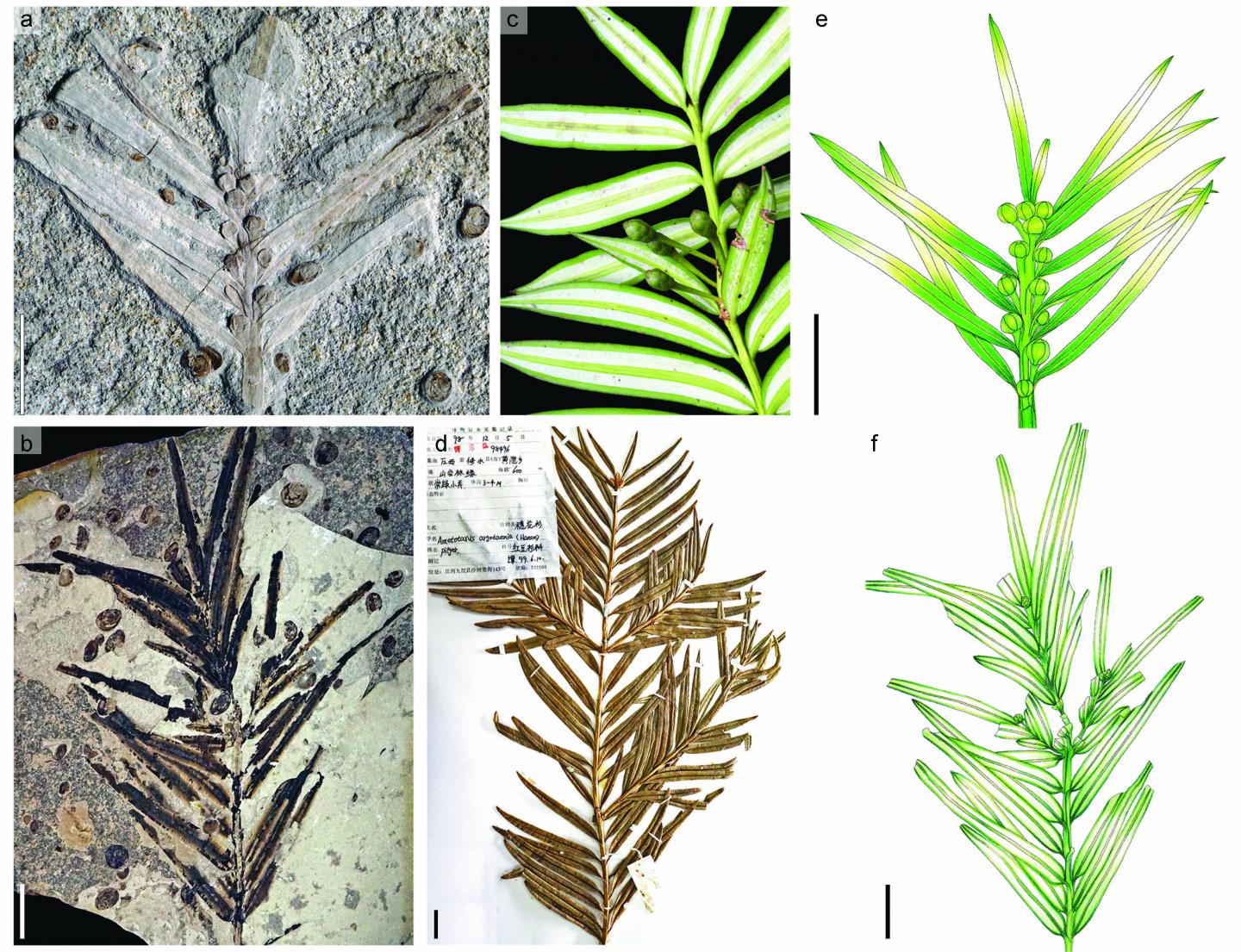
Dong and colleagues add to knowledge of early Taxaceae based on well-preserved fossils from the Middle-Late Jurassic (~160 Myr) Daohugou Bed in eastern Inner Mongolia, northeastern China. The material includes the terminal portion of a leafy shoot with attached seed-bearing structures, and a leafy shoot with two-orders of branching in which each ultimate shoot has a terminal conical bud. The fossil leafy shoots have opposite and decussate leaves. Attached seed-bearing structures arise singly from the axil of a normal vegetative leaf and consist of a short, naked axis bearing a single terminal seed that is enclosed by pairs of opposite and decussate bracts.

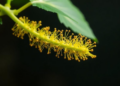
These fossils bear a striking resemblance to the leafy shoots and seed-bearing structures of extant catkin-yews Amentotaxus and only differ in having shorter seed-bearing axes. Assignment of the fossils to the living genus is also supported by cladistic analyses based on morphological characters of living and fossil Taxaceae. These fossils are among the most completely known of all fossil Taxaceae. Extant catkin-yews are endangered and have very restricted distributions in Eastern Asia. The Daohugou fossils document that among the diverse extinct Mesozoic Taxaceae were ancient catkin-yews. Like Ginkgo biloba, the catkin-yews are living fossils that have undergone little morphological change since the Middle-Late Jurassic.

###

See the article:

Dong C., Shi G., Herrera F., Wang Y., Herendeen P.S., Crane P.R., 2020. Middle-Late Jurassic fossils from northeastern China reveal morphological stasis in the catkin-yew. National Science Review, nwaa138. DOI: 10.1093/nsr/nwaa138

Link: https://doi.org/10.1093/nsr/nwaa138

Media Contact
Gongle Shi
[email protected]

Related Journal Article

http://dx.doi.org/10.1093/nsr/nwaa138

Tags: BiodiversityBiologyEvolutionPaleontologyPlant Sciences
Share13Tweet8Share2ShareShareShare2

Related Posts

Florida Cane Toad: Complex Spread and Selective Evolution

Florida Cane Toad: Complex Spread and Selective Evolution

February 7, 2026
New Study Uncovers Mechanism Behind Burn Pit Particulate Matter–Induced Lung Inflammation

New Study Uncovers Mechanism Behind Burn Pit Particulate Matter–Induced Lung Inflammation

February 6, 2026

DeepBlastoid: Advancing Automated and Efficient Evaluation of Human Blastoids with Deep Learning

February 6, 2026

Navigating the Gut: The Role of Formic Acid in the Microbiome

February 6, 2026
Please login to join discussion

POPULAR NEWS

  • Robotic Ureteral Reconstruction: A Novel Approach

    Robotic Ureteral Reconstruction: A Novel Approach

    82 shares
    Share 33 Tweet 21
  • Digital Privacy: Health Data Control in Incarceration

    63 shares
    Share 25 Tweet 16
  • Study Reveals Lipid Accumulation in ME/CFS Cells

    57 shares
    Share 23 Tweet 14
  • Breakthrough in RNA Research Accelerates Medical Innovations Timeline

    53 shares
    Share 21 Tweet 13

About

We bring you the latest biotechnology news from best research centers and universities around the world. Check our website.

Follow us

Recent News

Evaluating Pediatric Emergency Care Quality in Ethiopia

TPMT Expression Predictions Linked to Azathioprine Side Effects

Improving Dementia Care with Enhanced Activity Kits

Subscribe to Blog via Email

Success! An email was just sent to confirm your subscription. Please find the email now and click 'Confirm' to start subscribing.

Join 73 other subscribers
  • Contact Us

Bioengineer.org © Copyright 2023 All Rights Reserved.

Welcome Back!

Login to your account below

Forgotten Password?

Retrieve your password

Please enter your username or email address to reset your password.

Log In
No Result
View All Result
  • Homepages
    • Home Page 1
    • Home Page 2
  • News
  • National
  • Business
  • Health
  • Lifestyle
  • Science

Bioengineer.org © Copyright 2023 All Rights Reserved.