Scientists are a step closer to developing a fast and cost effective camera that utilizes terahertz radiation, potentially opening the opportunity for them to be used in non-invasive security and medical screening
Credit: University of Warwick
Scientists are a step closer to developing a fast and cost effective camera that utilises terahertz radiation, potentially opening the opportunity for them to be used in non-invasive security and medical screening.
A research team led by Professor Emma Pickwell-Macpherson from the University of Warwick Department of Physics and involving Rayko Ivanov Stantchev and scientists from the Department of Electronic Engineering at The Chinese University of Hong Kong has reached a crucial milestone towards developing single-pixel terahertz imaging technology for use in biomedical and industrial applications.
Their single-pixel terahertz camera reached 100 times faster acquisition than the previous state-of-the-art without adding any significant costs to the entire system or sacrificing the sub-picosecond temporal resolution needed for the most sought-after applications.
The breakthrough has been published in the journal Nature Communications.
The potentials and problems of Terahertz radiation
Terahertz (THz) radiation, or T-rays, sit in-between infrared and WiFi on the electromagnetic spectrum. T-rays have different properties from other electromagnetic waves, most notably they can see through many common materials such as plastics, ceramics and clothes, making them potentially useful in non-invasive inspections. Another quality is that the low-energy photons of T-rays are non-ionizing, making them very safe in biological settings including security and medical screening. They are also highly sensitive to water and can observe minute changes to the hydration state of biological matter. This means that diseases perturbing the water content of biological matter, such as skin cancer, can potentially be detected using T-rays in vivo without any histological markers.
Efficient detection and generation of T-rays has been possible in laboratory settings for the last 25 years. However, THz technology is still not widely used in commercial settings as the cost, robustness and/or ease of use is still lagging behind for commercial adoption in industrial settings.
For biomedical applications, very few clinical trials have been performed most notably due to the equipment not being user-friendly and imaging being too slow due to the need for measuring multiple terahertz frequencies (for accurate diagnosis). Finally, equipment and running costs need to be within hospital budgets. As a result, a lot of research into terahertz technology is currently focused on developing the equipment to improve imaging speed, without reducing diagnosis accuracy or incurring large costs. As a result, we have to explore alternative imaging techniques to those currently used in modern day smart phones.
The advantages of single-pixel cameras
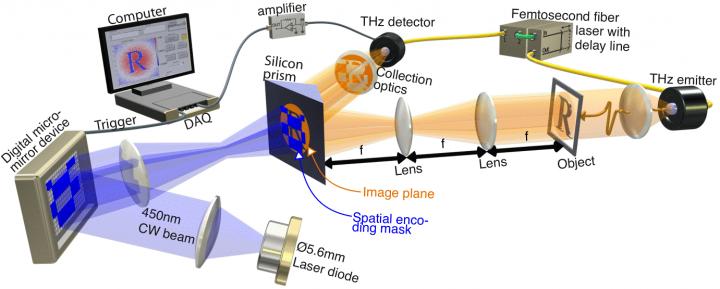
Professor Emma Pickwell-Macpherson, from the Department of Physics at the University of Warwick, said: “We use what is called ‘a single-pixel camera’ to obtain our images. In short, we spatially modulate the THz beam and shine this light onto an object. Then, using a single-element detector, we record the light that is transmitted (or reflected) through the object we want to image. We keep doing this for many different spatial patterns until we can mathematically reconstruct an image of our object.”
The researchers have to keep changing the shape of the THz beam many times which means this method is usually slower compared to multi-pixel detector arrays. However, multi-pixel arrays for the terahertz regime usually lack sub-picosecond temporal resolution, require cryogenic temperatures to operate or incur large equipment costs (>US$ 350,000). The setup developed by the Warwick team, which is based on a single-element detector, is reasonably priced (~US$20,000), robust, has sub-picosecond temporal resolution (needed for accurate diagnosis) and operates at room temperature.
Professor Pickwell-Macpherson adds: “Our latest work improves upon the acquisition rate of single-pixel terahertz cameras by a factor of 100 from the previous state-of-the-art, acquiring a 32×32 video at 6 frames-per-second. We do this by firstly determining the optimal modulation geometry, secondly by modelizing the temporal response of our imaging system for improvement in signal-to-noise, and thirdly by reducing the total number of measurements with compressed sensing techniques. In fact, part of our work shows that we can reach a five times faster acquisition rate if we have sufficient signal-to-noise ratio.”
The researchers have previously developed several THz devices including THz modulators that make use of the total internal reflection geometry to achieve high MDs across a broadband frequency range and a new approach for amplitude and phase modulation exploiting the Brewster angle. They are also working to improve the resolution of single pixel THz imaging through signal processing approaches. Future work will focus on improving the signal-to-noise and optimizing the software needed for accurate medical diagnosis, with the ultimate goal being to use single pixel THz imaging for in vivo cancer diagnosis.
###
* ‘Real-time THz imaging with a single-pixel detector’ is published in Nature Communications https:/
* Read more about the research: http://bme.
* Professor Emma Pickwell-MacPherson has been awarded funds from the Research Grants Council, Innovation and Technology Fund, Engineering and Physical Sciences Research Council and The Royal Society to support her research in Hong Kong and the UK.
Notes to editors:
For interviews contact:
Peter Thorley
Media Relations Manager (Warwick Medical School and Department of Physics) | Press & Media Relations | University of Warwick
Email: [email protected]
Mob: +44 (0) 7824 540863
Media Contact
Peter Thorley
[email protected]
Related Journal Article
http://dx.