• HOME
  • NEWS
  • EXPLORE
    • CAREER
      • Companies
      • Jobs
    • EVENTS
    • iGEM
      • News
      • Team
    • PHOTOS
    • VIDEO
    • WIKI
  • BLOG
  • COMMUNITY
    • FACEBOOK
    • INSTAGRAM
    • TWITTER
Monday, January 12, 2026
BIOENGINEER.ORG
No Result
View All Result
  • Login
  • HOME
  • NEWS
  • EXPLORE
    • CAREER
      • Companies
      • Jobs
        • Lecturer
        • PhD Studentship
        • Postdoc
        • Research Assistant
    • EVENTS
    • iGEM
      • News
      • Team
    • PHOTOS
    • VIDEO
    • WIKI
  • BLOG
  • COMMUNITY
    • FACEBOOK
    • INSTAGRAM
    • TWITTER
  • HOME
  • NEWS
  • EXPLORE
    • CAREER
      • Companies
      • Jobs
        • Lecturer
        • PhD Studentship
        • Postdoc
        • Research Assistant
    • EVENTS
    • iGEM
      • News
      • Team
    • PHOTOS
    • VIDEO
    • WIKI
  • BLOG
  • COMMUNITY
    • FACEBOOK
    • INSTAGRAM
    • TWITTER
No Result
View All Result
Bioengineer.org
No Result
View All Result
Home NEWS Science News Biology

UQ researchers solve a 50-year-old enzyme mystery

Bioengineer by Bioengineer
July 10, 2020
in Biology
Reading Time: 2 mins read
0
IMAGE
Share on FacebookShare on TwitterShare on LinkedinShare on RedditShare on Telegram

IMAGE

Credit: The University of Queensland

Advanced herbicides and treatments for infection may result from the unravelling of a 50-year-old mystery by University of Queensland researchers.

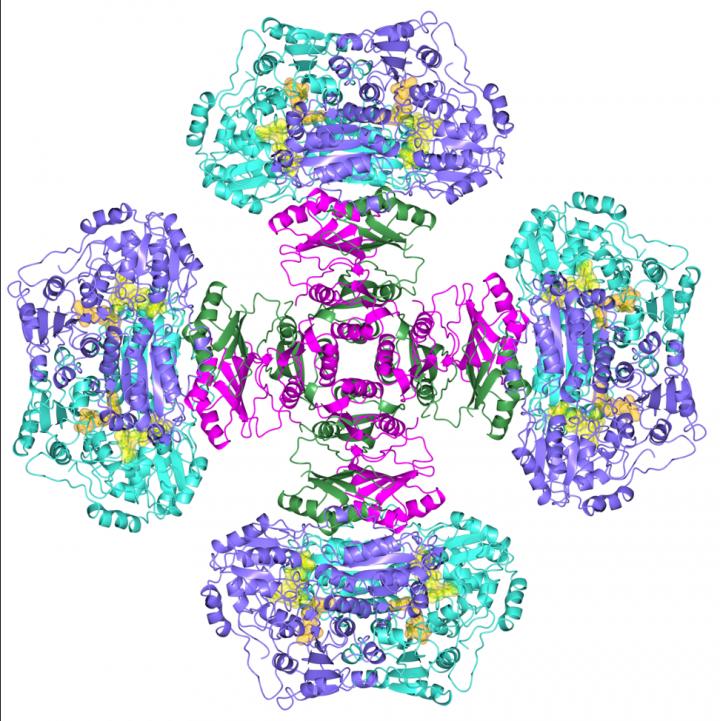
The research team, led by UQ’s Professor Luke Guddat, revealed the complete three-dimensional structure of an enzyme, providing the first step in the biosynthesis of three essential amino acids – leucine, valine and isoleucine.

“This is a major scientific advance, which has been pursued globally by chemists for half a century,” Professor Guddat said.

“This information provides new insights into an important enzyme – acetohydroxyacid synthase – a target for more than 50 commercial herbicides.

“It’s also a potential target for new drugs to treat infections such as tuberculosis and invasive Candida infections.”

Using advanced techniques such as cryo-electron microscopy and X-ray crystallography, the team deciphered the structure of the plant and fungal versions of the enzyme.

“We identified how this highly complex structure is assembled, which is the highly unusual shape of a Maltese Cross,” Professor Guddat said.

“Coincidently, the Maltese Cross also features as a part of UQ’s logo.”

Professor Guddat said the discovery could have big implications for global agriculture.

“Sulfometuron is a herbicide that targets this enzyme, and was widely used in the 1990s for wheat crop protection throughout Australia,” he said.

“But today it is completely ineffective due to the development of resistance.

“With this new insight, we will be able to make changes to existing herbicides, restoring options for future herbicide application.”

Professor Guddat said the enzyme was only found in plants and microbes, not in humans.

“For this reason, the herbicides and drugs that it targets are likely to be safe and non-toxic to all mammals,” he said.

“And another surprising finding of the research was the role that the molecule known as ATP plays in the regulation of the enzyme.

“Normally ATP plays a role in providing energy to all living cells,” Professor Guddat said.

“However, here it is acting like a piece of glue to hold the structure together.”

“They’re fascinating findings for us, and we’re excited for new opportunities for targeted design of next-gen herbicides and antimicrobial agents.”

###

The majority of the study was undertaken by Dr Thierry Lonhienne and UQ PhD candidate, Yu Shang Low, who worked closely with the ShanghaiTech University, China to obtain the cryo-EM images for the plant enzyme.

The research has been published in Nature (DOI: 10.1038/s41586-020-2514-3).

Media Contact
Luke Guddat
[email protected]

Original Source

https://www.uq.edu.au/news/article/2020/07/uq-researchers-solve-50-year-old-enzyme-mystery

Related Journal Article

http://dx.doi.org/10.1038/s41586-020-2514-3

Tags: AgricultureBiochemistryChemistry/Physics/Materials SciencesFertilizers/Pest ManagementMedicine/Health
Share12Tweet8Share2ShareShareShare2

Related Posts

blank

Unveiling Complex Chromosomal Insertions with Karyotyping

January 12, 2026
Diving Deep: Sindiplozoon Coreius Mitochondrial Genome Unveiled

Diving Deep: Sindiplozoon Coreius Mitochondrial Genome Unveiled

January 12, 2026

PET Microplastics Harm Pig Pancreas Through Lipotoxicity

January 11, 2026

Stem Cell-Derived Vesicles Combat UVB-Induced Skin Aging

January 11, 2026
Please login to join discussion

POPULAR NEWS

  • Enhancing Spiritual Care Education in Nursing Programs

    154 shares
    Share 62 Tweet 39
  • PTSD, Depression, Anxiety in Childhood Cancer Survivors, Parents

    146 shares
    Share 58 Tweet 37
  • Robotic Ureteral Reconstruction: A Novel Approach

    69 shares
    Share 28 Tweet 17
  • Impact of Vegan Diet and Resistance Exercise on Muscle Volume

    47 shares
    Share 19 Tweet 12

About

We bring you the latest biotechnology news from best research centers and universities around the world. Check our website.

Follow us

Recent News

Unveiling Complex Chromosomal Insertions with Karyotyping

Enhanced Coherent Ranging via Phase-Multiplied Interferometry

Adaphostin Triggers Oxidative Stress in Esophageal Cancer

Subscribe to Blog via Email

Enter your email address to subscribe to this blog and receive notifications of new posts by email.

Join 71 other subscribers
  • Contact Us

Bioengineer.org © Copyright 2023 All Rights Reserved.

Welcome Back!

Login to your account below

Forgotten Password?

Retrieve your password

Please enter your username or email address to reset your password.

Log In
No Result
View All Result
  • Homepages
    • Home Page 1
    • Home Page 2
  • News
  • National
  • Business
  • Health
  • Lifestyle
  • Science

Bioengineer.org © Copyright 2023 All Rights Reserved.