• HOME
  • NEWS
  • EXPLORE
    • CAREER
      • Companies
      • Jobs
    • EVENTS
    • iGEM
      • News
      • Team
    • PHOTOS
    • VIDEO
    • WIKI
  • BLOG
  • COMMUNITY
    • FACEBOOK
    • INSTAGRAM
    • TWITTER
Saturday, December 27, 2025
BIOENGINEER.ORG
No Result
View All Result
  • Login
  • HOME
  • NEWS
  • EXPLORE
    • CAREER
      • Companies
      • Jobs
        • Lecturer
        • PhD Studentship
        • Postdoc
        • Research Assistant
    • EVENTS
    • iGEM
      • News
      • Team
    • PHOTOS
    • VIDEO
    • WIKI
  • BLOG
  • COMMUNITY
    • FACEBOOK
    • INSTAGRAM
    • TWITTER
  • HOME
  • NEWS
  • EXPLORE
    • CAREER
      • Companies
      • Jobs
        • Lecturer
        • PhD Studentship
        • Postdoc
        • Research Assistant
    • EVENTS
    • iGEM
      • News
      • Team
    • PHOTOS
    • VIDEO
    • WIKI
  • BLOG
  • COMMUNITY
    • FACEBOOK
    • INSTAGRAM
    • TWITTER
No Result
View All Result
Bioengineer.org
No Result
View All Result
Home NEWS Science News Biology

Revealing winners & losers in projected future climates

Bioengineer by Bioengineer
July 10, 2020
in Biology
Reading Time: 2 mins read
0
IMAGE
Share on FacebookShare on TwitterShare on LinkedinShare on RedditShare on Telegram

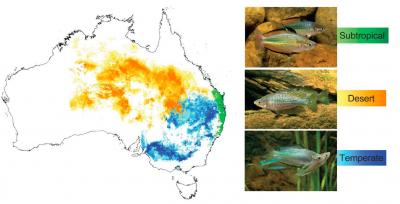
New research reveals how winners & losers from climate change can be identified based on their ability to adapt to rising temperatures
IMAGE

Credit: PNAS

New research reveals how winners & losers from climate change can be identified based on their ability to adapt to rising future temperatures.

In the first study of its kind published in PNAS, Flinders University evolutionary biologists have shown that resilience or vulnerability to future climates is influenced by the thermal conditions of the climatic regions where species evolved.

The study compared thermal tolerance and gene expression (which genes are activated within a cell) in subtropical, desert and temperate Australian rainbowfishes.

Evolutionary biologist Professor Luciano Beheregaray says subtropical species were the winners in future climates because evolution suits their local conditions given these fish have the ability to turn on and off a larger number of heat stress genes in hotter climates.

The study shows that subtropical species have greater capacity to adapt to future climates than desert species, and that temperate species are the most vulnerable.

By looking at how all the genes are expressed in current temperatures and in temperatures projected for 2070, the researchers produced a catalogue of genes that informs about the adaptive capacity to climate change.

“Resilience or vulnerability to climate change is expected to be influenced by the thermal conditions where species are found, but we knew very little about this, and hardly anything about how this might vary across different climatic regions”, says co-author Dr Jonathan Sandoval-Castillo.

“Our results suggest that the vulnerability of species to climate change will be highly influenced by geographic factors, emphasising the value of assessments of climate traits for more accurate estimates of population impacts and the way ecosystems will ultimately respond”, says co-author and PhD student Katie Gates.

The findings can also be extended to many non-migratory species, aquatic or terrestrial, under pressure due to climate change.

“This information is important for identifying biodiversity at high risk of extinction and to develop ways to help them to adapt and persist. This includes restoring lost habitat and actively moving populations to more favourable climatic locations, while we still have time”, says Professor Beheregaray.

###

“Adaptation of plasticity to projected maximum temperatures and across climatically defined bioregions” by Flinders University evolutionary biologists Professor Luciano Beheregaray, Dr Jonathan Sandoval-Castillo, Katie Gates and Dr Chris Brauer and by collaborators Prof Louis Bernatchez (Université Laval, Canada) and Dr Steve Smith (University of Vienna, Austria) is published in the Proceedings of the National Academy of Science (PNAS) 7 July 2020

Link: https://www.pnas.org/content/early/2020/07/06/1921124117

Media Contact
Professor Luciano Beheregaray
[email protected]

Related Journal Article

http://dx.doi.org/10.1073/pnas.1921124117

Tags: BiologyClimate ChangeClimate ScienceEarth ScienceEvolutionGenetics
Share12Tweet8Share2ShareShareShare2

Related Posts

Tissue-Specific Gene Expression Variance in Mice

Tissue-Specific Gene Expression Variance in Mice

December 27, 2025
Sex Differences in Liver Metabolism and Disease

Sex Differences in Liver Metabolism and Disease

December 27, 2025

SyBValS: Ensuring Accuracy in Biological Pathway Mapping

December 27, 2025

Enhancing Snail Breeding: Age at First Oviposition

December 27, 2025
Please login to join discussion

POPULAR NEWS

  • Robotic Waist Tether for Research Into Metabolic Cost of Walking

    NSF funds machine-learning research at UNO and UNL to study energy requirements of walking in older adults

    71 shares
    Share 28 Tweet 18
  • Nurses’ Views on Online Learning: Effects on Performance

    70 shares
    Share 28 Tweet 18
  • Exploring Audiology Accessibility in Johannesburg, South Africa

    51 shares
    Share 20 Tweet 13
  • Unraveling Levofloxacin’s Impact on Brain Function

    54 shares
    Share 22 Tweet 14

About

We bring you the latest biotechnology news from best research centers and universities around the world. Check our website.

Follow us

Recent News

Understanding Privacy and Disclosure in Eating Disorders

Ultrathin Silicon Hall Sensors Detect 3D Tumors Early

Tissue-Specific Gene Expression Variance in Mice

Subscribe to Blog via Email

Enter your email address to subscribe to this blog and receive notifications of new posts by email.

Join 71 other subscribers
  • Contact Us

Bioengineer.org © Copyright 2023 All Rights Reserved.

Welcome Back!

Login to your account below

Forgotten Password?

Retrieve your password

Please enter your username or email address to reset your password.

Log In
No Result
View All Result
  • Homepages
    • Home Page 1
    • Home Page 2
  • News
  • National
  • Business
  • Health
  • Lifestyle
  • Science

Bioengineer.org © Copyright 2023 All Rights Reserved.