PortionSize promises an affordable method to measure how much users eat
Credit: John Apolzan, Corby Martin
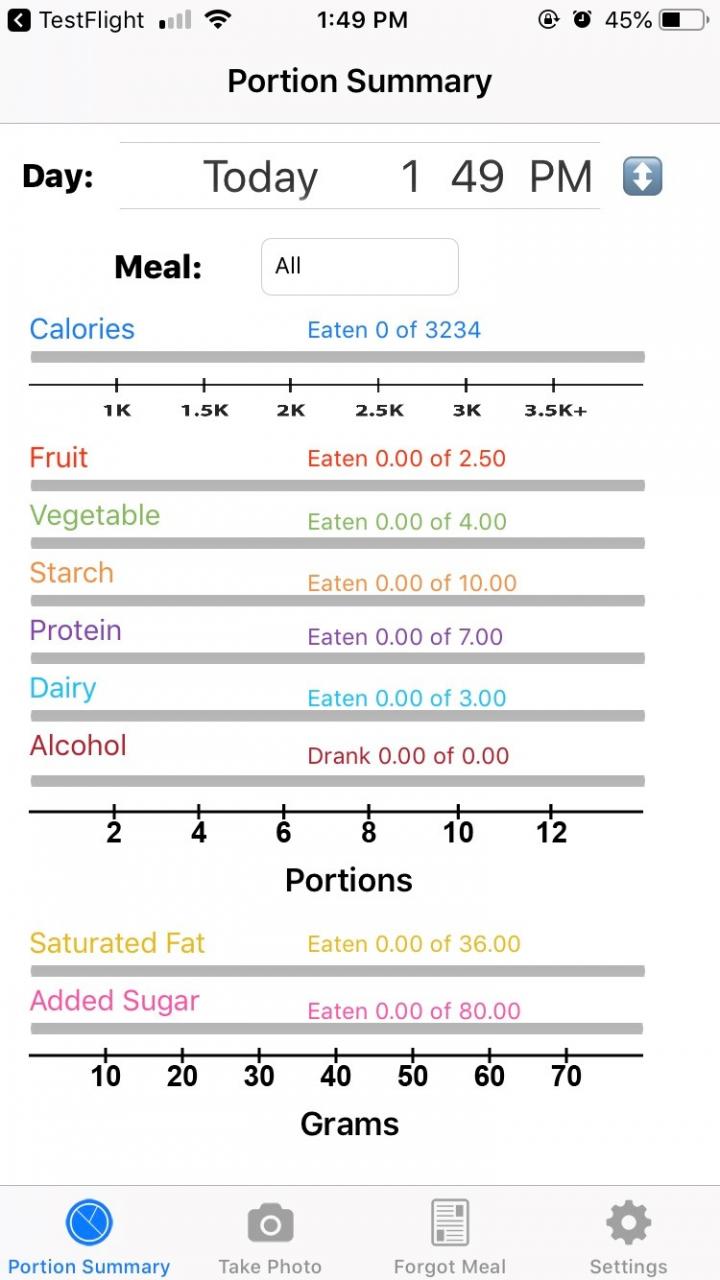
A new smartphone app promises to make it easier for consumers to stick to their weight-management plans by automatically gauging calorie consumption.
The PortionSize™ app analyzes pictures of users’ meals and instantly lets them know how many calories they have eaten. Scientists at Pennington Biomedical Research Center will test the app against the current “gold-standard” calorie-consumption measures under a four-year, $1.8 million grant from the National Institutes of Health. Around 150 participants will be recruited for the study.
“One of the keys to successful weight management or weight loss is making sure you are eating the correct amount of food. But measuring calorie consumption accurately can be very difficult if you rely on a food diary or your memory to keep track,” said Corby Martin, PhD, Professor and Co-principal Investigator of the study. “More often than not people underestimate how much they have eaten.”
The flaws inherent to these self-report methods also complicate nutritional epidemiological research.
“For consumers, counting calories is made even more difficult because portions – the amount of food in a meal or a snack – have increased greatly over the last two-plus decades,” said John Apolzan, PhD, Assistant Professor and Co-principal Investigator of the study. “What people now consider a normal portion is generally too much for a single individual.”
For example, 20 years ago the average cheeseburger contained 333 calories. A blueberry muffin weighed 1.5 ounces and contained 210 calories. Today the average cheeseburger is 590 calories while the typical blueberry muffin weighs in at 5 ounces and 500 calories.
PortionSize helps offset what the NIH refers to as “portion distortion,” giving consumers a more accurate way to gauge calorie consumption.
Martin and Apolzan, who invented the app, said their preliminary data show that PortionSize is a promising and user-friendly approach.
The scientists plan to begin pilot testing the app sometime between mid-July and mid-August with roughly a dozen participants. They then plan to conduct three full studies over three years, starting in 2021. Each study will enroll around 40-50 people.
The scientists will evaluate the app under three conditions:
- Laboratory-based test meals.
- Free-living conditions, where participants will consume pre-weighed food from a cooler.
- Free-living conditions, where energy intake is also assessed by doubly labeled water. Study subjects are given two forms of water with stable isotopes. The difference in the isotopes’ rates of disappearance allows researchers to calculate how many calories a person has burned. This can then be used to calculate actual calorie intake.
More information about the trials will be posted to http://www.
The app is not yet commercially available. If PortionSize proves itself against the gold standard, the app will help researchers, clinicians, and consumers by offering an accurate, affordable way to measure and track how much food users are eating in real-time.
This research is supported by the National Institutes of Health via the National Institute of Diabetes and Digestive and Kidney Diseases under award number R01 DK124558. The content is solely the responsibility of the authors and does not necessarily represent the official views of the National Institutes of Health.
###
About the Pennington Biomedical Research Center
The Pennington Biomedical Research Center is at the forefront of medical discovery as it relates to understanding the triggers of obesity, diabetes, cardiovascular disease, cancer and dementia. The Center conducts basic, clinical, and population research, and is affiliated with Louisiana State University. The research enterprise at Pennington Biomedical includes over 450 employees within a network of 40 clinics and research laboratories, and 13 highly specialized core service facilities. Its scientists and physician/scientists are supported by research trainees, lab technicians, nurses, dietitians, and other support personnel. Pennington Biomedical is located in state-of-the-art research facilities on a 222-acre campus in Baton Rouge, Louisiana. For more information, see http://www.
Pennington Biomedical Research Center
6400 Perkins Road
Baton Rouge, LA 70808
Media Contact
Ted Griggs
[email protected]
Original Source
https:/