• HOME
  • NEWS
  • EXPLORE
    • CAREER
      • Companies
      • Jobs
    • EVENTS
    • iGEM
      • News
      • Team
    • PHOTOS
    • VIDEO
    • WIKI
  • BLOG
  • COMMUNITY
    • FACEBOOK
    • INSTAGRAM
    • TWITTER
Sunday, August 23, 2026
BIOENGINEER.ORG
No Result
View All Result
  • Login
  • HOME
  • NEWS
  • EXPLORE
    • CAREER
      • Companies
      • Jobs
        • Lecturer
        • PhD Studentship
        • Postdoc
        • Research Assistant
    • EVENTS
    • iGEM
      • News
      • Team
    • PHOTOS
    • VIDEO
    • WIKI
  • BLOG
  • COMMUNITY
    • FACEBOOK
    • INSTAGRAM
    • TWITTER
  • HOME
  • NEWS
  • EXPLORE
    • CAREER
      • Companies
      • Jobs
        • Lecturer
        • PhD Studentship
        • Postdoc
        • Research Assistant
    • EVENTS
    • iGEM
      • News
      • Team
    • PHOTOS
    • VIDEO
    • WIKI
  • BLOG
  • COMMUNITY
    • FACEBOOK
    • INSTAGRAM
    • TWITTER
No Result
View All Result
Bioengineer.org
No Result
View All Result
Home NEWS Science News Biology

Newly discovered pathogen in NY apples causes bitter rot disease

Bioengineer by Bioengineer
July 6, 2020
in Biology
Reading Time: 2 mins read
0
IMAGE
Share on FacebookShare on TwitterShare on LinkedinShare on RedditShare on Telegram

IMAGE

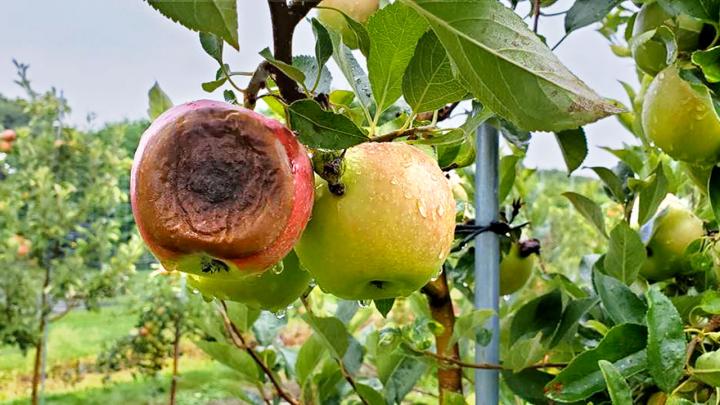
Credit: Srdjan Goran Acimovic

ITHACA, N.Y. – In a study of New York state apple orchards, Cornell University plant pathologists have identified a new fungal pathogen that causes bitter rot disease in apples. In addition, a second related fungus known to cause rot disease in other fruits was found for the first time in apples.

“We were shocked by what we found, just dumbfounded,” said Srdjan Acimovic, a senior extension associate at the Hudson Valley Research Laboratory (part of Cornell AgriTech) and the paper’s senior author. “We found these two species, one that has never been described before and one that has been described before but never on this host.”

Both pathogens belong to the genus Colletotrichum, which contains 189 species of fungi that cause devastating rot diseases in a wide variety of fruit crops, including banana, strawberry, citrus, avocado, papaya, mango and apple.

If protective practices are not applied in a timely manner, apple losses from bitter rot in New York state can average up to 25% per year, with reports of some organic farms losing up to 100% of their crop. Bitter rot also accounts for up to 5% additional loss of marketable fruit in storage post-harvest.

This damage is costly for farmers; the farm gate value for New York apples was roughly $260 million in 2018, according to U.S. Department of Agriculture statistics.

The dominant species found in the apples was C. fioriniae, followed by C. chrysophilum, which is found in other fruits but not apples until now, and the newly discovered C. noveboracense, named after New York state in Latin.

Colletotrichum fungi that infect apple fruit can largely be divided in two main groups. One group called the C. gloeosporioides complex thrives in warmer growing regions than the other group, the C. acutatum complex, which is more frequently reported in cooler apple growing regions. And based on the group they belong to, species can react differently to fungicides, which the researchers also tested. For this reason, identifying and characterizing the fungi is important for bitter rot management.

“When we know which species are dominant in our area, we know how environmental conditions will affect them and which control method is best in an orchard,” said study first author Fatemeh Khodadadi, a postdoctoral researcher in Acimovic’s lab.

In the future, the researchers plan to work with other plant pathologists and apple breeders to identify possible genes that confer natural resistance to Colletotrichum fungi that may be bred into apple cultivars.

###

The study, “Identification and Characterization of Colletotrichum Species Causing Apple Bitter Rot in New York and Description of C. noveboracense sp. nov.,” was published July 6 in the journal Scientific Reports.

Media Contact
Lindsey Hadlock
[email protected]

Original Source

https://news.cornell.edu/stories/2020/07/scientists-identify-new-pathogen-ny-apples

Related Journal Article

http://dx.doi.org/10.1038/s41598-020-66761-9

Tags: AgricultureMolecular BiologyPlant Sciences
Share12Tweet8Share2ShareShareShare2

Related Posts

Delayed antiviral response in alveolar type 2 cells heightens influenza susceptibility

Delayed antiviral response in alveolar type 2 cells heightens influenza susceptibility

August 22, 2026
Genetic evidence links sleep disruption to hemorrhoidal disease, revealing a hidden connection

Genetic evidence links sleep disruption to hemorrhoidal disease, revealing a hidden connection

August 22, 2026

LASIK Versus Contact Lenses for Correcting Myopia

August 22, 2026

New Advances in Minimally Invasive Laryngeal Surgery

August 22, 2026
Please login to join discussion

POPULAR NEWS

  • Blocking glucosylceramide production kills cancer cells via lysosomal dysfunction, not ceramide buildup

    29 shares
    Share 12 Tweet 7
  • ZCCHC4 boosts replication-dependent histone mRNA translation by interacting with eIF3

    29 shares
    Share 12 Tweet 7
  • KAIST Surface Defects Boost Droplet Formation, Removal, and Heat Transfer by 5.5-Fold

    29 shares
    Share 12 Tweet 7
  • Dual-oxygen pancreatic cancer organoids mirror basal-classical diversity, spatial transcriptomics confirms

    29 shares
    Share 12 Tweet 7

About

We bring you the latest biotechnology news from best research centers and universities around the world. Check our website.

Follow us

Recent News

Blocking glucosylceramide production kills cancer cells via lysosomal dysfunction, not ceramide buildup

ZCCHC4 boosts replication-dependent histone mRNA translation by interacting with eIF3

KAIST Surface Defects Boost Droplet Formation, Removal, and Heat Transfer by 5.5-Fold

Subscribe to Blog via Email

Success! An email was just sent to confirm your subscription. Please find the email now and click 'Confirm' to start subscribing.

Join 85 other subscribers
  • Contact Us

Bioengineer.org © Copyright 2023 All Rights Reserved.

Welcome Back!

Login to your account below

Forgotten Password?

Retrieve your password

Please enter your username or email address to reset your password.

Log In
No Result
View All Result
  • Homepages
    • Home Page 1
    • Home Page 2
  • News
  • National
  • Business
  • Health
  • Lifestyle
  • Science

Bioengineer.org © Copyright 2023 All Rights Reserved.