• HOME
  • NEWS
  • EXPLORE
    • CAREER
      • Companies
      • Jobs
    • EVENTS
    • iGEM
      • News
      • Team
    • PHOTOS
    • VIDEO
    • WIKI
  • BLOG
  • COMMUNITY
    • FACEBOOK
    • INSTAGRAM
    • TWITTER
Saturday, July 4, 2026
BIOENGINEER.ORG
No Result
View All Result
  • Login
  • HOME
  • NEWS
  • EXPLORE
    • CAREER
      • Companies
      • Jobs
        • Lecturer
        • PhD Studentship
        • Postdoc
        • Research Assistant
    • EVENTS
    • iGEM
      • News
      • Team
    • PHOTOS
    • VIDEO
    • WIKI
  • BLOG
  • COMMUNITY
    • FACEBOOK
    • INSTAGRAM
    • TWITTER
  • HOME
  • NEWS
  • EXPLORE
    • CAREER
      • Companies
      • Jobs
        • Lecturer
        • PhD Studentship
        • Postdoc
        • Research Assistant
    • EVENTS
    • iGEM
      • News
      • Team
    • PHOTOS
    • VIDEO
    • WIKI
  • BLOG
  • COMMUNITY
    • FACEBOOK
    • INSTAGRAM
    • TWITTER
No Result
View All Result
Bioengineer.org
No Result
View All Result
Home NEWS Science News

New breakthrough in ‘spintronics’ could boost high speed data technology

Bioengineer by Bioengineer
July 6, 2020
in Science News
Reading Time: 2 mins read
0
IMAGE
Share on FacebookShare on TwitterShare on LinkedinShare on RedditShare on Telegram

IMAGE

Credit: University of Exeter

Scientists have made a pivotal breakthrough in the important, emerging field of spintronics – which could lead to a new high speed energy efficient data technology.

An international team of researchers, including the University of Exeter, has made a revolutionary discovery that has the potential to provide high speed, low power-usage for some of the world’s most well-used electronic devices.

While today’s information technology relies on electronics that consumes a huge amount of energy, the electrons within electric currents can also transfer a form of angular momentum called spin.

‘Spin-based electronics or ‘spintronics’, that exploits spin current, has the potential to be not just significantly faster, but also more energy efficient.

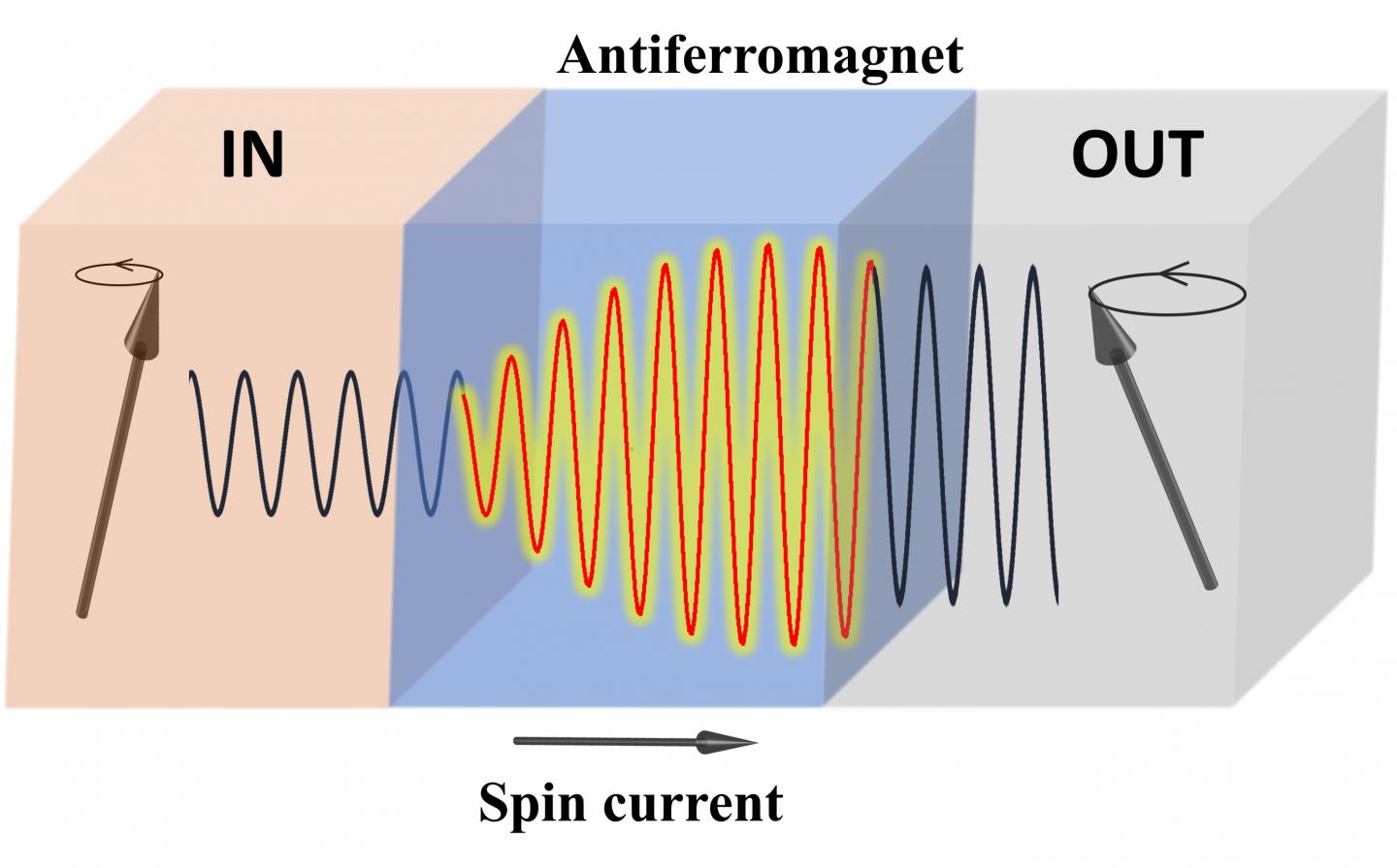
Scientists have recently discovered that some electrically insulating antiferromagnetic materials are exceptionally good conductors of pure spin current.

In the new research, scientists from Exeter, in collaboration with the Universities of Oxford, California Berkeley, and the Advanced and Diamond Light Sources, have experimentally demonstrated that high frequency alternating spin currents can be transmitted by, and sometimes amplified within, thin layers of antiferromagnetic NiO.

The results demonstrate that the spin current in thin NiO layers is mediated by evanescent spin waves, a mechanism akin to quantum mechanical tunnelling.

The use of thin NiO layers for transfer and amplification of ac spin current at room temperature and gigahertz frequencies may lead to more efficient future wireless communication technology.

The research is published in Physical Review Letters.

Maciej Dabrowski, first author from the University of Exeter said: “Confirmation of the evanescent spin wave mechanism shown by our experiment indicates that the transfer of angular momentum between the spins and the crystal lattice of an antiferromagnet can be realized in thin NiO films and opens the door to the construction of nanoscale spin current amplifiers”

###

Coherent transfer of spin angular momentum by evanescent spin waves within antiferromagnetic NiO is published in Physical Review Letters.

Media Contact
Duncan Sandes
[email protected]

Related Journal Article

http://dx.doi.org/10.1103/PhysRevLett.124.217201

Tags: Chemistry/Physics/Materials SciencesElectrical Engineering/ElectronicsElectromagneticsTechnology/Engineering/Computer Science
Share12Tweet8Share2ShareShareShare2

Related Posts

Decoding Ferroptosis: ATF4 and SREBF Roles Revealed

July 4, 2026
Steatosis Drives Liver Metastasis Diversity in CRC — Medicine

Steatosis Drives Liver Metastasis Diversity in CRC

July 2, 2026

Unlocking the Mysteries of Alzheimer’s Disease

July 2, 2026

Pensoft Introduces New Peer-Reviewed Journal of Regeneration to Advance Restorative Biology Across Species

July 2, 2026
Please login to join discussion

POPULAR NEWS

  • Detection of EDCs in Breast Milk and Infant Urine Up to Six Months Highlights Early Exposure Risks

    77 shares
    Share 31 Tweet 19
  • Saying Goodbye to PGY-6: Pediatric Fellowship Realities

    103 shares
    Share 41 Tweet 26
  • New Drug Candidate Developed at McMaster Shows Potential for Treating Brain Cancer

    58 shares
    Share 23 Tweet 15
  • KTU Researchers Explore Ultrasound’s Role in Enhancing Blood Flow Beyond Diagnostics

    53 shares
    Share 21 Tweet 13

About

We bring you the latest biotechnology news from best research centers and universities around the world. Check our website.

Follow us

Recent News

Decoding Ferroptosis: ATF4 and SREBF Roles Revealed

Steatosis Drives Liver Metastasis Diversity in CRC

Unlocking the Mysteries of Alzheimer’s Disease

Subscribe to Blog via Email

Enter your email address to subscribe to this blog and receive notifications of new posts by email.

Join 83 other subscribers
  • Contact Us

Bioengineer.org © Copyright 2023 All Rights Reserved.

Welcome Back!

Login to your account below

Forgotten Password?

Retrieve your password

Please enter your username or email address to reset your password.

Log In
No Result
View All Result
  • Homepages
    • Home Page 1
    • Home Page 2
  • News
  • National
  • Business
  • Health
  • Lifestyle
  • Science

Bioengineer.org © Copyright 2023 All Rights Reserved.