• HOME
  • NEWS
  • EXPLORE
    • CAREER
      • Companies
      • Jobs
    • EVENTS
    • iGEM
      • News
      • Team
    • PHOTOS
    • VIDEO
    • WIKI
  • BLOG
  • COMMUNITY
    • FACEBOOK
    • INSTAGRAM
    • TWITTER
Thursday, September 24, 2026
BIOENGINEER.ORG
No Result
View All Result
  • Login
  • HOME
  • NEWS
  • EXPLORE
    • CAREER
      • Companies
      • Jobs
        • Lecturer
        • PhD Studentship
        • Postdoc
        • Research Assistant
    • EVENTS
    • iGEM
      • News
      • Team
    • PHOTOS
    • VIDEO
    • WIKI
  • BLOG
  • COMMUNITY
    • FACEBOOK
    • INSTAGRAM
    • TWITTER
  • HOME
  • NEWS
  • EXPLORE
    • CAREER
      • Companies
      • Jobs
        • Lecturer
        • PhD Studentship
        • Postdoc
        • Research Assistant
    • EVENTS
    • iGEM
      • News
      • Team
    • PHOTOS
    • VIDEO
    • WIKI
  • BLOG
  • COMMUNITY
    • FACEBOOK
    • INSTAGRAM
    • TWITTER
No Result
View All Result
Bioengineer.org
No Result
View All Result
Home NEWS Science News Health

Novel biomarker discovery could lead to early diagnosis for deadly preeclampsia

Bioengineer by Bioengineer
July 3, 2020
in Health
Reading Time: 2 mins read
0
IMAGE
Share on FacebookShare on TwitterShare on LinkedinShare on RedditShare on Telegram

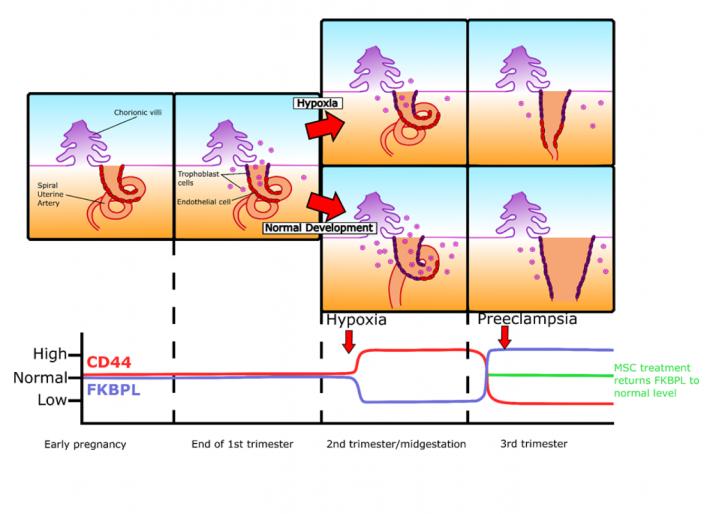
The discovery of two new biomarkers has the potential to predict key underlying causes of preeclampsia and could lead to the early diagnosis
IMAGE

Credit: Oxford Press

Preeclampsia is a devastating disorder that occurs very suddenly in the second half of pregnancy and causes severe health problems for both mother and baby. Preeclampsia also increases the risk of developing life-long chronic diseases such as diabetes and heart disease.

The discovery of two novel biomarkers, called FKBPL and CD44, has the potential to change the way the condition is managed according to research published in the Journal of Clinical Endocrinology and Metabolism. Preeclampsia can cause high blood pressure and organ failure in mothers and lead to preterm births and even stillbirth.

Senior author, Dr Lana McClements from the University of Technology Sydney, said the biomarkers can be used to diagnose and assess the risk of getting preeclampsia in both early and late pregnancy, “in women who otherwise appear healthy”.

“There are two main types of preeclampsia: early-onset preeclampsia diagnosed before 34 weeks of a pregnancy and late-onset preeclampsia diagnosed from 34 weeks onwards,” Dr McClements said.

“The vast majority of the current screening and monitoring strategies are focused on early-onset preeclampsia, which comprises only 10-15% of all preeclampsia cases, whereas late preeclampsia has been largely neglected,” she said.

The researchers say the two biomarkers are particularly useful for diagnosing cases of late-onset preeclampsia, between the second and third trimester, a period that currently lacks reliable biomarkers.

” The biomarkers allow the prediction of irregular placenta or maternal vascular function, which are key underlying causes of preeclampsia.

“This could lead to the early diagnosis and prevention of severe preeclampsia and associated complications including death, therefore also giving insight into disease mechanisms and possible treatment targets,” Dr McClements said.

The research also has potential to enhance the development of therapeutics to treat preeclampsia because the increase in one of the biomarkers, FKBPL, can be inhibited by mesenchymal stem cells potentially stopping the development of preeclampsia.

” This is why we are so excited by the discovery. In addition to their use in diagnosis, FKBPL and CD44 also show potential as drug and cell therapy targets of emerging treatments for preeclampsia, which offers hope for a future cure to this terrible disorder,” Dr McClements said.

###

Other institutions involved in the research are Queen’s University Belfast, UK; Medical University Graz, Austria; Royal College of Surgeons in Ireland, Ireland; University College Cork, Ireland; University of Liverpool, UK; University of Belgrade, Serbia; The Hashemite University, Jordan; Mayo Clinic, USA; Belfast Health and Social Care Trust, UK

Media Contact
Marea Martlew
[email protected]

Related Journal Article

http://dx.doi.org/10.1210/clinem/dgaa403

Tags: EndocrinologyGynecologyMedicine/Health
Share13Tweet8Share2ShareShareShare2

Related Posts

Swedish Birth Cohort Turns Its Lens on Mothers to Trace Breast Cancer’s Environmental Roots

September 24, 2026

New Risk Model Predicts Kidney Disease Years Before It Strikes People With Prediabetes

September 24, 2026

Hand-Sewn Suture Technique Achieves Coupler-Level Vessel Results in Head and Neck Rebuilds

September 24, 2026

Stigma in the Clinic Strongly Predicts HIV Treatment Interruption in Kenya

September 24, 2026
Please login to join discussion

POPULAR NEWS

  • Malaria Parasite Membrane Enzymes Emerge as Promising New Drug Targets

    29 shares
    Share 12 Tweet 7
  • Staphylococcal Protein Reprograms Liver Tumor Macrophages to Boost Immunotherapy

    29 shares
    Share 12 Tweet 7
  • Hidden Microbes Inside Mung Bean Show Striking Stress Tolerance and Fungal-Fighting Power

    29 shares
    Share 12 Tweet 7
  • Noisy Gates Put Gate Teleportation to the Test

    29 shares
    Share 12 Tweet 7

About

We bring you the latest biotechnology news from best research centers and universities around the world. Check our website.

Follow us

Recent News

Malaria Parasite Membrane Enzymes Emerge as Promising New Drug Targets

Staphylococcal Protein Reprograms Liver Tumor Macrophages to Boost Immunotherapy

Hidden Microbes Inside Mung Bean Show Striking Stress Tolerance and Fungal-Fighting Power

Subscribe to Blog via Email

Success! An email was just sent to confirm your subscription. Please find the email now and click 'Confirm' to start subscribing.

Join 85 other subscribers
  • Contact Us

Bioengineer.org © Copyright 2023 All Rights Reserved.

Welcome Back!

Login to your account below

Forgotten Password?

Retrieve your password

Please enter your username or email address to reset your password.

Log In
No Result
View All Result
  • Homepages
    • Home Page 1
    • Home Page 2
  • News
  • National
  • Business
  • Health
  • Lifestyle
  • Science

Bioengineer.org © Copyright 2023 All Rights Reserved.