• HOME
  • NEWS
  • EXPLORE
    • CAREER
      • Companies
      • Jobs
    • EVENTS
    • iGEM
      • News
      • Team
    • PHOTOS
    • VIDEO
    • WIKI
  • BLOG
  • COMMUNITY
    • FACEBOOK
    • INSTAGRAM
    • TWITTER
Saturday, February 7, 2026
BIOENGINEER.ORG
No Result
View All Result
  • Login
  • HOME
  • NEWS
  • EXPLORE
    • CAREER
      • Companies
      • Jobs
        • Lecturer
        • PhD Studentship
        • Postdoc
        • Research Assistant
    • EVENTS
    • iGEM
      • News
      • Team
    • PHOTOS
    • VIDEO
    • WIKI
  • BLOG
  • COMMUNITY
    • FACEBOOK
    • INSTAGRAM
    • TWITTER
  • HOME
  • NEWS
  • EXPLORE
    • CAREER
      • Companies
      • Jobs
        • Lecturer
        • PhD Studentship
        • Postdoc
        • Research Assistant
    • EVENTS
    • iGEM
      • News
      • Team
    • PHOTOS
    • VIDEO
    • WIKI
  • BLOG
  • COMMUNITY
    • FACEBOOK
    • INSTAGRAM
    • TWITTER
No Result
View All Result
Bioengineer.org
No Result
View All Result
Home NEWS Science News

Identified the genetic landscape of myelodysplastic/myeloproliferative neoplasms

Bioengineer by Bioengineer
July 1, 2020
in Science News
Reading Time: 2 mins read
0
IMAGE
Share on FacebookShare on TwitterShare on LinkedinShare on RedditShare on Telegram

IMAGE

Credit: Laura Palomo

Myelodysplastic/myeloproliferative neoplasms (MDS/MPN) is a group of rare malignancies with overlapping features from myelodysplastic syndromes (MDS) and myeloproliferative neoplasms (MPN), that include a variety of diseases depending on their phenotype (hematological and morphological characteristics). Adult MSD/MPN include Chronic Myelomonocytic Leukaemia (CMML), atypical chronic myeloid leukemia (aCML), MDS/MPN with ring sideroblasts and thrombocytosis (MDS/MPN-RS-T) and MDS/MPN unclassifiable (MDS/MPN-U).

Due to overlap features among these diseases, as well as with MDS and MPN, differential diagnosis remains a challenge. For hematologists, deciding a diagnosis of these rare malignancies is a broad process that involves the use of different tests and techniques, a long way of analyses, tests, prognosis evaluation, and decision making. In the end, the lack of knowledge that could allow a more precise and fast diagnosis to decide the best treatment and enhance good prognosis prolongs the patient’s pain.

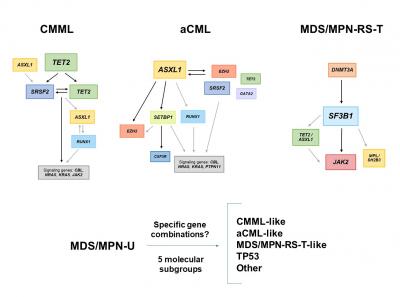
Laura Palomo and her colleagues from the MDS Group coordinated by Francesc Solé, from the Josep Carreras Leukaemia Research Institute, in a study led by Torsten Haferlach and his team from the Munich Leukemia Laboratory (MLL), have recently published a study in the Journal Blood that reveals the molecular landscape of these diseases and the combination of genes exclusively mutated in each of these rare neoplasms. These findings provide a useful tool to complement current diagnostic workup in MDS/MPN patients.

“In previous studies, over 90% of MDS/MPN harbored somatic mutations in a group of known genes, which are related to their pathophysiological features and play a role in their clinical heterogeneity, but none of them was specific of MDS/MPN. In our study, made with whole-genome data from a cohort of 367 patients with MDS/MPN, we identified genotype-phenotype associations and potential diagnostic and prognostic molecular markers that could translate to medical practice. We also wanted to provide novel insights into the clonal hierarchy of mutations of MDS/MPN.” Says Laura Palomo.

Researchers found recurrent combinations of mutations exclusive to some extent to CMML, aCML, and MDS/MPN-RS-T, while MDS/MPN-U show heterogeneous features that overlap with the other MDS/MPN, but that can be classified according to their molecular profile. For Palomo, “It is imperative to include targeted DNA sequencing techniques in clinical hematology laboratories to improve the diagnosis and risk stratification of these hematological malignancies.”

This project is part of an international effort from the MLL, the 5000 Genomes Project. This project includes whole-genome and transcriptome sequencing of 5000 patients with hematological neoplasms and is funded by the Torsten Haferlach Leukämie Diagnostikstiftung.

###

Media Contact
Isabel Troytiño
[email protected]

Related Journal Article

http://dx.doi.org/10.1182/blood.2019004229

Tags: Biomedical/Environmental/Chemical EngineeringCell BiologyDiagnosticsGenesGeneticsHematologyMedicine/HealthMolecular Biology
Share12Tweet8Share2ShareShareShare2

Related Posts

Barriers and Boosters of Seniors’ Physical Activity in Karachi

February 7, 2026

Evaluating Pediatric Emergency Care Quality in Ethiopia

February 7, 2026

TPMT Expression Predictions Linked to Azathioprine Side Effects

February 7, 2026

Improving Dementia Care with Enhanced Activity Kits

February 7, 2026
Please login to join discussion

POPULAR NEWS

  • Robotic Ureteral Reconstruction: A Novel Approach

    Robotic Ureteral Reconstruction: A Novel Approach

    82 shares
    Share 33 Tweet 21
  • Digital Privacy: Health Data Control in Incarceration

    63 shares
    Share 25 Tweet 16
  • Study Reveals Lipid Accumulation in ME/CFS Cells

    57 shares
    Share 23 Tweet 14
  • Breakthrough in RNA Research Accelerates Medical Innovations Timeline

    53 shares
    Share 21 Tweet 13

About

We bring you the latest biotechnology news from best research centers and universities around the world. Check our website.

Follow us

Recent News

Barriers and Boosters of Seniors’ Physical Activity in Karachi

Evaluating Pediatric Emergency Care Quality in Ethiopia

TPMT Expression Predictions Linked to Azathioprine Side Effects

Subscribe to Blog via Email

Enter your email address to subscribe to this blog and receive notifications of new posts by email.

Join 73 other subscribers
  • Contact Us

Bioengineer.org © Copyright 2023 All Rights Reserved.

Welcome Back!

Login to your account below

Forgotten Password?

Retrieve your password

Please enter your username or email address to reset your password.

Log In
No Result
View All Result
  • Homepages
    • Home Page 1
    • Home Page 2
  • News
  • National
  • Business
  • Health
  • Lifestyle
  • Science

Bioengineer.org © Copyright 2023 All Rights Reserved.