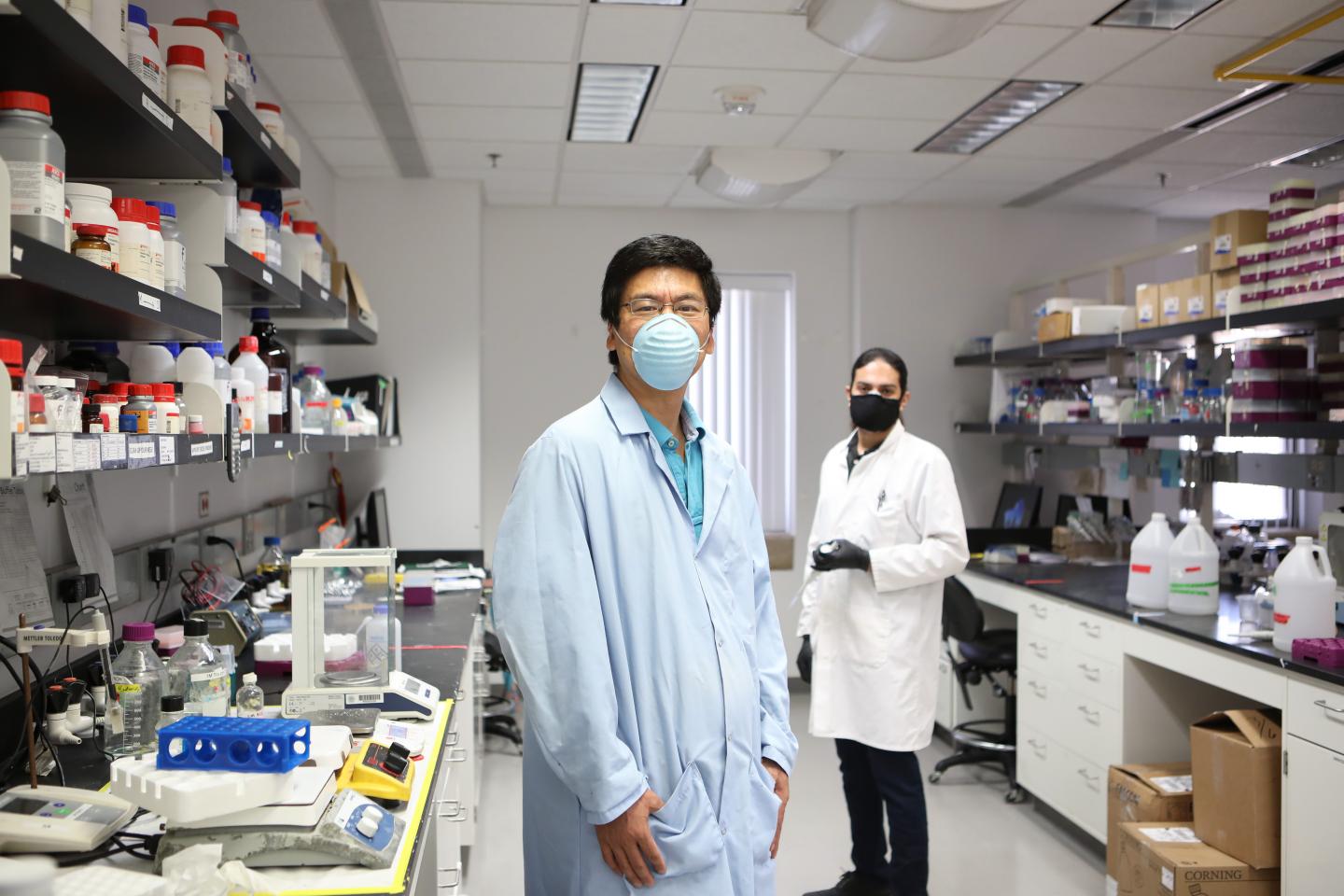
Credit: J.R. Hernandez / UTEP Communications
EL PASO, Texas – Biology students and faculty members from The University of Texas at El Paso have discovered a new target for tuberculosis drug development. Their study recently was published in the Journal of Biological Chemistry, a publication of the American Society of Biochemistry and Molecular Biology (ASBMB).
Jianjun Sun, Ph.D., associate professor in UTEP’s Department of Biological Sciences, led the research on Mycobacterium tuberculosis (Mtb), the bacterial pathogen that causes tuberculosis diseases, or TB.
TB is one of the leading infectious diseases in the world. Development of novel therapeutics against TB is urgently needed. Sun’s lab has been investigating the mechanisms of Mtb pathogenesis for more than 10 years at UTEP with a specific focus on EsxA, which is a virulence factor essential for Mtb virulence and a preferred target for developing novel anti-TB drugs and vaccines.
During infection, Mtb is “eaten up” by human immune cells. Normally, the bacteria are killed within the immune cells, but Mtb releases virulence factors, such as EsxA, to disarm the host’s immune defense. The study discovered that the Nα-acetylation of EsxA can drastically affect the course of the infection.
“This research was technically challenging, but the students were able to overcome the challenges and accomplished the goals,” Sun said. “All the hard work from the students and collaborators has finally come together to contribute a beautiful story in the prestigious Journal of Biological Chemistry from ASBMB.”
The study had many collaborators including Javier Aguilera, a doctoral student in Sun’s lab who is supported by the Research Initiative for Scientific Enhancement (RISE) Program. Other contributors include Salvador Vazquez-Reyes, a doctoral student in Sun’s lab, and Qi Zhang, Ph.D., a previous postdoctoral fellow in Sun’s lab.
“Knowing this work has a great impact in the TB research feels great,” Aguilera said. “Although it resulted in so many late nights of hard work and headaches for so many people, the end result was very well worth it!”
The study benefited from a collaboration with Lin Li, Ph.D., assistant professor of computational biophysics and bioinformatics in UTEP’s Department of Physics. Chitra B. Karki, a doctoral student in Li’s lab, provided help with molecular dynamic simulations to model the effects of Nα-acetylation on EsxA function. Igor Estevao and Brian I. Grajeda, from the Proteomics Analysis Core Facility of UTEP’s Border Biomedical Research Center, helped to identify the Nα-acetylation by using state-of-the-art mass spectrometry. Hugues Ouellet, Ph.D., associate professor of biological sciences, and his doctoral student Chenoa D. Arico assisted with mycobacterial biology and protein binding measurements.
###
Sun’s lab is supported by a grant from the National Institute of General Medical Sciences.
To read to the full article, visit: https:/
The University of Texas at El Paso is one of the largest and most successful Hispanic-serving institutions in the country, with a student body that is over 80% Hispanic. It enrolls more than 25,000 students in 167 bachelor’s, master’s and doctoral programs in 10 colleges and schools. With more than $100 million in total annual research expenditures, UTEP is ranked in the top 5% of research institutions nationally and fifth in Texas for federal research expenditures at public universities.
Media Contact
Victor H. Arreola
[email protected]
Related Journal Article
http://dx.