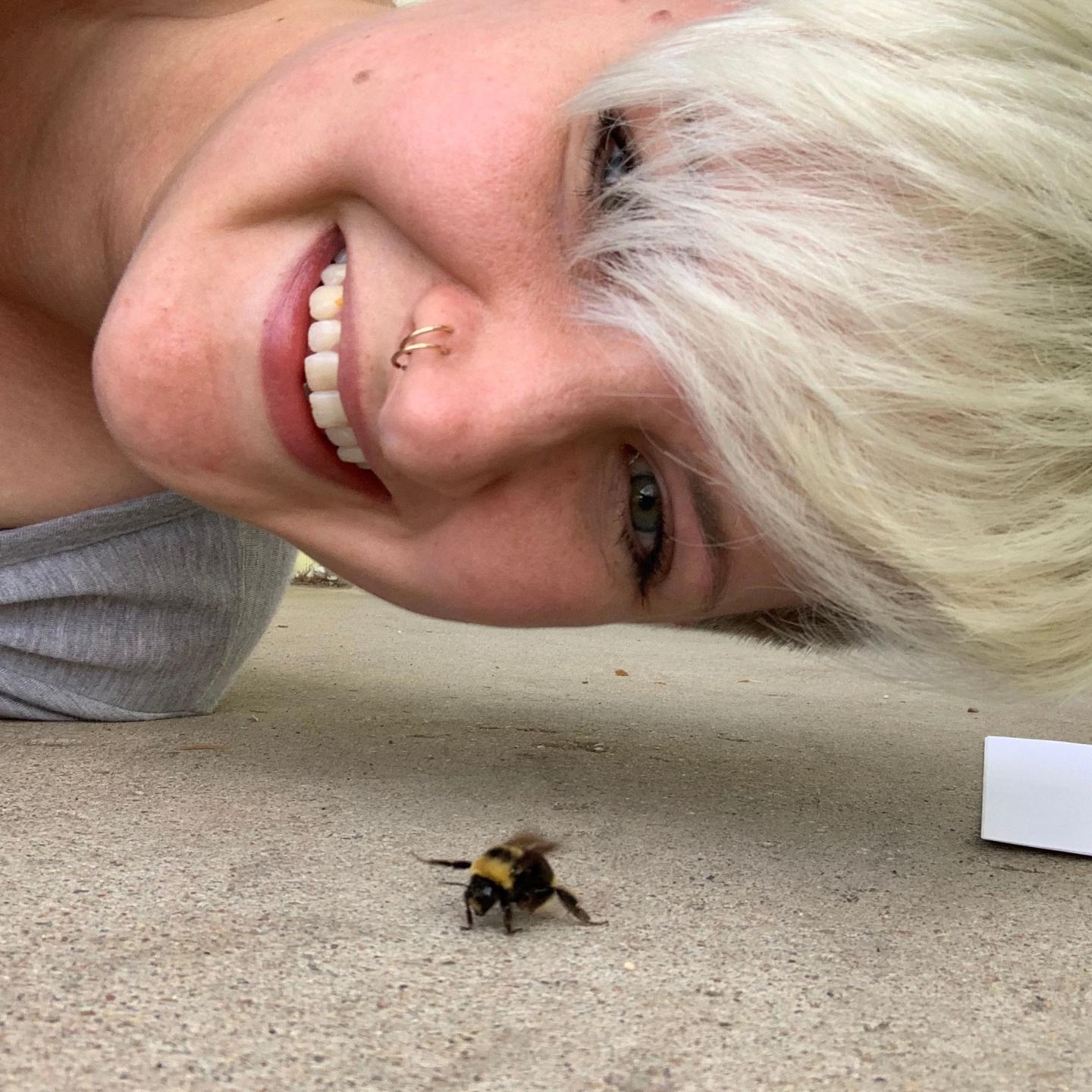
Credit: Christy Bell
A University of Wyoming researcher and her Ph.D. student have spent the last three years studying the decline of the Western bumblebee. The two have been working with a group of bumblebee experts to fill in gaps of missing information from previous data collected in the western United States. Their goal is to provide information on the Western bumblebee to the U.S. Fish and Wildlife Service while it considers listing this species under the U.S. Endangered Species Act.
“The decline of the Western bumblebee is likely not limited to one culprit but, instead, due to several factors that interact such as pesticides, pathogens, climate change and habitat loss,” says Lusha Tronstad, lead invertebrate zoologist with the Wyoming Natural Diversity Database (WYNDD). “Western bumblebees were once the most abundant bumblebees on the West Coast of the U.S., but they are much less frequently observed there now. Pathogens (or parasites) are thought to be a major reason for their decline.”
Tronstad and Christy Bell, her Ph.D. student in the Department of Zoology and Physiology, from Laramie, are co-authors of a paper, titled “Western Bumble Bee: Declines in the United States and Range-Wide Information Gaps,” that was published online June 26 in Ecosphere, a journal that publishes papers from all subdisciplines of ecological science, as well as interdisciplinary studies relating to ecology.
The two are co-authors because they are members of the Western Bumble Bee Working Group and serve as experts of the Western bumblebee in Wyoming, Tronstad says.
Other contributors to the paper are from the U.S. Geological Survey; U.S. Fish and Wildlife Service; Canadian Wildlife Service; Xerces Society for Invertebrate Conservation in Portland, Ore.; British Columbia Ministry of Environment and Climate Change Strategy; University of Hawaii-Hilo; U.S. Department of Agriculture; The Institute for Bird Populations; University of Vermont; Utah State University; Ohio State University; Denali National Park and Preserve; and the Royal Saskatchewan Museum.
This paper is the result of the Western Bumble Bee Working Group, which is a group of experts on this species who came together to assemble the state of knowledge on this species in the United States and Canada, Tronstad says. The paper shows both what is known and knowledge gaps, specifically in the lack of samples and lack of knowledge about the species. Some prime examples of where spatial gaps in limited sampling exist include most of Alaska, northwestern Canada and the southwestern United States.
“Some areas in the U.S. have less bumblebee sampling in the past and present,” Tronstad explains. “This could be for a variety of reasons such as lack of funding for such inventories, lack of bee expertise in that state, etc.”
Using occupancy modeling, the probability of detecting the Western bumblebee decreased by 93 percent from 1998-2018, Tronstad says. Occupancy modeling is a complex model that estimates how often the Western bumblebee was detected from sampling events between 1998-2018 in the western United States.
“The data we assembled will be used by the U.S. Fish and Wildlife Service to inform its decision on whether or not to protect the Western bumblebee under the U.S. Endangered Species Act,” Tronstad says. “At WYNDD, we collect data, and that data is used by managers. Our mission is to provide the most up-to-date data on which management decisions can be based.”
Tronstad says there are several things that homeowners or landowners can do to help this species of bumblebee survive and thrive. These include:
- Plant flowers that bloom throughout the summer. Make sure these flowers have pollen and produce nectar, and are not strictly ornamental.
- Provide a water source for bees. Tronstad says she adds a piece of wood to all of her stock tanks so bees can safely get a drink.
- Provide nesting and overwintering habitat. Most bumblebees nest in the ground, so leaving patches of bare ground covered with litter or small mammal holes will benefit these bees. Be sure not to work these areas until after you see large bumblebees (queen bees) buzzing around in the spring, usually in April for much of Wyoming, so you can find out where they are nesting.
Tronstad says Bell’s research will continue this summer, as Bell will investigate pathogens in the Rocky Mountains of Wyoming that affect Western bumblebees there. Max Packebush, a UW sophomore majoring in microbiology and molecular biology, from Littleton, Colo.; and Matt Green, a 2018 UW graduate from Camdenton, Mo., will assist Bell in her research. NASA and the Wyoming Research Scholars Program will fund Packebush to conduct his work.
The U.S. Geological Survey and the U.S. Fish and Wildlife Service funded the research for this paper.
###
Media Contact
Lusha Tronstad
[email protected]
Original Source
http://www.
Related Journal Article
http://dx.