• HOME
  • NEWS
  • EXPLORE
    • CAREER
      • Companies
      • Jobs
    • EVENTS
    • iGEM
      • News
      • Team
    • PHOTOS
    • VIDEO
    • WIKI
  • BLOG
  • COMMUNITY
    • FACEBOOK
    • INSTAGRAM
    • TWITTER
Saturday, February 7, 2026
BIOENGINEER.ORG
No Result
View All Result
  • Login
  • HOME
  • NEWS
  • EXPLORE
    • CAREER
      • Companies
      • Jobs
        • Lecturer
        • PhD Studentship
        • Postdoc
        • Research Assistant
    • EVENTS
    • iGEM
      • News
      • Team
    • PHOTOS
    • VIDEO
    • WIKI
  • BLOG
  • COMMUNITY
    • FACEBOOK
    • INSTAGRAM
    • TWITTER
  • HOME
  • NEWS
  • EXPLORE
    • CAREER
      • Companies
      • Jobs
        • Lecturer
        • PhD Studentship
        • Postdoc
        • Research Assistant
    • EVENTS
    • iGEM
      • News
      • Team
    • PHOTOS
    • VIDEO
    • WIKI
  • BLOG
  • COMMUNITY
    • FACEBOOK
    • INSTAGRAM
    • TWITTER
No Result
View All Result
Bioengineer.org
No Result
View All Result
Home NEWS Science News

Anammox bacteria generate energy from wastewater while taking a breath

Bioengineer by Bioengineer
June 29, 2020
in Science News
Reading Time: 3 mins read
0
IMAGE
Share on FacebookShare on TwitterShare on LinkedinShare on RedditShare on Telegram

IMAGE

Credit: © 2020 KAUST

A type of anaerobic bacteria responsible for more than 50 percent of nitrogen loss from marine environments has been shown to use solid-state matter present outside their cells for respiration. The finding by KAUST researchers adds to knowledge of the global nitrogen cycle and has important energy-saving potential for wastewater treatment.

Living organisms use oxidation/reduction reactions to harvest the energy they need for survival. This involves the transfer of electrons from an electron donor to an electron acceptor with energy generation. In humans, electrons are released from the food we digest and accepted by soluble oxygen inside our cells. But in many bacteria, other strategies are used for oxidation/reduction, with different types of electron donors and acceptors.

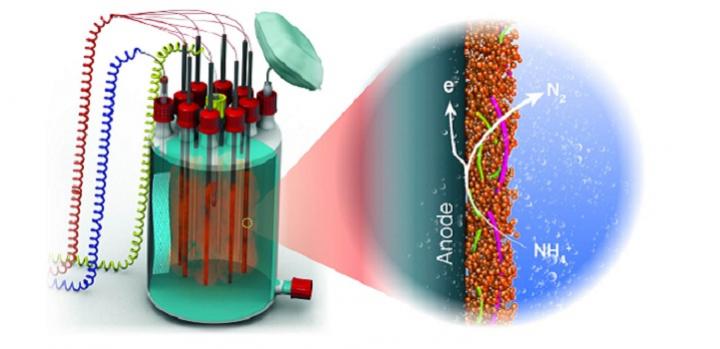
Anammox are anaerobic bacteria found in oxygen-lacking marine and freshwater environments, such as sediments. They derive energy by using ammonium as their electron donor and intracellular soluble nitrite as the acceptor, with the release of nitrogen gas–or so scientists thought.

“We found that freshwater and marine anammox bacteria can also transfer electrons from ammonium to extracellular electron acceptors, like graphene oxide or electrodes in microbial electrolysis cells,” says Ph.D. student, Dario Shaw. This novel extracellular electron transfer by anammox bacteria had been conjectured by scientists for more than a decade, but had not been properly explored.

Environmental biotechnologist Pascal Saikaly led a team that found, by looking into the anammox genome, that these bacteria had iron-containing proteins called cytochromes that are also present in types of bacteria known for their ability to transport electrons outside their cells. “We wanted to know if anammox bacteria could also perform extracellular electron transfer,” says Saikaly.

They found that electrons were transferred from ammonium inside the bacteria to solid-state matter outside the cell. For this to happen, the electrons crossed three different barriers, starting from inside an anammox cellular organelle called the anammoxosome. “This means that we have demonstrated for the first time a type of bacteria that can transfer electrons through three different membranes,” says Saikaly. “This finding challenges our perceptions of cell biology.”

“Our findings are a breakthrough in the fields of microbial ecology, bioelectrochemistry and sustainable wastewater treatment,” adds Shaw. Anammox bacteria are already used to make wastewater reusable by removing ammonium. They save energy compared to the conventional use of aerobic bacteria, which require oxygen as the electron acceptor for ammonium oxidation. Providing oxygen through an aeration system requires a lot of energy. Anammox bacteria used for wastewater treatment do not need oxygen, but they do currently need nitrite as the electron acceptor. This is provided by another type of bacteria that needs oxygen, and thus energy, to produce it.

The new finding suggests that anammox alone could be used for ammonium removal, while also producing energy in the form of an electric current or energy-rich hydrogen gas in microbial electrolysis cells.

###

Media Contact
Carolyn Unck
[email protected]

Original Source

https://discovery.kaust.edu.sa/en/article/988/anammox-bacteria-generate-energy-from-wastewater-while-taking-a-breath

Related Journal Article

http://dx.doi.org/10.1038/s41467-020-16016-y

Tags: BiologyBiomedical/Environmental/Chemical EngineeringBiotechnologyHydrology/Water ResourcesPollution/Remediation
Share13Tweet8Share2ShareShareShare2

Related Posts

Evaluating Pediatric Emergency Care Quality in Ethiopia

February 7, 2026

TPMT Expression Predictions Linked to Azathioprine Side Effects

February 7, 2026

Improving Dementia Care with Enhanced Activity Kits

February 7, 2026

Decoding Prostate Cancer Origins via snFLARE-seq, mxFRIZNGRND

February 7, 2026
Please login to join discussion

POPULAR NEWS

  • Robotic Ureteral Reconstruction: A Novel Approach

    Robotic Ureteral Reconstruction: A Novel Approach

    82 shares
    Share 33 Tweet 21
  • Digital Privacy: Health Data Control in Incarceration

    63 shares
    Share 25 Tweet 16
  • Study Reveals Lipid Accumulation in ME/CFS Cells

    57 shares
    Share 23 Tweet 14
  • Breakthrough in RNA Research Accelerates Medical Innovations Timeline

    53 shares
    Share 21 Tweet 13

About

We bring you the latest biotechnology news from best research centers and universities around the world. Check our website.

Follow us

Recent News

Evaluating Pediatric Emergency Care Quality in Ethiopia

TPMT Expression Predictions Linked to Azathioprine Side Effects

Improving Dementia Care with Enhanced Activity Kits

Subscribe to Blog via Email

Success! An email was just sent to confirm your subscription. Please find the email now and click 'Confirm' to start subscribing.

Join 73 other subscribers
  • Contact Us

Bioengineer.org © Copyright 2023 All Rights Reserved.

Welcome Back!

Login to your account below

Forgotten Password?

Retrieve your password

Please enter your username or email address to reset your password.

Log In
No Result
View All Result
  • Homepages
    • Home Page 1
    • Home Page 2
  • News
  • National
  • Business
  • Health
  • Lifestyle
  • Science

Bioengineer.org © Copyright 2023 All Rights Reserved.