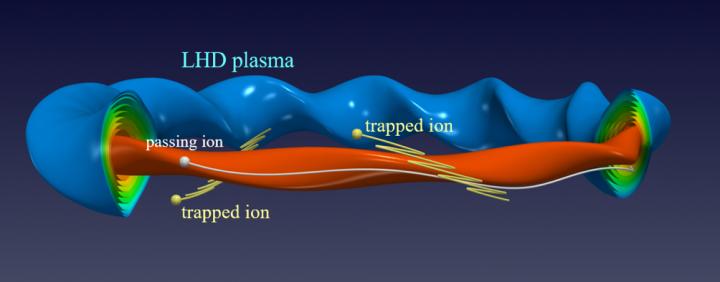
Credit: National Institute for Fusion Science
The research team of Assistant Professor Masahiko Sato and Professor Yasushi Todo of the National Institutes of Natural Sciences (NINS) National Institute for Fusion Science (NIFS) has succeeded using computer simulation in reproducing the high-pressure plasma confinement observed in the Large Helical Device (LHD). This result has enabled highly accurate predictions of plasma behavior aimed at realizing an economical helical fusion reactor.
In order to realize fusion energy, we must confine high pressure plasma using the magnetic field for a long duration. Although higher pressure plasma can be confined by a stronger magnetic field, it costs more to generate a stronger magnetic field using electromagnetic coils. Therefore, if the magnetic field strength is the same, a device that can confine higher pressure plasma is economically desirable. Because the LHD has succeeded in maintaining high-pressure plasma, there is great expectation in realizing a helical fusion reactor.
Design research for a future fusion reactor is performed based on computer simulations predicting the behavior of magnetically confined plasma. We require highly accurate simulations. To confirm the accuracy, the simulations are required to reproduce the experimental results obtained by the existing devices. However, the simulations had not reproduced the experimental results obtained by the LHD showing that high-pressure plasma is maintained. This has been a serious problem for the design research for an economical helical fusion reactor.
Simulations of high-pressure plasma in the LHD had been performed using a model in which the plasma is treated as a fluid. In this fluid model, the motion averaged over many ions consisting the plasma is calculated, and the difference among many ions with various velocities are neglected. At NIFS, a program that calculates individual motions of many ions was developed to improve the simulation accuracy. This program, which is called “the hybrid simulation program,” has been used to study energetic ions that will play an important role in sustaining high-temperature plasma in a future fusion reactor.
Assistant Professor Masahiko Sato and Professor Yasushi Todo attempted to reproduce high-pressure plasma confinement in the LHD by using the hybrid simulation program. They focused on the ions moving back-and-forth, which are called “trapped ions” (Image 1) and whose motion is a characteristic of the LHD. To investigate the effect of the trapped ions, the researchers studied the long-time evolution of plasma pressure and tens of millions of ions including millions of trapped ions. Although such a simulation requires enormous amounts of calculations, the researchers, by making full use of “Plasma Simulator” (the supercomputer owned by NIFS), has succeeded in reproducing the LHD experimental result showing that high-pressure plasma is maintained (Image 2). From the detailed analysis of the simulation data, it has been found that the trapped ions greatly contribute to the stable confinement of high-pressure plasma by suppressing the fluctuations that can cause the reduction of plasma pressure.
Thus, the research team has significantly improved the prediction accuracy of high-pressure plasma in a future helical fusion reactor. It is expected that the design research aimed at an economical helical reactor will be accelerated based on this study.
This research result was published as Sato and Todo “Ion kinetic effects on linear pressure driven MHD instabilities in helical plasmas” in Journal of Plasma Physics in June 2020.
###
Media Contact
Kentaro Yaji
[email protected]
Related Journal Article
http://dx.