• HOME
  • NEWS
  • EXPLORE
    • CAREER
      • Companies
      • Jobs
    • EVENTS
    • iGEM
      • News
      • Team
    • PHOTOS
    • VIDEO
    • WIKI
  • BLOG
  • COMMUNITY
    • FACEBOOK
    • INSTAGRAM
    • TWITTER
Thursday, December 25, 2025
BIOENGINEER.ORG
No Result
View All Result
  • Login
  • HOME
  • NEWS
  • EXPLORE
    • CAREER
      • Companies
      • Jobs
        • Lecturer
        • PhD Studentship
        • Postdoc
        • Research Assistant
    • EVENTS
    • iGEM
      • News
      • Team
    • PHOTOS
    • VIDEO
    • WIKI
  • BLOG
  • COMMUNITY
    • FACEBOOK
    • INSTAGRAM
    • TWITTER
  • HOME
  • NEWS
  • EXPLORE
    • CAREER
      • Companies
      • Jobs
        • Lecturer
        • PhD Studentship
        • Postdoc
        • Research Assistant
    • EVENTS
    • iGEM
      • News
      • Team
    • PHOTOS
    • VIDEO
    • WIKI
  • BLOG
  • COMMUNITY
    • FACEBOOK
    • INSTAGRAM
    • TWITTER
No Result
View All Result
Bioengineer.org
No Result
View All Result
Home NEWS Science News Chemistry

3D magnetotelluric imaging reveals magma recharging beneath Weishan volcano

Bioengineer by Bioengineer
June 29, 2020
in Chemistry
Reading Time: 2 mins read
0
IMAGE
Share on FacebookShare on TwitterShare on LinkedinShare on RedditShare on Telegram

IMAGE

Credit: GAO Ji et al.

A collaborative research team from University of Science and Technology of China (USTC) of the Chinese Academy of Sciences (CAS) and China Geological Survey (CGS) have succeeded in obtaining a high-resolution 3D resistivity model of approximately 20 km depth beneath the Weishan volcano in the Wudalianchi volcanic field (WVF) for the first time. The study, published in Geology, revealed the image of potential magma chambers and the estimated melt fractions.

WVF in the northeast of China, comprised of 14 volcanoes that have erupted about 300 years ago, is one of the largest active volcanic areas. Volcanic activities are hazard to human life and have severe environmental consequences, thus it is important to characterize the magmatic system beneath the volcanoes to understand the nature of the eruption.

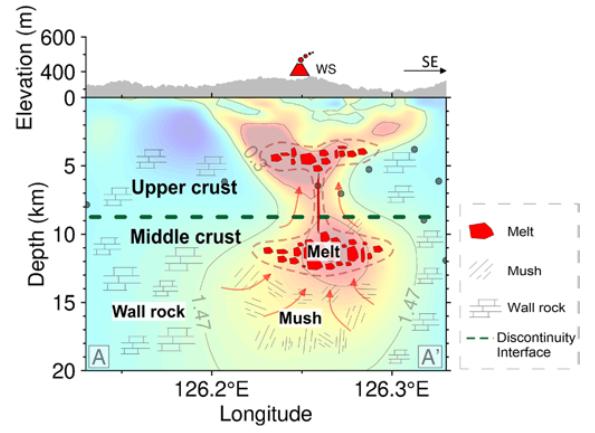
In conjunction with the Center for Hydrogeology and Environmental Geology, CGS, Prof. ZHANG Jianghai’s group from School of Earth and Space Sciences, USTC, utilized magnetotelluric (MT) methods to image magma reservoirs beneath Weishan volcano and obtained its high-resolution spatial resistivity distribution up to 20 km deep. Their findings showed the existence of vertically distributed low-resistivity anomalies that are narrowest in the middle. This was further interpreted as magma reservoirs existing both in the upper crust and the middle crust, which are linked by very thin vertical channels for magma upwelling.

Meanwhile, they cooperated with Institute of Geodesy and Geophysics of CAS, combining both the velocity model from ambient noise tomography (ANT) and the resistivity model from MT imaging to estimate that the melt fractions of the magma reservoirs in the upper crust and the middle crust are reliably to be >~15%. This phenomenon demonstrated that there should be an even deeper source for recharging the magma chambers to keep the melt fraction increasing, and indicated that the volcano is still active.

Considering the significant melt fractions and the active earthquakes and tremors occurred around the magma reservoirs several years ago, the Weishan volcano is likely in an active stage with magma recharging. Although the melt fraction does not reach the eruption threshold (~40%), it is necessary to increase monitoring capabilities to better forecasting its potential future eruptions.

Overall, this study has revealed that the volcanoes in northeast China may be in an active stage. This poses a grave threat to man and environment, thus proper monitoring is required to forecast its hazardous implications.

###

Media Contact
Jane FAN Qiong
[email protected]

Original Source

http://english.cas.cn/newsroom/research_news/earth/202006/t20200627_239220.shtml

Related Journal Article

http://dx.doi.org/10.1130/G47531.1

Tags: Earth ScienceGeology/SoilGeophysics/Gravity
Share12Tweet8Share2ShareShareShare2

Related Posts

Cutting Electrolyte Reduction Boosts High-Energy Battery Performance

Cutting Electrolyte Reduction Boosts High-Energy Battery Performance

December 19, 2025
Microenvironment Shapes Gold-Catalysed CO2 Electroreduction

Microenvironment Shapes Gold-Catalysed CO2 Electroreduction

December 11, 2025

Photoswitchable Olefins Enable Controlled Polymerization

December 11, 2025

Cation Hydration Entropy Controls Chloride Ion Diffusion

December 10, 2025
Please login to join discussion

POPULAR NEWS

  • Nurses’ Views on Online Learning: Effects on Performance

    Nurses’ Views on Online Learning: Effects on Performance

    70 shares
    Share 28 Tweet 18
  • NSF funds machine-learning research at UNO and UNL to study energy requirements of walking in older adults

    71 shares
    Share 28 Tweet 18
  • Unraveling Levofloxacin’s Impact on Brain Function

    54 shares
    Share 22 Tweet 14
  • Exploring Audiology Accessibility in Johannesburg, South Africa

    51 shares
    Share 20 Tweet 13

About

We bring you the latest biotechnology news from best research centers and universities around the world. Check our website.

Follow us

Recent News

Transforming Art: Fusion GANs for Style Conversion

Navigating Dementia Care: Transitions in Home Management

ERO1A Enhances Bladder Cancer Growth via JAK-STAT

Subscribe to Blog via Email

Enter your email address to subscribe to this blog and receive notifications of new posts by email.

Join 70 other subscribers
  • Contact Us

Bioengineer.org © Copyright 2023 All Rights Reserved.

Welcome Back!

Login to your account below

Forgotten Password?

Retrieve your password

Please enter your username or email address to reset your password.

Log In
No Result
View All Result
  • Homepages
    • Home Page 1
    • Home Page 2
  • News
  • National
  • Business
  • Health
  • Lifestyle
  • Science

Bioengineer.org © Copyright 2023 All Rights Reserved.