Credit: Javier Ortega-Hernández and Yu Liu
The Chengjiang biota in the Yunnan Province of China contains one of the most species-rich and well-preserved fossiliferous deposits for the early Cambrian (ca. 518 million years old), including numerous arthropod species. However, several Chengjiang arthropods have an unfamiliar morphology, are extremely rare, or are incompletely preserved, which often leads to many of these species being problematic, poorly known, or often both, thus hindering their contribution towards reconstructing the evolution of this major animal group.
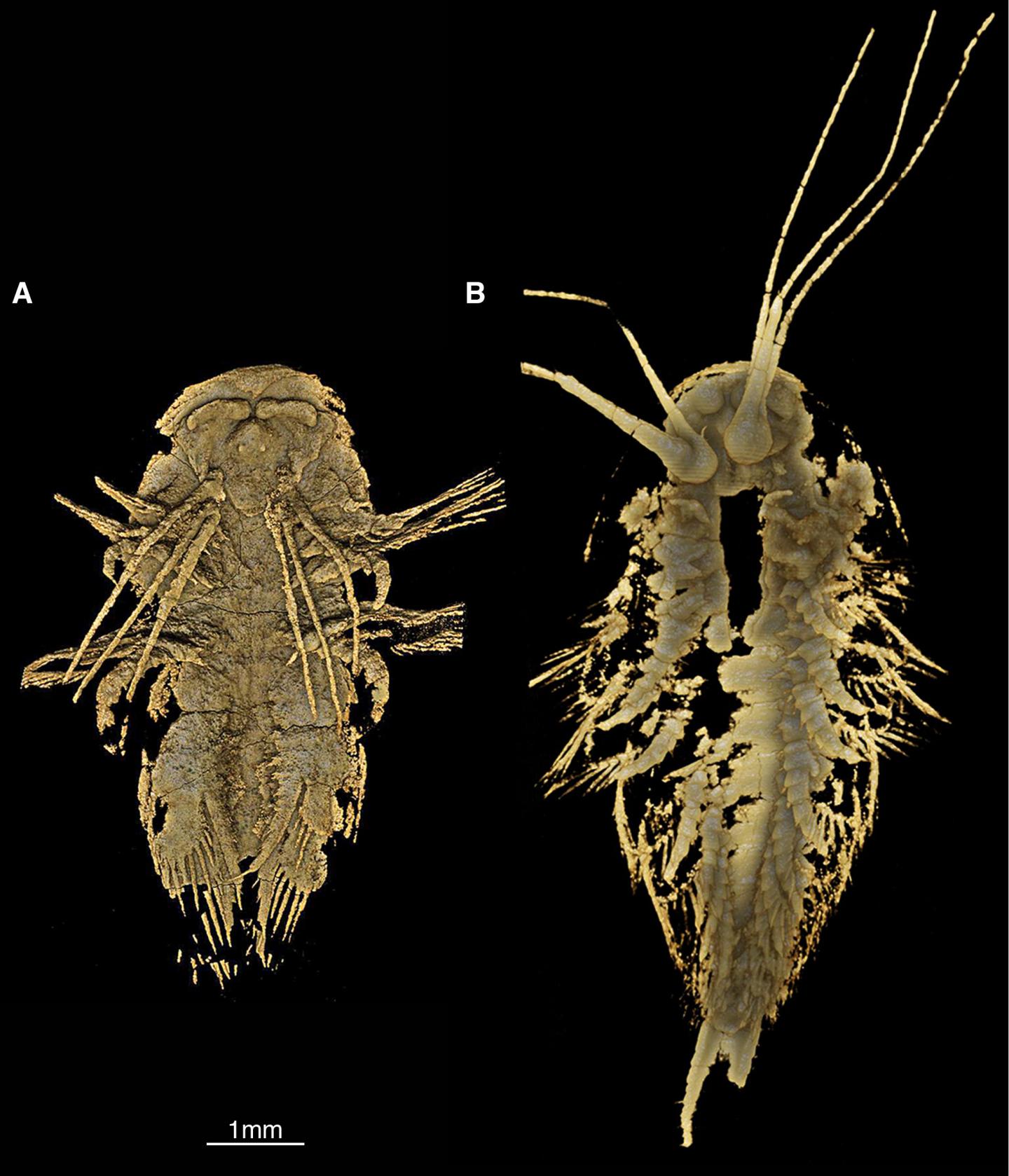
Javier Ortega-Hernández, Assistant Professor in the Department of Organismic and Evolutionary Biology and Curator of Invertebrate Paleontology in the Museum of Comparative Zoology at Harvard University, and Yu Liu, Professor of Paleobiology, Yunnan University, China have collaborated for years in the study of Chengjiang arthropods and their evolutionary significance. Their latest paper in Current Biology shows with unprecedented clarity the head morphology of the species Leanchoilia illecebrosa – a member of Megacheira, a major extinct group characterized by distinctively raptorial great appendages. Ortega-Hernández’s and Liu’s reexamination of Leanchoilia demonstrates the presence of a labrum – a flap-like structure overlying the mouth opening in most modern arthropods – and offers renewed support to the hypothesis that megacheirans are distant relatives of modern chelicerates (e.g. horseshoe crabs, scorpions and spiders).
Ortega-Hernández and Liu used microCT, a technique that uses X-rays to visualize features that are not easily observable on the surface of the fossils, to study the organization of the head in small juveniles of Leanchoilia illecebrosa. With microCT they were able to understand the head in greater detail than ever before, and discover features that refute previously believed hypotheses.
“The biggest surprise came when studying structures close to the mouth,” said Ortega-Hernández. “Until now, the very existence of a labrum in megacheirans, and its position relative to the mouth, have been the source of heated debate. In living arthropods the labrum is considered an important feature of the head because of its precise origin during embryonic development. The 3D data on Leanchoilia allowed us to show for the first time and with great clarity that this animal indeed had a labrum. This is a useful discovery because researchers have argued with each other whether a labrum was present or not in this and other closely related species, which has prompted very different interpretations about their evolution and affinities.”
The paper is the fifth in a series of publications that represent an ongoing collaboration between the research groups led by Ortega-Hernández and Liu. This study along with others in Current Biology (v29:1, 2019), BMC Evolutionary Biology (v19, 2019, and v20, 2020), and Geological Magazine (March 27, 2020) consists of the study, and often restudy, of exceptional arthropod fossils from the early Cambrian (ca. 518 million years ago) using microCT to reveal exceptional details of the preserved anatomy that are completely inaccessible through conventional preparation tools.
“With microCT we can discern between the iron-rich fossils and the iron-depleted rock matrix to produce highly detailed and informative virtual models in 3D that reveal their affinities, ecology and evolutionary significance,” said Ortega-Hernández. “Although each publication is a bit different and tells a distinct story for the early evolution of arthropods, they all follow the same overall goal and structure, and use similar techniques and methodology.”
“We have several ongoing projects as part of this collaboration, including many new and exciting species, as well as re-descriptions of some old favorites,” said Ortega-Hernández. “There are certainly a few pleasant surprises, and we expect that this collaboration will continue yielding high-quality morphological information for several years, as we have only started to scratch the surface.” The ongoing project is partially funded by the Harvard China Fund.
###
Article and author details
Yu Liu, Javier Ortega-Hernández, Dayou Zhai, and Xianguang Hou. 2020. A Reduced Labrum in a Cambrian Great-Appendage Euarthropod. Current Biology 30, .
doi: 10.1016/j.cub.2020.05.085
Corresponding authors
Yu Liu, [email protected]
Javier Ortega-Hernández, [email protected]
Media Contact
Wendy Heywood
[email protected]
Original Source
https:/
Related Journal Article
http://dx.