Heidelberg researchers develop new method and demonstrate its application in experiments
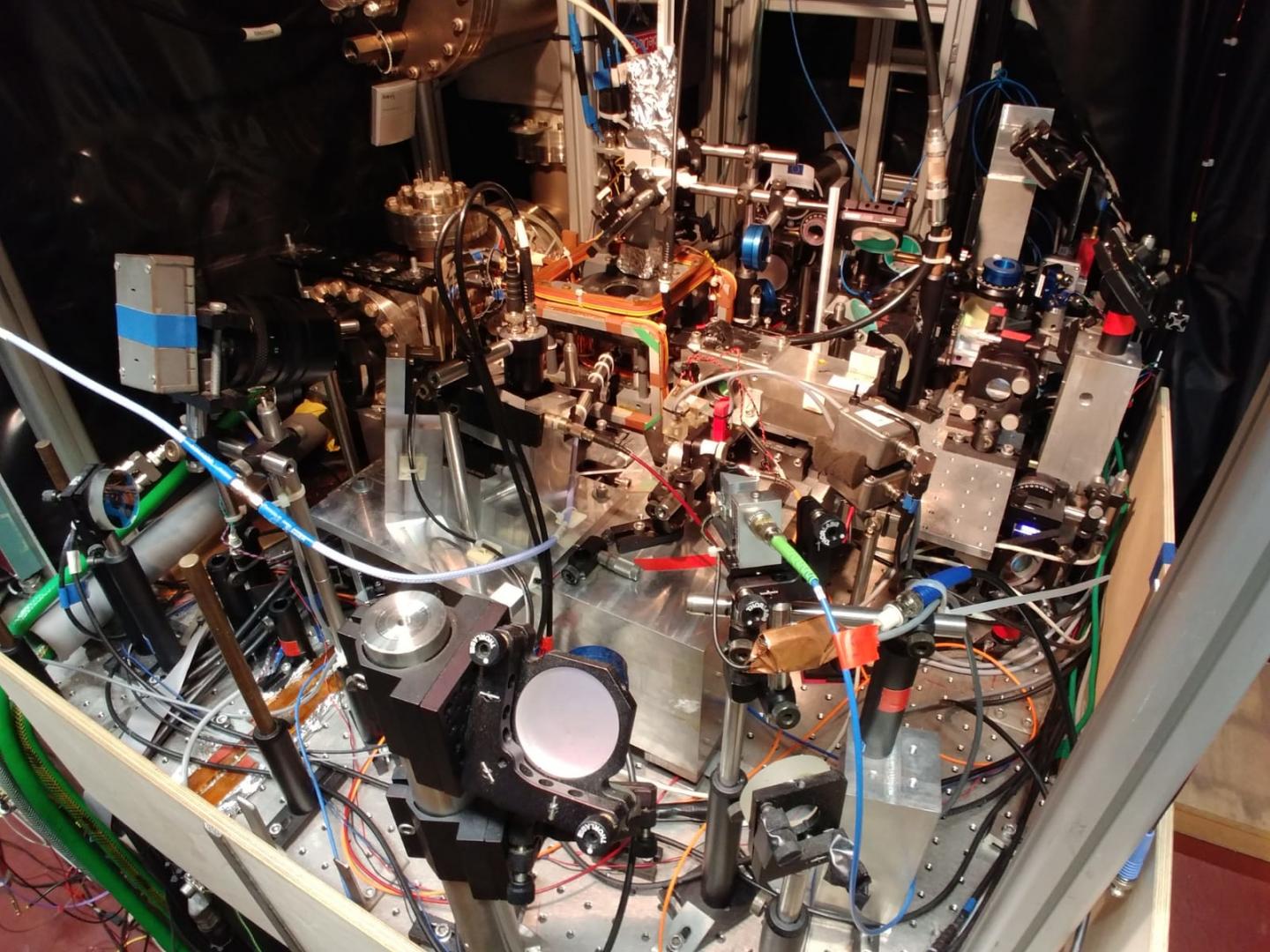
Credit: Photo: Alexis Bonnin
One goal of science is to find physical descriptions of nature by studying how basic system components interact with one another. For complex many-body systems, effective theories are frequently used to this end. They allow describing the interactions without having to observe a system on the smallest of scales. Physicists at Heidelberg University have now developed a new method that makes it possible to identify such theories experimentally with the aid of so-called quantum simulators. The results of the research effort, led by Prof. Dr Markus Oberthaler (experimental physics) and Prof. Dr Jürgen Berges (theoretical physics), were published in the journal “Nature Physics“.
Deriving predictions about physical phenomena at the level of individual particles from a microscopic description is practically impossible for large systems. This applies not only to quantum mechanical many-body systems, but also to classical physics, such as when heated water in a cooking pot needs to be described at the level of the individual water molecules. But if a system is observed on large scales, like water waves in a pot, new properties can become relevant under certain preconditions. To describe such physics efficiently, effective theories are used. “Our research aimed to identify these theories in experiments with the help of quantum simulators,” explains Torsten Zache, the primary author of the theoretical portion of the study. Quantum simulators are used to modify many-body systems more simply and to calculate their properties.
The Heidelberg physicists recently demonstrated their newly developed method in an experiment on ultracold rubidium atoms, which are captured in an optical trap and brought out of equilibrium. “In the scenario we prepared, the atoms behave like tiny magnets whose orientation we are able to precisely read out using new processes,” according to Maximilian Prüfer, the primary author on the experimental side of the study. To determine the effective interactions of these “magnets”, the experiment has to be repeated several thousand times, which requires extreme stability.
“The underlying theoretical concepts allow us to interpret the experimental results in a completely new way and thereby gain insights through experiments into areas that have thus far been inaccessible through theory,” points out Prof. Oberthaler. “In turn, this can tell us about new types of theoretical approaches to successfully describe the relevant physical laws in complex many-body systems,” states Prof. Berges. The approach used by the Heidelberg physicists is transferrable to a number of other systems, thus opening groundbreaking territory for quantum simulations. Jürgen Berges and Markus Oberthaler are confident that this new way of identifying effective theories will make it possible to answer fundamental questions in physics.
###
The research work was conducted under the auspices of the “Isolated Quantum Systems and Universality In Extreme Conditions” Collaborative Research Centre (ISOQUANT) of Heidelberg University. It is also part of the “Entanglement Generation in Universal Time Dynamics” project, for which Prof. Oberthaler received an ERC Advanced Grant from the European Research Council (ERC).
Media Contact
Dr Markus Oberthaler
[email protected]
Original Source
https:/
Related Journal Article
http://dx.