• HOME
  • NEWS
  • EXPLORE
    • CAREER
      • Companies
      • Jobs
    • EVENTS
    • iGEM
      • News
      • Team
    • PHOTOS
    • VIDEO
    • WIKI
  • BLOG
  • COMMUNITY
    • FACEBOOK
    • INSTAGRAM
    • TWITTER
Saturday, June 27, 2026
BIOENGINEER.ORG
No Result
View All Result
  • Login
  • HOME
  • NEWS
  • EXPLORE
    • CAREER
      • Companies
      • Jobs
        • Lecturer
        • PhD Studentship
        • Postdoc
        • Research Assistant
    • EVENTS
    • iGEM
      • News
      • Team
    • PHOTOS
    • VIDEO
    • WIKI
  • BLOG
  • COMMUNITY
    • FACEBOOK
    • INSTAGRAM
    • TWITTER
  • HOME
  • NEWS
  • EXPLORE
    • CAREER
      • Companies
      • Jobs
        • Lecturer
        • PhD Studentship
        • Postdoc
        • Research Assistant
    • EVENTS
    • iGEM
      • News
      • Team
    • PHOTOS
    • VIDEO
    • WIKI
  • BLOG
  • COMMUNITY
    • FACEBOOK
    • INSTAGRAM
    • TWITTER
No Result
View All Result
Bioengineer.org
No Result
View All Result
Home NEWS Science News Chemistry

Single-spin electron paramagnetic resonance spectrum with kilohertz spectral resolution

Bioengineer by Bioengineer
June 19, 2020
in Chemistry
Reading Time: 2 mins read
0
IMAGE
Share on FacebookShare on TwitterShare on LinkedinShare on RedditShare on Telegram

IMAGE

Credit: DU Jiangfeng et al.

A high-resolution paramagnetic resonance detection method based on the diamond nitrogen-vacancy (NV) color center quantum sensor was proposed and experimentally implemented in a study led by academician DU Jiangfeng from CAS Key Laboratory of Microscale Magnetic Resonance of University of Science and Technology of China (USTC) of the Chinese Academy of Sciences (CAS).

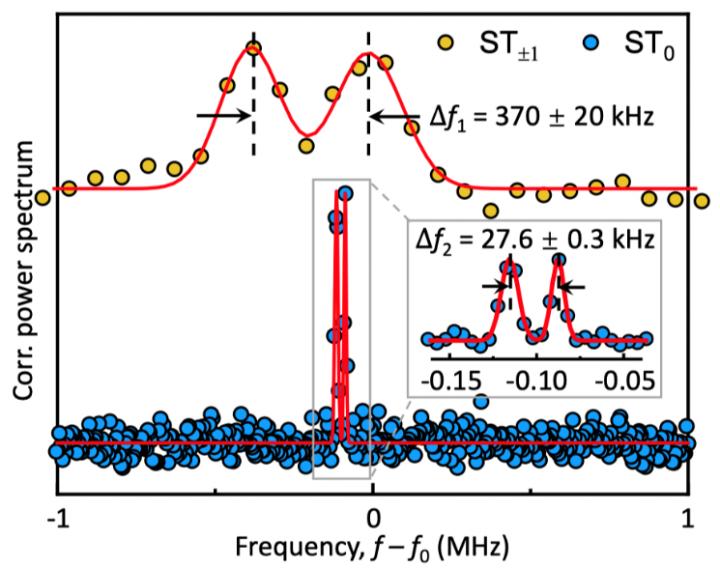
The researchers obtained the single-spin paramagnetic resonance spectrum with kilohertz (kHz) spectral resolution. The study was published in Science Advances.

A major development trend of electron paramagnetic resonance spectroscopy is to get as accurate information as possible from as few samples as possible, which requires enhancing both spatial resolution and spectral resolution. In recent decades, the spatial resolution has been improved considerably, and the detection of single-spin paramagnetic resonance even reached to the nanoscale due to the emergence of new detection technology. However, the spectral resolution remains in the megahertz (MHz) scale because of uncontrollable external noise. Therefore, a new method has to be found in order to break through the current limitation of spectral resolution caused by noise.

One more direct and effective way is to make the measured spin naturally insensitive to external noise. A certain kind of spin states can resist the disturbance of external magnetic field noise, and the spectral lines generated by electron when transiting between these spin states will be narrowed. It has been reported that this phenomenon also exists for a kind of paramagnetic material under zero magnetic field in previous research. However, the detection sensitivity of traditional paramagnetic resonance technology is related to the magnitude of magnetic field, and the detection efficiency in zero field is extremely low, which limits the practical application.

Therefore, the researchers used NV color center quantum sensor in diamond to detect paramagnetic resonance. Previous work has proved that the NV color center still has single-spin level detection sensitivity even at zero field.

In order to observe the narrowing of the spectral lines and realize high-resolution spectroscopy detection, it is also necessary to eliminate the broadening of the spectral line caused by the NV sensor itself. Inspired by the correlation detection in nuclear magnetic resonance (NMR), DU’s team designed a paramagnetic resonance correlation sequence suitable for zero field, which greatly suppressed the intrinsic broadening of NV sensors.

Using this new method, they successfully detected the narrowing transition of the electron spin of a single nitrogen atom in diamond in their experiment. Compared with the traditional method, the spectral resolution has been improved considerably by 27 times, reaching 8.6 kHz.

This experimental results showed that the paramagnetic resonance technology based on NV quantum sensor can achieve both high spatial and high spectral resolution. At the same time, this method is not limited by harsh environmental conditions (such as vacuum or low temperature), which is very competitive in biological applications. More detailed information of structural, dynamic changes and local environmental characteristics of a single molecule can be analyzed.

###

Media Contact
Jane FAN Qiong
[email protected]

Related Journal Article

http://dx.doi.org/10.1126/sciadv.aaz8244

Tags: Atomic/Molecular/Particle PhysicsBiologyBiotechnologyChemistry/Physics/Materials Sciences
Share12Tweet8Share2ShareShareShare2

Related Posts

AI and Physics Collaborate to Design Advanced Hydrogen Storage Materials

June 25, 2026

International Team Including Dresden Scientists Develops Novel Designer Proteins for Advanced Study of Living Tissue

June 25, 2026

New Study Uncovers Key Factors Driving Water Chemistry in Nanoscale Environments

June 25, 2026

Plasma Technology Extends Catalyst Lifespan in Hydrogen Production

June 24, 2026
Please login to join discussion

POPULAR NEWS

  • Saying Goodbye to PGY-6: Pediatric Fellowship Realities

    103 shares
    Share 41 Tweet 26
  • Multi-Hospital Study Reveals Long Covid Burden Is Twice as High as Current Estimates

    92 shares
    Share 36 Tweet 23
  • Detection of EDCs in Breast Milk and Infant Urine Up to Six Months Highlights Early Exposure Risks

    77 shares
    Share 31 Tweet 19
  • New Drug Candidate Developed at McMaster Shows Potential for Treating Brain Cancer

    58 shares
    Share 23 Tweet 15

About

We bring you the latest biotechnology news from best research centers and universities around the world. Check our website.

Follow us

Recent News

Tracking Lanthanide-Labeled Microplastics in Plants

POSTECH Researchers Slash Cost of Reconstituted Cell-Free Systems by 95%

AI and Physics Collaborate to Design Advanced Hydrogen Storage Materials

Subscribe to Blog via Email

Success! An email was just sent to confirm your subscription. Please find the email now and click 'Confirm' to start subscribing.

Join 82 other subscribers
  • Contact Us

Bioengineer.org © Copyright 2023 All Rights Reserved.

Welcome Back!

Login to your account below

Forgotten Password?

Retrieve your password

Please enter your username or email address to reset your password.

Log In
No Result
View All Result
  • Homepages
    • Home Page 1
    • Home Page 2
  • News
  • National
  • Business
  • Health
  • Lifestyle
  • Science

Bioengineer.org © Copyright 2023 All Rights Reserved.