• HOME
  • NEWS
  • EXPLORE
    • CAREER
      • Companies
      • Jobs
    • EVENTS
    • iGEM
      • News
      • Team
    • PHOTOS
    • VIDEO
    • WIKI
  • BLOG
  • COMMUNITY
    • FACEBOOK
    • INSTAGRAM
    • TWITTER
Thursday, March 26, 2026
BIOENGINEER.ORG
No Result
View All Result
  • Login
  • HOME
  • NEWS
  • EXPLORE
    • CAREER
      • Companies
      • Jobs
        • Lecturer
        • PhD Studentship
        • Postdoc
        • Research Assistant
    • EVENTS
    • iGEM
      • News
      • Team
    • PHOTOS
    • VIDEO
    • WIKI
  • BLOG
  • COMMUNITY
    • FACEBOOK
    • INSTAGRAM
    • TWITTER
  • HOME
  • NEWS
  • EXPLORE
    • CAREER
      • Companies
      • Jobs
        • Lecturer
        • PhD Studentship
        • Postdoc
        • Research Assistant
    • EVENTS
    • iGEM
      • News
      • Team
    • PHOTOS
    • VIDEO
    • WIKI
  • BLOG
  • COMMUNITY
    • FACEBOOK
    • INSTAGRAM
    • TWITTER
No Result
View All Result
Bioengineer.org
No Result
View All Result
Home NEWS Science News

Innovative gear principle

Bioengineer by Bioengineer
June 16, 2020
in Science News
Reading Time: 3 mins read
0
IMAGE
Share on FacebookShare on TwitterShare on LinkedinShare on RedditShare on Telegram

“Smart Gear” makes industrial robots more powerful and intelligent
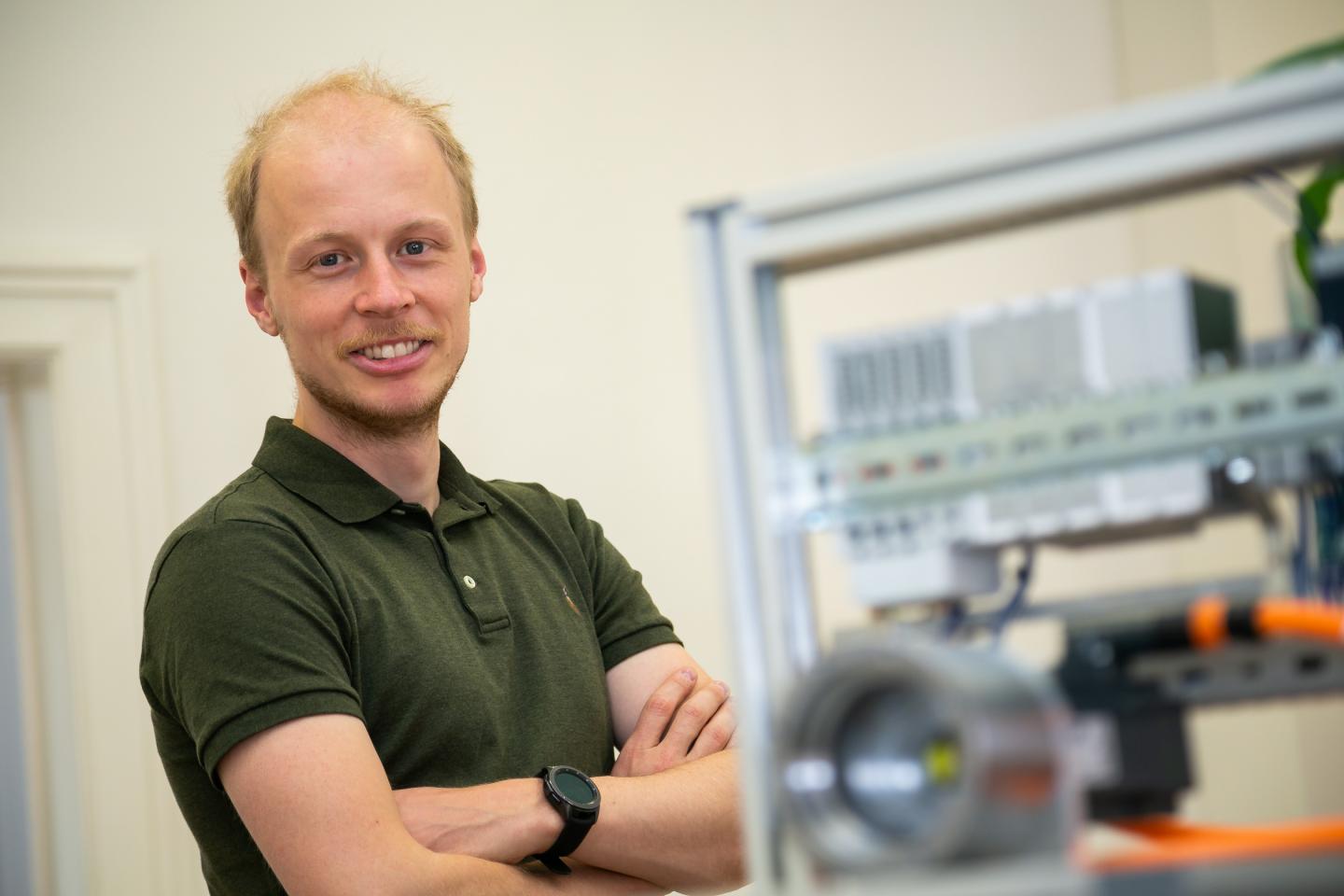
IMAGE

Credit: © Frankl – TU Graz

Additional portrait for download can be found at the end of the message

As part of his master’s thesis at TU Graz, Philipp Eisele developed a concept for a collaborative robot in 2019, i.e. an industrial robot that works together with humans. As a doctoral student at TU Graz’s Institute of Production Engineering, he developed the concept further – and is now the inventor of “Smart Gear”. This is an innovative and meanwhile patented drive system which is currently being implemented as a prototype and could be a watershed in drive technology.

Lightweight with smart interior

The innovative gear principle allows transmission ratios twice as high as previous coaxial gears, as Eisele uses pistons for power transmission instead of revolving gear wheels. “Compared to conventional gear units, the patented system allows the transmission ratio to be doubled while increasing the transmitted torque.” As a result, the size and thus the weight can be halved in comparison to existing gear units without losing effect. The Smart Gear prototype consists of steel and aluminium. The structure is modular, which means that the individual components can be inexpensively produced in mass production and cover a wide range of products through various combinations. “In practice, this means drives will become smaller, lighter and cheaper,” says Eisele, summarising the advantages. The use of Smart Gear is possible with industrial robots, lifting devices and positioning equipment.

The main strength of Smart Gear lies in the available space in the housing, which was created by the elimination of the revolving gears, as Eisele explains: “We can use the empty space for intelligent sensor technology to enable completely new services.” For example, the gear can be connected to cloud services or local company networks, allowing companies to monitor performance data and transmission status in addition to the mechanical system, thus enabling them to manage their production processes efficiently.

Worthwhile payment models

In addition, the networking of the gear opens up new business models that can be used to keep acquisition costs low. Eisele names three types as examples: “As in pay-by-use models, only those hours during which the gear is used are charged for. In fact, the company only pays for the actual duration of use. The system also allows for predictable maintenance. This maximizes uptime and reduces costs for the company. In addition, the maximum power can be limited by software and can be unlocked as needed, allowing a power upgrade without having to replace the gearbox.” With this business model, Smart Gear won the twelfth edition of the Start-Up Garage in 2019 – a cooperation project between TU Graz and the University of Graz that trains students to become the founders of tomorrow – and thus also attracted investment.

System to be further developed with business partners

Pre-series production is scheduled to start this year; initial talks are already underway with robot manufacturers and companies from the manufacturing industry who want to integrate Smart Gear into their products. Eisele is already thinking one step ahead. He would like to make production even more cost-effective and efficient by using innovative manufacturing processes and new materials.

This research is anchored in the Field of Expertise “Mobility & Production” at TU Graz, one of five strategic research core areas of the University.

Media Contact
Philipp EISELE
[email protected]

Original Source

https://www.tugraz.at/en/tu-graz/services/news-stories/media-service/singleview/article/innovatives-getriebeprinzip-smart-gear-macht-industrieroboter-leistungsfaehiger-und-intelligenter0/

Tags: Civil EngineeringIndustrial Engineering/ChemistryMechanical EngineeringRobotry/Artificial IntelligenceTechnology TransferTechnology/Engineering/Computer Science
Share12Tweet8Share2ShareShareShare2

Related Posts

Starburst Winds Drain Supernova Energy Quickly

Starburst Winds Drain Supernova Energy Quickly

March 26, 2026
Decoding the Phosphorus Puzzle: How Microplastics and Hydrochar Transform Nutrient Dynamics in Rice Paddies

Decoding the Phosphorus Puzzle: How Microplastics and Hydrochar Transform Nutrient Dynamics in Rice Paddies

March 26, 2026

Microtubules Found to Actively Ensure Accurate Chromosome Distribution During Cell Division

March 25, 2026

Aversive Learning Hijacks Brain Sugar Sensor

March 25, 2026
Please login to join discussion

POPULAR NEWS

  • blank

    Revolutionary AI Model Enhances Precision in Detecting Food Contamination

    96 shares
    Share 38 Tweet 24
  • Imagine a Social Media Feed That Challenges Your Views Instead of Reinforcing Them

    1003 shares
    Share 397 Tweet 248
  • Uncovering Functions of Cavernous Malformation Proteins in Organoids

    54 shares
    Share 22 Tweet 14
  • Promising Outcomes from First Clinical Trials of Gene Regulation in Epilepsy

    51 shares
    Share 20 Tweet 13

About

We bring you the latest biotechnology news from best research centers and universities around the world. Check our website.

Follow us

Recent News

In-Sensor Cryptography Links Physical Process to Digital Identity

Can Psychosocial Factors Influence Cancer Risk?

Depression Factors in Elderly: Pre vs. Post-COVID Analysis

Subscribe to Blog via Email

Success! An email was just sent to confirm your subscription. Please find the email now and click 'Confirm' to start subscribing.

Join 78 other subscribers
  • Contact Us

Bioengineer.org © Copyright 2023 All Rights Reserved.

Welcome Back!

Login to your account below

Forgotten Password?

Retrieve your password

Please enter your username or email address to reset your password.

Log In
No Result
View All Result
  • Homepages
    • Home Page 1
    • Home Page 2
  • News
  • National
  • Business
  • Health
  • Lifestyle
  • Science

Bioengineer.org © Copyright 2023 All Rights Reserved.