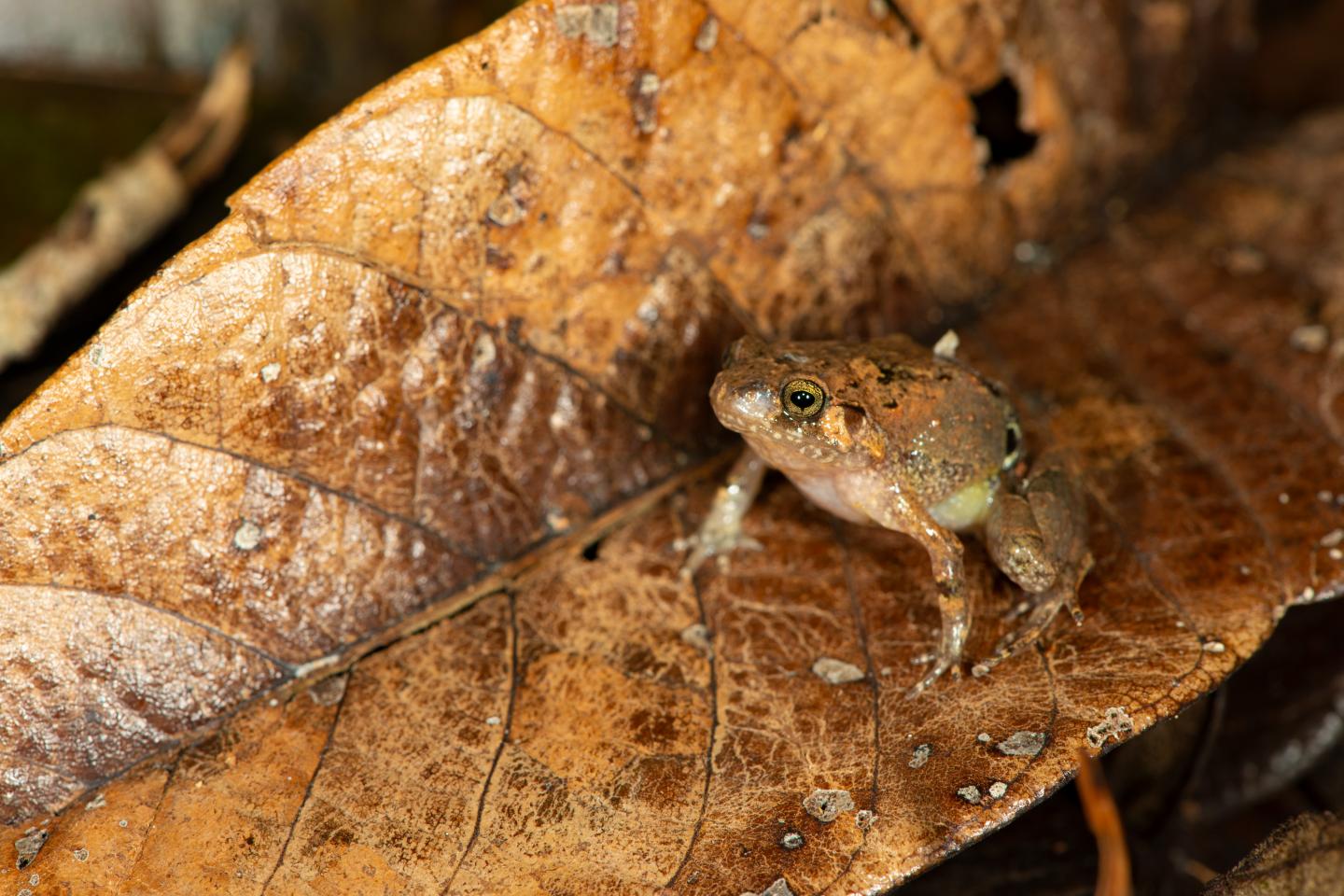
Credit: Mark D. Scherz
Despite the active ongoing taxonomic progress on Madagascar’s frogs, the amphibian inventory of this hyper-diverse island is still very far from being complete. The known diversity of the diamond frog genus Rhombophryne in Madagascar has increased significantly (more than doubled!) over the last 10 years, but still there are several undescribed candidate species awaiting description. New species are constantly being discovered in Madagascar, often even within already well-studied areas. One such place is the Montagne d’Ambre National Park in northern Madagascar.
Montagne d’Ambre National Park is widely known for its endemic flora and fauna, waterfalls and crater lakes, and considered to be a relatively well-studied area. Yet, only two studies have been published so far on the reptiles and amphibians of the Park.
Serving the pursuit of knowledge of the herpetofauna in the region, Germany-based herpetologist Dr. Mark D. Scherz (Bavarian State Collection of Zoology, Technical University of Braunschweig, University of Konstanz) published a description of a new diamond frog species: Rhombophryne ellae, in the open-access journal Zoosystematics and Evolution.
“As soon as I saw this frog, I knew it was a new species,” shares Dr. Scherz, “The orange flash-markings on the legs and the large black spots on the hip made it immediately obvious to me. During my Master’s and PhD research, I studied this genus and described several species, and there are no described species with such orange legs, and only few species have these black markings on the hip. It’s rare that we find a frog and are immediately able to recognise that it is a new species without having to wait for the DNA sequence results to come back, so this was elating.”
The new species is most closely related to a poorly-known and still undescribed species from Tsaratanana in northern Madagascar, but is otherwise quite different from all other diamond frogs. With the orange colouration on its legs, Rhombophryne ellae joins the growing list of frogs that have red to orange flash-markings. The function of this striking colouration remains unknown, despite having evolved repeatedly in frogs, including numerous times in Madagascar’s narrow-mouthed frogs alone.
“The discovery of such a distinctive species within a comparatively well-studied park points towards the gaps in our knowledge of the amphibians of the tropics. It also highlights the role that bad weather, especially cyclones, can play in bringing otherwise hidden frogs out of hiding–Rhombophryne ellae was caught just as Cyclone Ava was moving in on Madagascar, and several other species my colleagues and I have recently described were also caught under similar cyclonic conditions”, says Dr. Scherz.
The species is known so far only from a single specimen, making it difficult to estimate its conservation status. Yet, based on the status of other, related frogs from the same area, it will probably be Red-listed as Near Threatened due to its presumably small range and micro-endemicity.
###
Original Source:
Scherz MD (2020) Diamond frogs forever: a new species of Rhombophryne Boettger, 1880 (Microhylidae, Cophylinae) from Montagne d’Ambre National Park, northern Madagascar. Zoosystematics and Evolution 96(2): 313-323. https:/
Media Contact
Mark D. Scherz
[email protected]
Related Journal Article
http://dx.