New research investigates the role of lipid rafts in virus infiltration
Credit: Carotenuto, Lunghi et al.
PITTSBURGH (June 15, 2020) — A cell’s membrane acts as a natural shield, a fence around the cell that protects and contains it. It mediates processes that let nutrients through and let waste out, and it acts as a physical barrier to the entry of toxic substances and pathogens, like the viruses SARS-CoV-1 and SARS-CoV-2, the one that causes COVID-19.
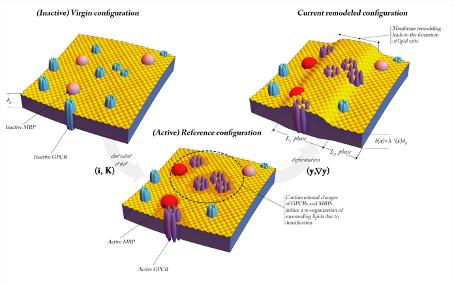
Such pathogens, however, employ clever strategies to trick and penetrate the cell, thereby replicating themselves and infecting the human body. The virus deceives the membrane by exposing specific anti-receptors to which suitable cell’s receptors normally bind. The virus tricks the receptors into believing that what’s landing is something else, namely an affine ligand, something that is safe. Such a process activates and grows thickened zones along the cell membrane, or “lipid rafts,” which are more likely to permit the virus to alter the cell’s membrane, yielding its entry into the cell.
New interdisciplinary research published in the Journal of the Mechanics and Physics of Solids sheds light on how and why the cell membrane forms and grows lipid rafts triggered by ligand-receptor activity. The work could lead to new strategies and innovative approaches to prevent or fight the action of the virus through the integration of biomedical and engineering knowledge.
“Although lipid rafts’ influence on a cell’s response to external agents has been deeply investigated, the physical components of what takes place during ligand-binding has not yet been fully understood,” said Luca Deseri, research professor at the University of Pittsburgh’s Swanson School of Engineering in the Mechanical Engineering and Materials Science Department, full professor and head of the graduate school in Engineering at DICAM-University of Trento in Italy, and corresponding author on the paper. “Our team used an interdisciplinary approach to better understand why active receptors tend to cluster on lipid rafts. More importantly, we confirm and predict the formation of the complex ligand receptors.”
Through the studies of how mechanical forces and biochemical interactions affect the cell membrane, this research sheds light on the way localized thickening across cell membranes is triggered by the formation of the ligand-receptor complex. The researchers concluded that the formation of ligand-receptor complexes could not take place in thinner zones of the cell membrane; the thickening of the cell membrane provides the necessary force relief to allow for configurational changes of the receptors, which then become more prone to ligand binding
Understanding the way viruses use lipid rafts to alter the cell wall could lead to new approaches to treat and prevent viruses, like the one that causes COVID-19, from spreading in the body.
###
The work is a joint effort between Deseri, Massimiliano Fraldi, full professor of solid and structural mechanics at the University of Naples-Federico II in Naples, Italy, and Nicola M. Pugno, full professor of solid and structural mechanics at DICAM-University of Trento. The research was also co-authored by researchers from Carnegie Mellon University, from the University of Palermo, and from the University of Ferrara, where the experiments on the cells were performed.
The paper, “Mechanobiology predicts raft formations triggered by ligand-receptor activity across the cell membrane,” (DOI: 10.1016/j.jmps.2020.103974) was published in the Journal of the Mechanics and Physics of Solids. It was authored by Angelo R. Carotenuto, Laura Lunghi, Valentina Piccolo, Mahnoush Babaei, Kaushik Dayal, Nicola M. Pugno, Massimiliano Zingales, Luca Deseri and Massimiliano Fraldi. The researchers will submit related work to the Frontiers in Materials as part of a special issue, edited by Pugno, about the COVID-19 pandemic.
Media Contact
Maggie Pavlick
[email protected]
Original Source
https:/
Related Journal Article
http://dx.