• HOME
  • NEWS
  • EXPLORE
    • CAREER
      • Companies
      • Jobs
    • EVENTS
    • iGEM
      • News
      • Team
    • PHOTOS
    • VIDEO
    • WIKI
  • BLOG
  • COMMUNITY
    • FACEBOOK
    • INSTAGRAM
    • TWITTER
Monday, October 5, 2026
BIOENGINEER.ORG
No Result
View All Result
  • Login
  • HOME
  • NEWS
  • EXPLORE
    • CAREER
      • Companies
      • Jobs
        • Lecturer
        • PhD Studentship
        • Postdoc
        • Research Assistant
    • EVENTS
    • iGEM
      • News
      • Team
    • PHOTOS
    • VIDEO
    • WIKI
  • BLOG
  • COMMUNITY
    • FACEBOOK
    • INSTAGRAM
    • TWITTER
No Result
View All Result
Bioengineer.org
No Result
View All Result
Home NEWS Science News

Self-driving cars that recognize free space can better detect objects

Bioengineer by Bioengineer
June 11, 2020
in Science News
Reading Time: 2 mins read
0
IMAGE
Share on FacebookShare on TwitterShare on LinkedinShare on RedditShare on Telegram

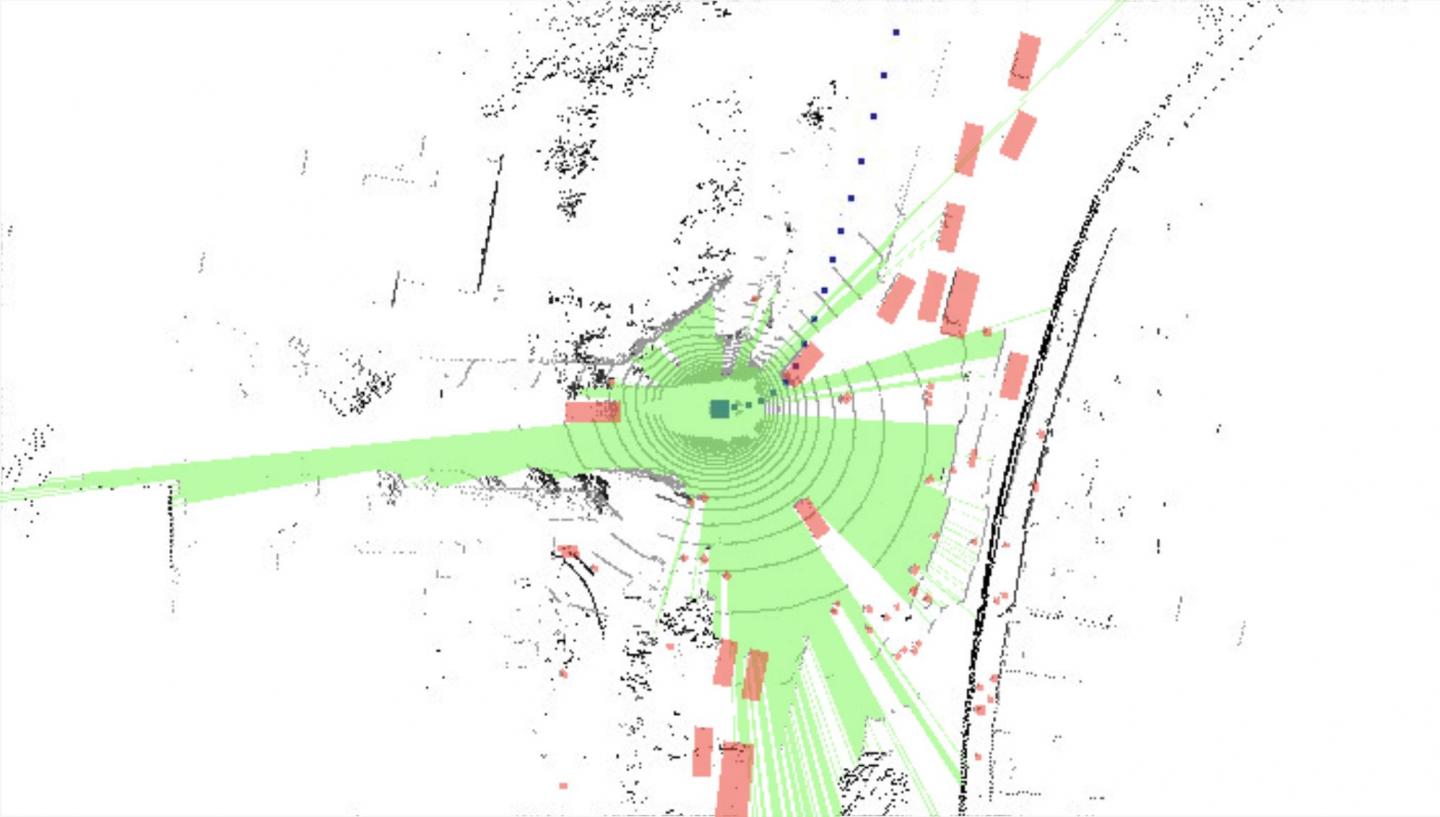
What a perception system doesn’t see can help it understand what it sees
IMAGE

Credit: Carnegie Mellon University

PITTSBURGH–It’s important that self-driving cars quickly detect other cars or pedestrians sharing the road. Researchers at Carnegie Mellon University have shown that they can significantly improve detection accuracy by helping the vehicle also recognize what it doesn’t see.

Empty space, that is.

The very fact that objects in your sight may obscure your view of things that lie further ahead is blindingly obvious to people. But Peiyun Hu, a Ph.D. student in CMU’s Robotics Institute, said that’s not how self-driving cars typically reason about objects around them.

Rather, they use 3D data from lidar to represent objects as a point cloud and then try to match those point clouds to a library of 3D representations of objects. The problem, Hu said, is that the 3D data from the vehicle’s lidar isn’t really 3D — the sensor can’t see the occluded parts of an object, and current algorithms don’t reason about such occlusions.

“Perception systems need to know their unknowns,” Hu observed.

Hu’s work enables a self-driving car’s perception systems to consider visibility as it reasons about what its sensors are seeing. In fact, reasoning about visibility is already used when companies build digital maps.

“Map-building fundamentally reasons about what’s empty space and what’s occupied,” said Deva Ramanan, an associate professor of robotics and director of the CMU Argo AI Center for Autonomous Vehicle Research. “But that doesn’t always occur for live, on-the-fly processing of obstacles moving at traffic speeds.”

In research to be presented at the Computer Vision and Pattern Recognition (CVPR) conference, which will be held virtually June 13-19, Hu and his colleagues borrow techniques from map-making to help the system reason about visibility when trying to recognize objects.

When tested against a standard benchmark, the CMU method outperformed the previous top-performing technique, improving detection by 10.7% for cars, 5.3% for pedestrians, 7.4% for trucks, 18.4% for buses and 16.7% for trailers.

One reason previous systems may not have taken visibility into account is a concern about computation time. But Hu said his team found that was not a problem: their method takes just 24 milliseconds to run. (For comparison, each sweep of the lidar is 100 milliseconds.)

###

In addition to Hu and Ramanan, the research team included Jason Ziglar of Argo AI and David Held, assistant professor of robotics. The Argo AI Center supported this research.

Media Contact
Byron Spice
[email protected]

Original Source

https://www.cs.cmu.edu/news/self-driving-cars-recognize-free-space-can-better-detect-objects

Tags: Computer ScienceRobotry/Artificial IntelligenceSoftware EngineeringTechnology/Engineering/Computer ScienceVehicles
Share12Tweet8Share2ShareShareShare2

Related Posts

Methane-Cutting Cattle Feed Keeps Milk Flowing but Shifts Milk Chemistry on Real Farms

Methane-Cutting Cattle Feed Keeps Milk Flowing but Shifts Milk Chemistry on Real Farms

October 5, 2026
Millions of Older Chinese Adults Struggle to Take Their Own Medicines, Study Finds

Millions of Older Chinese Adults Struggle to Take Their Own Medicines, Study Finds

October 5, 2026

Mouth Microbes as Medicine: Scientists Map the Future of Oral Microbiome Therapies

October 5, 2026

AI Model Tackles Rare Cancer Subtypes by Learning From Imbalanced Molecular Data

October 5, 2026
Please login to join discussion

POPULAR NEWS

  • Alloys That Shrink Their Own Grains: New PIX Mechanism Refines Metals With Heat Alone

    Alloys That Shrink Their Own Grains: New PIX Mechanism Refines Metals With Heat Alone

    29 shares
    Share 12 Tweet 7
  • Endurance Exercise Reshapes the Liver in Males and Females Through Distinct Molecular Routes

    29 shares
    Share 12 Tweet 7
  • Single Transcription Factor PU.1 Rapidly Converts Fibroblasts into Macrophage-Lineage Cells

    29 shares
    Share 12 Tweet 7
  • New Scale Measures How Ready Nurse Educators Really Are for the AI Era

    29 shares
    Share 12 Tweet 7

About

We bring you the latest biotechnology news from best research centers and universities around the world. Check our website.

Follow us

Recent News

Alloys That Shrink Their Own Grains: New PIX Mechanism Refines Metals With Heat Alone

Endurance Exercise Reshapes the Liver in Males and Females Through Distinct Molecular Routes

Single Transcription Factor PU.1 Rapidly Converts Fibroblasts into Macrophage-Lineage Cells

Subscribe to Blog via Email

Success! An email was just sent to confirm your subscription. Please find the email now and click 'Confirm' to start subscribing.

Join 85 other subscribers
  • Contact Us

Bioengineer.org © Copyright 2023 All Rights Reserved.

Welcome Back!

Login to your account below

Forgotten Password?

Retrieve your password

Please enter your username or email address to reset your password.

Log In
No Result
View All Result
  • Homepages
    • Home Page 1
    • Home Page 2
  • News
  • National
  • Business
  • Health
  • Lifestyle
  • Science

Bioengineer.org © Copyright 2023 All Rights Reserved.