The findings provide a promising pathway for leapfrog advancement in imaging, optical-computing technologies, biosensing and more
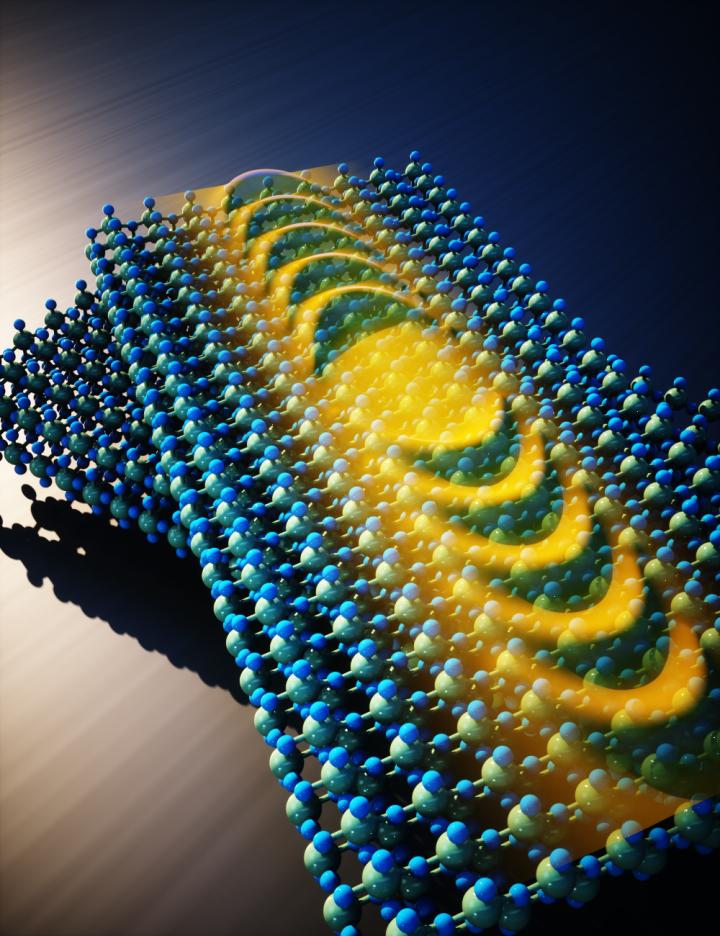
Credit: ASRC
NEW YORK, June 10, 2020 — A research team led by scientists at the Advanced Science Research Center at The Graduate Center, CUNY (CUNY ASRC), in collaboration with National University of Singapore, University of Texas at Austin and Monash University, has employed “twistronics” concepts (the science of layering and twisting two-dimensional materials to control their electrical properties) to manipulate the flow of light in extreme ways. The findings, published in the journal Nature, hold the promise for leapfrog advances in a variety of light-driven technologies, including nano-imaging devices; high-speed, low-energy optical computers; and biosensors.
The team took inspiration from the recent discovery of superconductivity in a pair of stacked graphene layers that were rotated to the “magic twist angle” of 1.1 degrees. In this configuration, electrons flow with no resistance. Separately, each graphene layer shows no special electrical properties. The discovery has shown how the careful control of rotational symmetries can unveil unexpected material responses.
The research team discovered that an analogous principle can be applied to manipulate light in highly unusual ways. At a specific rotation angle between two ultrathin layers of molybdenum trioxide, the researchers were able to prevent optical diffraction and enable robust light propagation in a tightly focused beam at desired wavelengths.
Typically, light radiated from a small emitter placed over a flat surface expands away in circles very much like the waves excited by a stone that falls into a pond. In their experiments, the researchers stacked two thin sheets of molybdenum trioxide — a material typically used in chemical processes — and rotated one of the layers with respect to the other. When the materials were excited by a tiny optical emitter, they observed widely controllable light emission over the surface as the rotation angle was varied. In particular, they showed that at the photonic magical twist angle the configured bilayer supports robust, diffraction-free light propagation in tightly focused channel beams over a wide range of wavelengths.
“While photons — the quanta of light — have very different physical properties than electrons, we have been intrigued by the emerging discovery of twistronics, and have been wondering if twisted two-dimensional materials may also provide unusual transport properties for light, to benefit photon-based technologies,” said Andrea Alù, founding director of the CUNY ASRC’s Photonics Initiative and Einstein Professor of Physics at The Graduate Center. “To unveil this phenomenon, we used thin layers of molybdenum trioxide. By stacking two of such layers on top of each other and controlling their relative rotation, we have observed dramatic control of the light guiding properties. At the photonic magic angle, light does not diffract, and it propagates very confined along straight lines. This is an ideal feature for nanoscience and photonic technologies.”
“Our discovery was based on quite a specific material and wavelength range, but with advanced nanofabrication we can pattern many other material platforms to replicate these unusual optical features over a wide range of light wavelengths,” said National University of Singapore (NUS) graduate student Guangwei Hu, who is first author of the study and a long-term visiting researcher with Alù’s group. “Our study shows that twistronics for photons can open truly exciting opportunities for light-based technologies, and we are excited to continue exploring these opportunities,” said Prof. C.W. Qiu, Mr. Hu’s co-advisor at NUS.
###
The research team consisted of scientists from CUNY ASRC, National University of Singapore, University of Texas at Austin and Monash University. Their work was supported by an Air Force Office of Scientific Research MURI grant, the Office of Naval Research, the Department of Defense Vannevar Bush Fellowship Program, and the National Science Foundation.
About the Advanced Science Research Center
The ASRC elevates scientific research and education at CUNY and beyond through initiatives in five distinctive, but increasingly interconnected disciplines: environmental sciences, nanoscience, neuroscience, photonics, and structural biology. The ASRC promotes a collaborative, interdisciplinary research culture with renowned researchers from each of the initiatives working side-by-side in the ASRC’s core facilities, sharing equipment that is among the most advanced available.
About The Graduate Center of The City University of New York
The Graduate Center of The City University of New York is a leader in public graduate education devoted to enhancing the public good through pioneering research, serious learning, and reasoned debate. The Graduate Center offers ambitious students more than 40 doctoral and master’s programs of the highest caliber, taught by top faculty from throughout CUNY — the world’s largest public urban university. Through its nearly 40 centers, institutes, and initiatives, The Graduate Center influences public policy and discourse and shapes innovation. The Graduate Center’s extensive public programs make it a home for culture and conversation.
Media Contact
Shawn Rhea
[email protected]
Related Journal Article
http://dx.