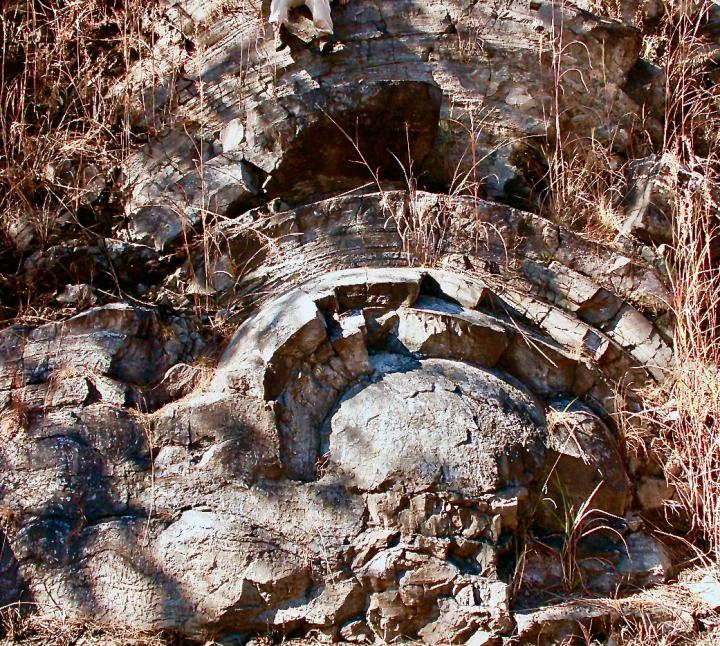
Credit: David Catling/University of Washington
Oxygen first accumulated in the Earth’s atmosphere about 2.4 billion years ago, during the Great Oxidation Event. A long-standing puzzle has been that geologic clues suggest early bacteria were photosynthesizing and pumping out oxygen hundreds of millions of years before then. Where was it all going?
Something was holding back oxygen’s rise. A new interpretation of rocks billions of years old finds volcanic gases are the likely culprits. The study led by the University of Washington was published in June in the open-access journal Nature Communications.
“This study revives a classic hypothesis for the evolution of atmospheric oxygen,” said lead author Shintaro Kadoya, a UW postdoctoral researcher in Earth and space sciences. “The data demonstrates that an evolution of the mantle of the Earth could control an evolution of the atmosphere of the Earth, and possibly an evolution of life.”
Multicellular life needs a concentrated supply of oxygen, so the accumulation of oxygen is key to the evolution of oxygen-breathing life on Earth.
“If changes in the mantle controlled atmospheric oxygen, as this study suggests, the mantle might ultimately set a tempo of the evolution of life,” Kadoya said.
The new work builds on a 2019 paper that found the early Earth’s mantle was far less oxidized, or contained more substances that can react with oxygen, than the modern mantle. That study of ancient volcanic rocks, up to 3.55 billion years old, were collected from sites that included South Africa and Canada.
Robert Nicklas at Scripps Institution of Oceanography, Igor Puchtel at the University of Maryland, and Ariel Anbar at Arizona State University are among the authors of the 2019 study. They are also co-authors of the new paper, looking at how changes in the mantle influenced the volcanic gases that escaped to the surface.
The Archean Eon, when only microbial life was widespread on Earth, was more volcanically active than today. Volcanic eruptions are fed by magma – a mixture of molten and semi-molten rock – as well as gases that escape even when the volcano is not erupting.
Some of those gases react with oxygen, or oxidize, to form other compounds. This happens because oxygen tends to be hungry for electrons, so any atom with one or two loosely held electrons reacts with it. For instance, hydrogen released by a volcano combines with any free oxygen, removing that oxygen from the atmosphere.
The chemical makeup of Earth’s mantle, or softer layer of rock below the Earth’s crust, ultimately controls the types of molten rock and gases coming from volcanoes. A less-oxidized early mantle would produce more of the gases like hydrogen that combine with free oxygen. The 2019 paper shows that the mantle became gradually more oxidized from 3.5 billion years ago to today.
The new study combines that data with evidence from ancient sedimentary rocks to show a tipping point sometime after 2.5 billion years ago, when oxygen produced by microbes overcame its loss to volcanic gases and began to accumulate in the atmosphere.
“Basically, the supply of oxidizable volcanic gases was capable of gobbling up photosynthetic oxygen for hundreds of millions of years after photosynthesis evolved,” said co-author David Catling, a UW professor of Earth and space sciences. “But as the mantle itself became more oxidized, fewer oxidizable volcanic gases were released. Then oxygen flooded the air when there was no longer enough volcanic gas to mop it all up.”
This has implications for understanding the emergence of complex life on Earth and the possibility of life on other planets.
“The study indicates that we cannot exclude the mantle of a planet when considering the evolution of the surface and life of the planet,” Kadoya said.
###
This research was funded by the National Science Foundation.
For more information, contact Kadoya at [email protected] or Catling at [email protected].
Media Contact
Hannah Hickey
[email protected]
Original Source
https:/
Related Journal Article
http://dx.