• HOME
  • NEWS
  • EXPLORE
    • CAREER
      • Companies
      • Jobs
    • EVENTS
    • iGEM
      • News
      • Team
    • PHOTOS
    • VIDEO
    • WIKI
  • BLOG
  • COMMUNITY
    • FACEBOOK
    • INSTAGRAM
    • TWITTER
Tuesday, January 13, 2026
BIOENGINEER.ORG
No Result
View All Result
  • Login
  • HOME
  • NEWS
  • EXPLORE
    • CAREER
      • Companies
      • Jobs
        • Lecturer
        • PhD Studentship
        • Postdoc
        • Research Assistant
    • EVENTS
    • iGEM
      • News
      • Team
    • PHOTOS
    • VIDEO
    • WIKI
  • BLOG
  • COMMUNITY
    • FACEBOOK
    • INSTAGRAM
    • TWITTER
  • HOME
  • NEWS
  • EXPLORE
    • CAREER
      • Companies
      • Jobs
        • Lecturer
        • PhD Studentship
        • Postdoc
        • Research Assistant
    • EVENTS
    • iGEM
      • News
      • Team
    • PHOTOS
    • VIDEO
    • WIKI
  • BLOG
  • COMMUNITY
    • FACEBOOK
    • INSTAGRAM
    • TWITTER
No Result
View All Result
Bioengineer.org
No Result
View All Result
Home NEWS Science News Chemistry

Magnesium ductility improvement elucidated thru first principles and molecular dynamics simulation

Bioengineer by Bioengineer
June 9, 2020
in Chemistry
Reading Time: 2 mins read
0
IMAGE
Share on FacebookShare on TwitterShare on LinkedinShare on RedditShare on Telegram

IMAGE

Credit: Daisuke Matsunaka, Department of Mechanical Systems Engineering, Shinshu University

Magnesium is a promising material for use in structural materials because they are lightweight, have high-specific strength, and high-specific stiffness. However, its limited formability at room temperature keeps its potential use limited.

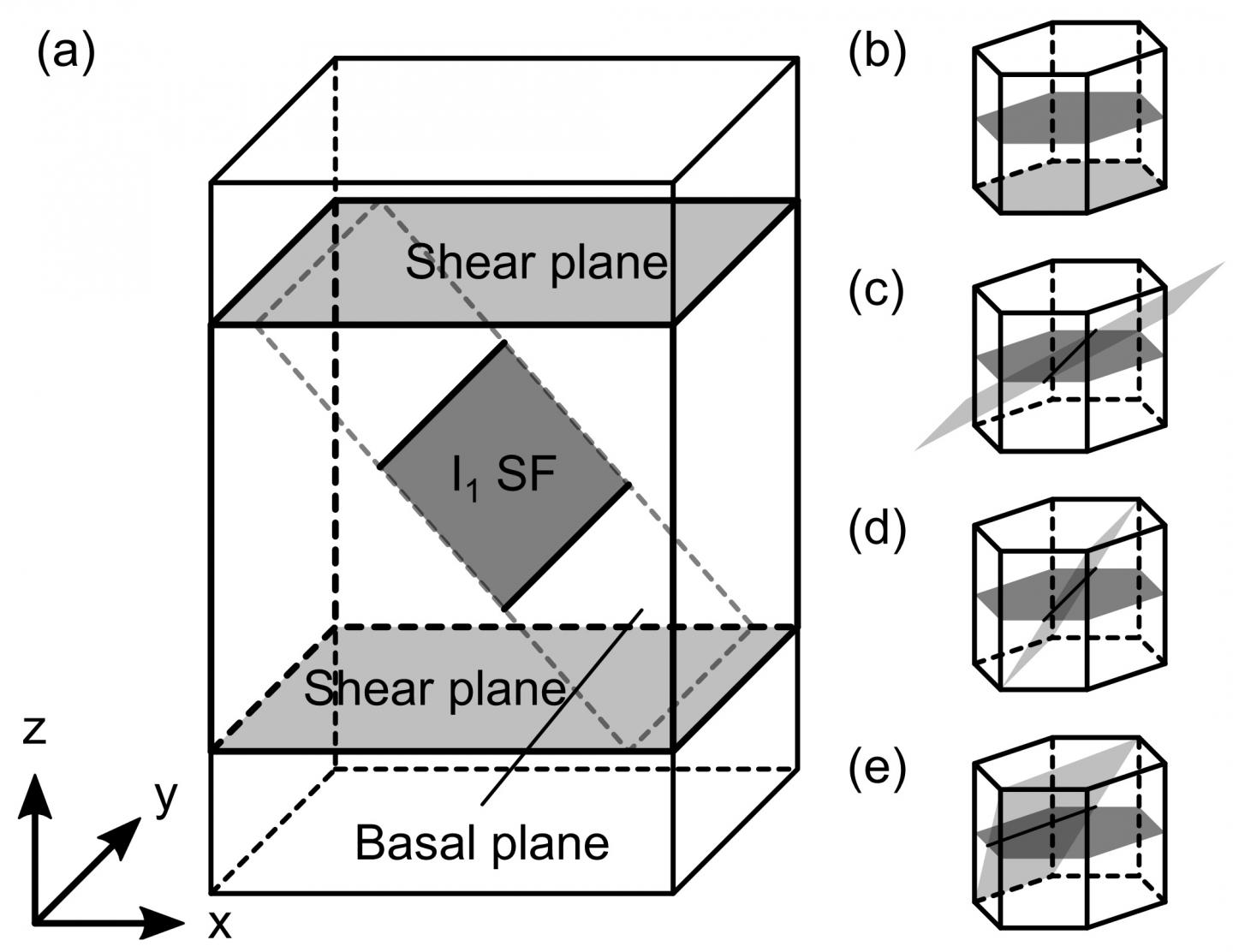
Activation of non-basal slip systems has been observed in several magnesium alloys which showed improvement of ductility. To elucidate the mechanism of the activation of non-basal slip systems, So Yoshikawa and Daisuke Matsunaka of Shinshu University conducted molecular dynamics simulations of defect nucleation in the vicinity of the I1-type stacking fault.

Stacking fault is one kind of defect in crystals. Previous first-principles calculations found that the alloying elements capable of improving ductility reduce the stacking fault energy. Yoshikawa and Matsunaka applied shear stress to atomic models of about 60,000 atoms including an I1-type stacking fault and observed its deformation behavior. Analyzing atomic configurations at each snapshot in the simulations, they discussed defect nucleation from the I1-type stacking fault. Then, they found that dislocations associated with pyramidal slips as well as (11-21) twins were generated from the I1-type stacking fault, depending on the applied stress state.

This study successfully obtained the atomistic picture of dislocation generation from I1-type stacking fault. To elucidate effects of alloying elements on mechanical properties at the atomic level, the team will progress their computational and theoretical study to other defect events in magnesium and construct a highly accurate interatomic potential for molecular dynamics simulations of magnesium alloys through machine learning techniques.

Plastic deformation in hexagonal close-packed (HCP) metals such as magnesium is more complex than body centered cubic and face centered cubic metals. Detailed understanding of deformation mechanisms in magnesium, brought from this study and others in the field, would contribute to not only efficient designing high-performance magnesium alloys but also the development of materials science of HCP metals.

###

For more information on the study please read: Defect nucleation from a pre-existing intrinsic I1 stacking fault in magnesium by molecular dynamics simulations.

So Yoshikawa: Conceptualization, Methodology, Software, Formal analysis, Investigation, Writing- original draft, review & editing, Visualization

Daisuke Matsunaka: Conceptualization, Resources, Writing- review & editing, Project administration, Funding acquisition.

Media Contact
Hitomi Thompson
[email protected]

Related Journal Article

http://dx.doi.org/10.1016/j.commatsci.2020.109644

Tags: Chemistry/Physics/Materials SciencesMaterialsMolecular Physics
Share12Tweet8Share2ShareShareShare2

Related Posts

blank

Thermal [2+2] Cycloaddition Builds Gem-Difluoro Bicycloalkanes

January 13, 2026
blank

Cobalt-Catalyzed Thioester Coupling via Siloxycarbene

January 12, 2026

Advancing Alkene Chemistry: Homologative Difunctionalization Breakthrough

January 8, 2026

Biocompatible Ligand Enables Safe In-Cell Protein Arylation

January 8, 2026
Please login to join discussion

POPULAR NEWS

  • Enhancing Spiritual Care Education in Nursing Programs

    154 shares
    Share 62 Tweet 39
  • PTSD, Depression, Anxiety in Childhood Cancer Survivors, Parents

    146 shares
    Share 58 Tweet 37
  • Robotic Ureteral Reconstruction: A Novel Approach

    72 shares
    Share 29 Tweet 18
  • Study Reveals Lipid Accumulation in ME/CFS Cells

    51 shares
    Share 20 Tweet 13

About

We bring you the latest biotechnology news from best research centers and universities around the world. Check our website.

Follow us

Recent News

YOLOv11 Enhances Real-Time Obstacle Detection in Dynamic Roads

Lactate Triggers GPR81/FARP1 for Insulin-Free Glucose Uptake

Limnospira indica Boosts Plant Microbiota, Growth

Subscribe to Blog via Email

Enter your email address to subscribe to this blog and receive notifications of new posts by email.

Join 71 other subscribers
  • Contact Us

Bioengineer.org © Copyright 2023 All Rights Reserved.

Welcome Back!

Login to your account below

Forgotten Password?

Retrieve your password

Please enter your username or email address to reset your password.

Log In
No Result
View All Result
  • Homepages
    • Home Page 1
    • Home Page 2
  • News
  • National
  • Business
  • Health
  • Lifestyle
  • Science

Bioengineer.org © Copyright 2023 All Rights Reserved.