• HOME
  • NEWS
  • EXPLORE
    • CAREER
      • Companies
      • Jobs
    • EVENTS
    • iGEM
      • News
      • Team
    • PHOTOS
    • VIDEO
    • WIKI
  • BLOG
  • COMMUNITY
    • FACEBOOK
    • INSTAGRAM
    • TWITTER
Thursday, March 26, 2026
BIOENGINEER.ORG
No Result
View All Result
  • Login
  • HOME
  • NEWS
  • EXPLORE
    • CAREER
      • Companies
      • Jobs
        • Lecturer
        • PhD Studentship
        • Postdoc
        • Research Assistant
    • EVENTS
    • iGEM
      • News
      • Team
    • PHOTOS
    • VIDEO
    • WIKI
  • BLOG
  • COMMUNITY
    • FACEBOOK
    • INSTAGRAM
    • TWITTER
  • HOME
  • NEWS
  • EXPLORE
    • CAREER
      • Companies
      • Jobs
        • Lecturer
        • PhD Studentship
        • Postdoc
        • Research Assistant
    • EVENTS
    • iGEM
      • News
      • Team
    • PHOTOS
    • VIDEO
    • WIKI
  • BLOG
  • COMMUNITY
    • FACEBOOK
    • INSTAGRAM
    • TWITTER
No Result
View All Result
Bioengineer.org
No Result
View All Result
Home NEWS Science News Chemistry

Physicists create quantum-inspired optical sensor

Bioengineer by Bioengineer
June 5, 2020
in Chemistry
Reading Time: 2 mins read
0
IMAGE
Share on FacebookShare on TwitterShare on LinkedinShare on RedditShare on Telegram

IMAGE

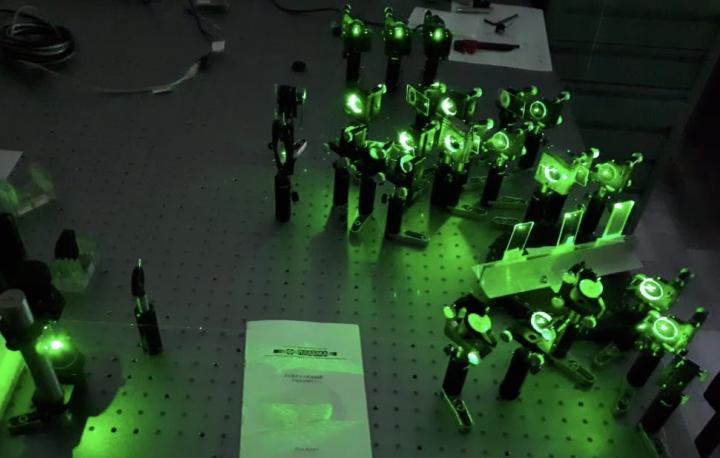
Credit: Nikita Kirsanov/MIPT

Researchers from the Moscow Institute of Physics and Technology, joined by a colleague from Argonne National Laboratory, U.S., have implemented an advanced quantum algorithm for measuring physical quantities using simple optical tools. Published in Scientific Reports, their study takes us a step closer to affordable linear optics-based sensors with high performance characteristics. Such tools are sought after in diverse research fields, from astronomy to biology.

Maximizing the sensitivity of measurement tools is crucial for any field of science and technology. Astronomers seek to detect remote cosmic phenomena, biologists need to discern exceedingly tiny organic structures, and engineers have to measure the positions and velocities of objects, to name a few examples.

Until recently, no measurement tool could ensure precision above the so-called shot noise limit, which has to do with the statistical features inherent in classical observations. Quantum technology has provided a way around this, boosting precision to the fundamental Heisenberg limit, stemming from the basic principles of quantum mechanics. The LIGO experiment, which detected gravitational waves for the first time in 2016, shows it is possible to achieve Heisenberg-limited sensitivity by combining complex optical interference schemes and quantum techniques.

Quantum metrology is a cutting-edge area of physics concerned with the technological and algorithmic tools for making highly precise quantum measurements. In their recent study, the team from MIPT and ANL fused quantum metrology with linear optics.

“We devised and constructed an optical scheme that runs the Fourier transform-based phase estimation procedure,” said study co-author Nikita Kirsanov from MIPT. “This procedure lies at the core of many quantum algorithms, including high-precision measurement protocols.”

A specific arrangement of a very large number of linear optical elements — beam splitters, phase shifters, and mirrors — makes it possible to gain information about the geometric angles, positions, velocities as well as other parameters of physical objects. The measurement involves encoding the quantity of interest in the optical phases, which are then determined directly.

“This research is a follow-up to our work on universal quantum measurement algorithms,” commented principal investigator Gordey Lesovik, who heads the MIPT Laboratory of the Physics of Quantum Information Technology. “In an earlier collaboration with a research group from Aalto University in Finland, we experimentally implemented a similar measurement algorithm on transmon qubits.”

The experiment showed that despite the large number of optical elements in the scheme, it is nevertheless tunable and controllable. According to the theoretical estimates provided in the paper linear optics tools are viable for implementing even operations that are considerably more complex.

“The study has demonstrated that linear optics offers an affordable and effective platform for implementing moderate-scale quantum measurements and computations,” said Argonne Distinguished Fellow Valerii Vinokur.

###

Media Contact
Varvara Bogomlova
[email protected]

Original Source

https://mipt.ru/english/news/physicists_create_quantum_inspired_optical_sensor

Related Journal Article

http://dx.doi.org/10.1038/s41598-020-65466-3

Tags: Chemistry/Physics/Materials SciencesOpticsTheoretical Sciences
Share12Tweet8Share2ShareShareShare2

Related Posts

Isolated H2-Reduced Clusters Boost CO2-to-Methanol Catalysis

Isolated H2-Reduced Clusters Boost CO2-to-Methanol Catalysis

March 25, 2026
blank

Physicists Identify Electronic Drivers Behind Flat Band Quantum Materials

March 21, 2026

Würzburg Chemistry Professor Claudia Höbartner Receives Prestigious Honor

March 20, 2026

Scientists Reveal How Magnets Control Metamaterial Behavior

March 20, 2026
Please login to join discussion

POPULAR NEWS

  • blank

    Revolutionary AI Model Enhances Precision in Detecting Food Contamination

    96 shares
    Share 38 Tweet 24
  • Imagine a Social Media Feed That Challenges Your Views Instead of Reinforcing Them

    1003 shares
    Share 397 Tweet 248
  • Uncovering Functions of Cavernous Malformation Proteins in Organoids

    54 shares
    Share 22 Tweet 14
  • Promising Outcomes from First Clinical Trials of Gene Regulation in Epilepsy

    51 shares
    Share 20 Tweet 13

About

We bring you the latest biotechnology news from best research centers and universities around the world. Check our website.

Follow us

Recent News

In-Sensor Cryptography Links Physical Process to Digital Identity

Can Psychosocial Factors Influence Cancer Risk?

Depression Factors in Elderly: Pre vs. Post-COVID Analysis

Subscribe to Blog via Email

Success! An email was just sent to confirm your subscription. Please find the email now and click 'Confirm' to start subscribing.

Join 78 other subscribers
  • Contact Us

Bioengineer.org © Copyright 2023 All Rights Reserved.

Welcome Back!

Login to your account below

Forgotten Password?

Retrieve your password

Please enter your username or email address to reset your password.

Log In
No Result
View All Result
  • Homepages
    • Home Page 1
    • Home Page 2
  • News
  • National
  • Business
  • Health
  • Lifestyle
  • Science

Bioengineer.org © Copyright 2023 All Rights Reserved.