• HOME
  • NEWS
  • EXPLORE
    • CAREER
      • Companies
      • Jobs
    • EVENTS
    • iGEM
      • News
      • Team
    • PHOTOS
    • VIDEO
    • WIKI
  • BLOG
  • COMMUNITY
    • FACEBOOK
    • INSTAGRAM
    • TWITTER
Saturday, February 7, 2026
BIOENGINEER.ORG
No Result
View All Result
  • Login
  • HOME
  • NEWS
  • EXPLORE
    • CAREER
      • Companies
      • Jobs
        • Lecturer
        • PhD Studentship
        • Postdoc
        • Research Assistant
    • EVENTS
    • iGEM
      • News
      • Team
    • PHOTOS
    • VIDEO
    • WIKI
  • BLOG
  • COMMUNITY
    • FACEBOOK
    • INSTAGRAM
    • TWITTER
  • HOME
  • NEWS
  • EXPLORE
    • CAREER
      • Companies
      • Jobs
        • Lecturer
        • PhD Studentship
        • Postdoc
        • Research Assistant
    • EVENTS
    • iGEM
      • News
      • Team
    • PHOTOS
    • VIDEO
    • WIKI
  • BLOG
  • COMMUNITY
    • FACEBOOK
    • INSTAGRAM
    • TWITTER
No Result
View All Result
Bioengineer.org
No Result
View All Result
Home NEWS Science News Health

Discovery of a novel gene involved in DNA damage repair and male fertility

Bioengineer by Bioengineer
June 4, 2020
in Health
Reading Time: 3 mins read
0
IMAGE
Share on FacebookShare on TwitterShare on LinkedinShare on RedditShare on Telegram

Clarifying the mechanisms for meiotic recombination in sperm production
IMAGE

Credit: Dr. Kei-ichiro Ishiguro

A research group from the Institute of Molecular Embryology and Genetics (IMEG) at Kumamoto University, Japan has discovered that the gene C19ORF57 plays a critical role in meiosis. The gene appears to be related to the cause of male infertility and could be a big step forward for reproductive medicine.

Meiosis is a specialized type of cell division that generates sperm or eggs. During Meiosis, genetic information is exchanged between maternal and paternal chromosomes through meiotic recombination. This process introduces genetic differences to the next generation.

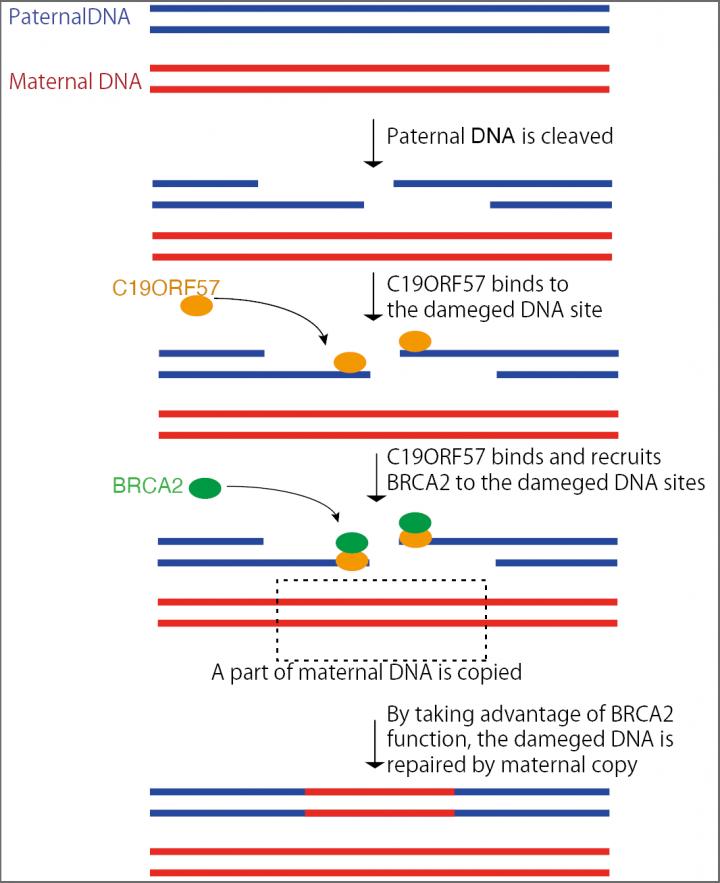
Normally, meiotic recombination is initiated by introducing breaks in the DNA. However, this process is nothing less than DNA damage that is a threat to the cell. Although introduction of DNA breaks is a normal and necessary process to trigger meiotic recombination, these breaks must be repaired immediately. In this study, Drs. Ishiguro and Takemoto discovered a novel gene that plays a crucial role in repairing DNA damage during meiotic recombination.

Previously, the same group discovered the Meiosin gene which acts as a switch to turn on meiosis as well as hundreds of other genes in the process. However, the functions of all the other genes have not yet been fully elucidated. The C19ORF57 gene is one of those controlled by MEIOSIN and its function was unknown until now.

The researchers set out to clarify the role of C19ORF57 in meiosis. Using mass spectrometry, the group found that it binds to breast cancer suppressor BRCA2, a protein that is known to play a role in repairing damaged DNA. This data suggests that C19ORF57 and BRCA2 function together in germ cells.

Further evidence showing cooperation between C19ORF57 and BRCA2 was found through microscopic imaging. The researchers discovered that C19ORF57 goes first to damaged DNA sites and then recruits BRCA2 to the same position on the chromosomes.

Using genome editing technology to artificially inhibit the C19orf57 gene in mice, researchers found that the male animals became infertile because meiotic recombination did not complete and sperm were not produced. Further analysis of male gonads revealed that the gene plays an essential role in repairing damaged DNA.

There are many unknown causes of human male infertility and this finding potentially reveals a new pathology. Even though these experiments were performed on animal models, the C19ORF57 gene is present in humans. Therapies and diagnostics developed from this research could ensure meiosis quality and decrease the instances of complications.

###

This research was posted online in Cell Reports on 26 May 2020.

A 5-minute video introducing this research can be found on YouTube.

[Source]

Takemoto, K., Tani, N., Takada-Horisawa, Y., Fujimura, S., Tanno, N., Yamane, M., … Ishiguro, K. (2020). Meiosis-Specific C19orf57/4930432K21Rik/BRME1 Modulates Localization of RAD51 and DMC1 to DSBs in Mouse Meiotic Recombination. Cell Reports, 31(8), 107686. doi:10.1016/j.celrep.2020.107686

Media Contact
J. Sanderson & N. Fukuda
[email protected]

Original Source

https://www.sciencedirect.com/science/article/pii/S2211124720306392?via%3Dihub

Related Journal Article

http://dx.doi.org/10.1016/j.celrep.2020.107686

Tags: Developmental/Reproductive BiologyFertilityGeneticsMedicine/HealthSex-Linked ConditionsUrogenital System
Share12Tweet8Share2ShareShareShare2

Related Posts

Evaluating Pediatric Emergency Care Quality in Ethiopia

February 7, 2026

TPMT Expression Predictions Linked to Azathioprine Side Effects

February 7, 2026

Improving Dementia Care with Enhanced Activity Kits

February 7, 2026

Decoding Prostate Cancer Origins via snFLARE-seq, mxFRIZNGRND

February 7, 2026
Please login to join discussion

POPULAR NEWS

  • Robotic Ureteral Reconstruction: A Novel Approach

    Robotic Ureteral Reconstruction: A Novel Approach

    82 shares
    Share 33 Tweet 21
  • Digital Privacy: Health Data Control in Incarceration

    63 shares
    Share 25 Tweet 16
  • Study Reveals Lipid Accumulation in ME/CFS Cells

    57 shares
    Share 23 Tweet 14
  • Breakthrough in RNA Research Accelerates Medical Innovations Timeline

    53 shares
    Share 21 Tweet 13

About

We bring you the latest biotechnology news from best research centers and universities around the world. Check our website.

Follow us

Recent News

Evaluating Pediatric Emergency Care Quality in Ethiopia

TPMT Expression Predictions Linked to Azathioprine Side Effects

Improving Dementia Care with Enhanced Activity Kits

Subscribe to Blog via Email

Success! An email was just sent to confirm your subscription. Please find the email now and click 'Confirm' to start subscribing.

Join 73 other subscribers
  • Contact Us

Bioengineer.org © Copyright 2023 All Rights Reserved.

Welcome Back!

Login to your account below

Forgotten Password?

Retrieve your password

Please enter your username or email address to reset your password.

Log In
No Result
View All Result
  • Homepages
    • Home Page 1
    • Home Page 2
  • News
  • National
  • Business
  • Health
  • Lifestyle
  • Science

Bioengineer.org © Copyright 2023 All Rights Reserved.