• HOME
  • NEWS
  • EXPLORE
    • CAREER
      • Companies
      • Jobs
    • EVENTS
    • iGEM
      • News
      • Team
    • PHOTOS
    • VIDEO
    • WIKI
  • BLOG
  • COMMUNITY
    • FACEBOOK
    • INSTAGRAM
    • TWITTER
Saturday, February 7, 2026
BIOENGINEER.ORG
No Result
View All Result
  • Login
  • HOME
  • NEWS
  • EXPLORE
    • CAREER
      • Companies
      • Jobs
        • Lecturer
        • PhD Studentship
        • Postdoc
        • Research Assistant
    • EVENTS
    • iGEM
      • News
      • Team
    • PHOTOS
    • VIDEO
    • WIKI
  • BLOG
  • COMMUNITY
    • FACEBOOK
    • INSTAGRAM
    • TWITTER
  • HOME
  • NEWS
  • EXPLORE
    • CAREER
      • Companies
      • Jobs
        • Lecturer
        • PhD Studentship
        • Postdoc
        • Research Assistant
    • EVENTS
    • iGEM
      • News
      • Team
    • PHOTOS
    • VIDEO
    • WIKI
  • BLOG
  • COMMUNITY
    • FACEBOOK
    • INSTAGRAM
    • TWITTER
No Result
View All Result
Bioengineer.org
No Result
View All Result
Home NEWS Science News Health

Cardiologist investigates why TAVR might not work for some heart patient

Bioengineer by Bioengineer
June 3, 2020
in Health
Reading Time: 2 mins read
0
IMAGE
Share on FacebookShare on TwitterShare on LinkedinShare on RedditShare on Telegram

Observational study at the University of Cincinnati planned for patients receiving aortic valve replacement
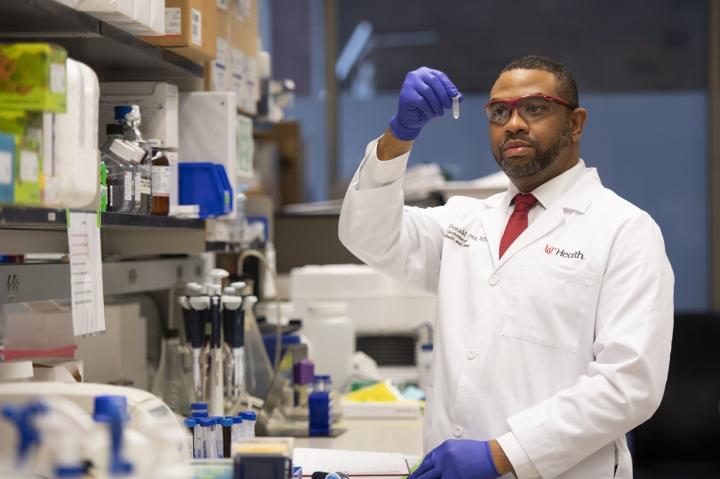
IMAGE

Credit: Colleen Kelley/UC Creative + Brand

A University of Cincinnati physician-researcher says unlocking the key to how platelets function before, after and during transcatheter aortic valve replacement (TAVR) may provide insight as to why some patients undergoing the heart procedure have better outcomes than others.

“We are looking at how platelets’ ability to contribute to clot formation are impacted by inflammation associated with endovascular procedures such as TAVR,” says Donald Lynch, MD, assistant professor in the UC College of Medicine and UC Health cardiologist. “We hope that these studies will help us understand why some patients have a persistent drop in platelet count which may be associated with excessive bleeding or clotting issues.”

Aortic stenosis, or narrowing of the valve in the blood vessel, occurs when the heart’s aortic valve thickens leading to a reduction in its opening. It affects about 4% of the population over age 75 and is a leading cause of heart failure and the need for transcatheter aortic valve replacements.

Lynch will conduct an observational study of 150 heart valve replacement patients at UC Medical Center and the University of Kentucky. These patients will undergo TAVR, a procedure in which a catheter-mounted valve is inserted through a small incision in the groin and is minimally invasive compared to open heart surgery. Patients who consent to participate in the study will have blood drawn before the procedure begins, prior to discharge and during clinic follow-ups to determine what biomarkers are predictive of short- and long-term clinical outcomes.

Lynch’s research is supported by a five-year grant of $898,020 recently awarded from the National Heart, Lung and Blood Institute. The research grant number is 1K23HL151872-01.

“TARV has become the gold standard for patients who have a narrowing of the aortic valve,” says Lynch. “Traditionally, the only way to definitely address patients with a narrowed aortic valve was to take them into the operating room, open their chest and take out the old valve and put in a new one. But during the past 14 years, TAVR has become an option for many patients.”

“The advantage is patients can usually go home the next day,” says Lynch. “Most patients do quite well, but there is a subset of patients that may have problems with clotting leading to a stroke or other issues such as bleeding. My study will help to determine why some patients may develop these issues and help us to find better ways to reduce this risk.”

“We are assessing components of blood itself using samples collected during the procedure to better understand how platelets and coagulation proteins may react differently in older versus younger patients,” says Lynch. “We are trying to determine how to best treat these patients.”

“My study is crucial because it helps to personalize therapies for patients,” says Lynch.

###

Media Contact
Cedric Ricks
[email protected]

Original Source

https://www.uc.edu/news/articles/2020/06/n20920759.html

Tags: CardiologyInternal MedicineMedicine/Health
Share12Tweet8Share2ShareShareShare2

Related Posts

Personalized Guide to Understanding and Reducing Chemicals

February 7, 2026

Inflammasome Protein ASC Drives Pancreatic Cancer Metabolism

February 7, 2026

Phage-Antibiotic Combo Beats Resistant Peritoneal Infection

February 7, 2026

Boosting Remote Healthcare: Stepped-Wedge Trial Insights

February 7, 2026
Please login to join discussion

POPULAR NEWS

  • Robotic Ureteral Reconstruction: A Novel Approach

    Robotic Ureteral Reconstruction: A Novel Approach

    82 shares
    Share 33 Tweet 21
  • Digital Privacy: Health Data Control in Incarceration

    63 shares
    Share 25 Tweet 16
  • Study Reveals Lipid Accumulation in ME/CFS Cells

    57 shares
    Share 23 Tweet 14
  • Breakthrough in RNA Research Accelerates Medical Innovations Timeline

    53 shares
    Share 21 Tweet 13

About

We bring you the latest biotechnology news from best research centers and universities around the world. Check our website.

Follow us

Recent News

Personalized Guide to Understanding and Reducing Chemicals

Inflammasome Protein ASC Drives Pancreatic Cancer Metabolism

Phage-Antibiotic Combo Beats Resistant Peritoneal Infection

Subscribe to Blog via Email

Enter your email address to subscribe to this blog and receive notifications of new posts by email.

Join 73 other subscribers
  • Contact Us

Bioengineer.org © Copyright 2023 All Rights Reserved.

Welcome Back!

Login to your account below

Forgotten Password?

Retrieve your password

Please enter your username or email address to reset your password.

Log In
No Result
View All Result
  • Homepages
    • Home Page 1
    • Home Page 2
  • News
  • National
  • Business
  • Health
  • Lifestyle
  • Science

Bioengineer.org © Copyright 2023 All Rights Reserved.