• HOME
  • NEWS
  • EXPLORE
    • CAREER
      • Companies
      • Jobs
    • EVENTS
    • iGEM
      • News
      • Team
    • PHOTOS
    • VIDEO
    • WIKI
  • BLOG
  • COMMUNITY
    • FACEBOOK
    • INSTAGRAM
    • TWITTER
Friday, June 19, 2026
BIOENGINEER.ORG
No Result
View All Result
  • Login
  • HOME
  • NEWS
  • EXPLORE
    • CAREER
      • Companies
      • Jobs
        • Lecturer
        • PhD Studentship
        • Postdoc
        • Research Assistant
    • EVENTS
    • iGEM
      • News
      • Team
    • PHOTOS
    • VIDEO
    • WIKI
  • BLOG
  • COMMUNITY
    • FACEBOOK
    • INSTAGRAM
    • TWITTER
  • HOME
  • NEWS
  • EXPLORE
    • CAREER
      • Companies
      • Jobs
        • Lecturer
        • PhD Studentship
        • Postdoc
        • Research Assistant
    • EVENTS
    • iGEM
      • News
      • Team
    • PHOTOS
    • VIDEO
    • WIKI
  • BLOG
  • COMMUNITY
    • FACEBOOK
    • INSTAGRAM
    • TWITTER
No Result
View All Result
Bioengineer.org
No Result
View All Result
Home NEWS Science News Chemistry

First optical measurements of Milky Way’s Fermi Bubbles probe their origin

Bioengineer by Bioengineer
June 3, 2020
in Chemistry
Reading Time: 2 mins read
0
IMAGE
Share on FacebookShare on TwitterShare on LinkedinShare on RedditShare on Telegram

IMAGE

Credit: Images by Dhanesh Krishnarao and NASA

MADISON -Using the Wisconsin H-Alpha Mapper telescope, astronomers have for the first time measured the Fermi Bubbles in the visible light spectrum. The Fermi Bubbles are two enormous outflows of high-energy gas that emanate from the Milky Way and the finding refines our understanding of the properties of these mysterious blobs.

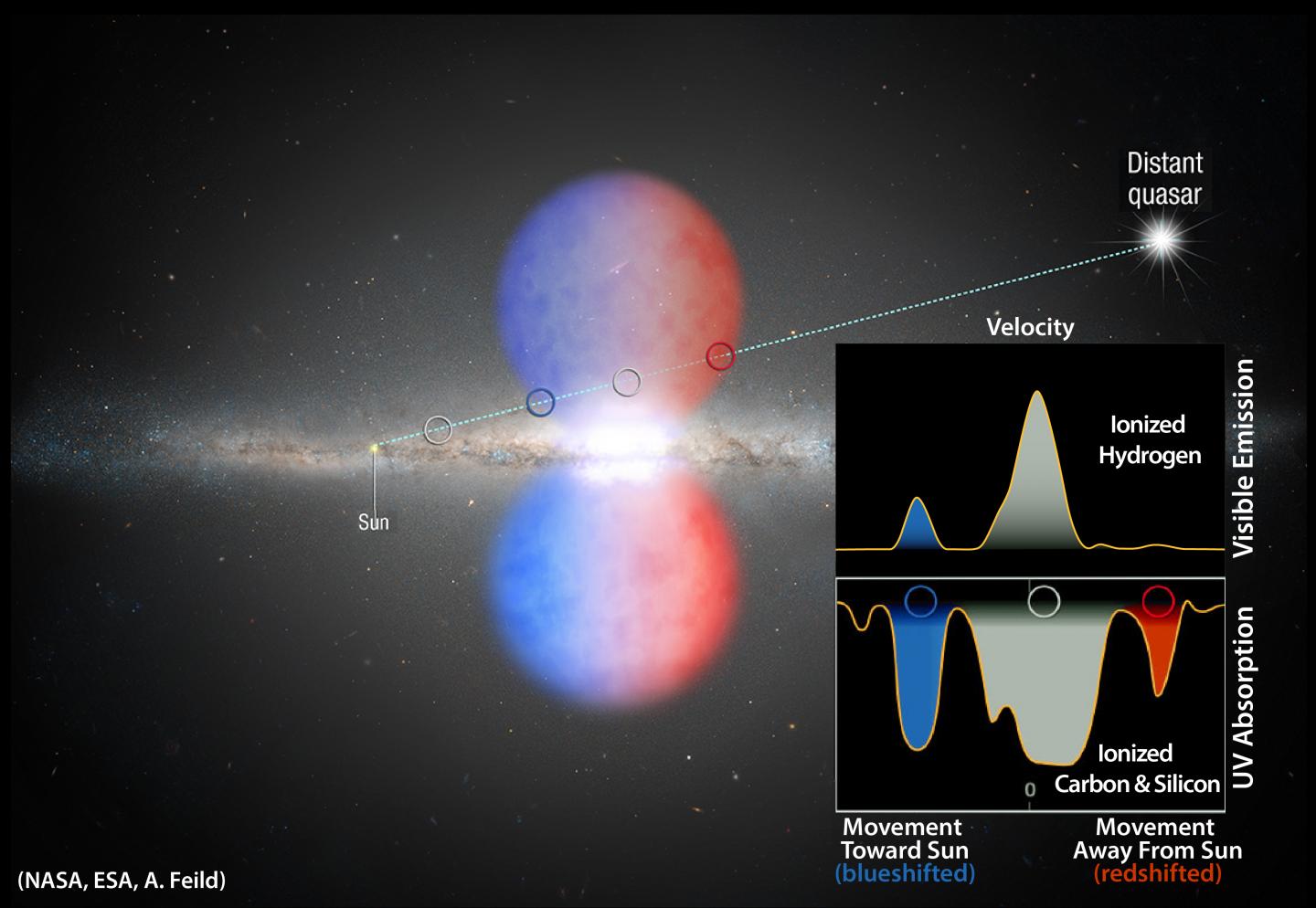
The research team from the University of Wisconsin-Madison, UW-Whitewater and Embry-Riddle Aeronautical University measured the emission of light from hydrogen and nitrogen in the Fermi Bubbles at the same position as recent ultraviolet absorption measurements made by the Hubble Telescope.

“We combined those two measurements of emission and absorption to estimate the density, pressure and temperature of the ionized gas, and that lets us better understand where this gas is coming from,” says Dhanesh Krishnarao, lead author of the new study and an astronomy graduate student at UW-Madison.

The researchers announced their findings June 3 at the 236th meeting of the American Astronomical Society, which was held virtually for the first time since 1899, in response to the COVID-19 pandemic.

Extending 25,000 light years both above and below the center of the Milky Way, the Fermi Bubbles were discovered in 2010 by the Fermi Gamma Ray Telescope. These faint but highly energetic outflows of gas are racing away from the center of the Milky Way at millions of miles per hour. But while the origin of the phenomenon has been inferred to date back several million years ago, the events that produced the bubbles remain a mystery.

Now, with new measurements of the density and pressure of the ionized gas, researchers can test models of the Fermi Bubbles against observations.

“The other significant thing is that we now have the possibility of measuring the density and pressure and the velocity structure in many locations,” with the all-sky WHAM telescope, says Bob Benjamin, a professor of astronomy at UW-Whitewater and co-author of the study. “We can do an extensive mapping effort across the Fermi Bubbles above and below the plane of the galaxy to see if the models that people have developed are holding up. Because, unlike the ultraviolet data, we’re not limited to just specific lines of sight.”

Matt Haffner, professor of physics and astronomy at Embry-Riddle Aeronautical University and a co-author of the report, says the work demonstrates the usefulness of the WHAM telescope, developed at UW-Madison, to tell us more about the workings of the Milky Way. The central region of our home galaxy has long been difficult to study because of gas blocking out view, but WHAM has provided new opportunities to gather the kind of information we have for distant galaxies.

“There are regions of the galaxy we can target with very sensitive instruments like WHAM to get this kind of new information toward the center that previously we are only able to do in the infrared and radio,” says Haffner. “We can make comparisons to other galaxies by making the same kind of measurements towards the center of the Milky Way.”

###

–Eric Hamilton, (608) 263-1986, [email protected]

Media Contact
Dhanesh Krishnarao
[email protected]

Tags: AstronomyAstrophysicsSpace/Planetary Science
Share12Tweet8Share2ShareShareShare2

Related Posts

Harnessing Machine Learning to Combat Antibiotic-Resistant Gonorrhea — Chemistry

Harnessing Machine Learning to Combat Antibiotic-Resistant Gonorrhea

June 17, 2026
Innovative Field Study Reveals Effective Method to Reduce Nitrogen Pollution in Tea Plantations — Chemistry

Innovative Field Study Reveals Effective Method to Reduce Nitrogen Pollution in Tea Plantations

June 17, 2026

Scientists Create Modular Nanorobot Inspired by Mini Lunar Rockets

June 17, 2026

Creating a Clean Energy Future Using Molecular Sponges

June 17, 2026
Please login to join discussion

POPULAR NEWS

  • ESMO 2025: mRNA COVID Vaccines Enhance Efficacy of Cancer Immunotherapy

    326 shares
    Share 130 Tweet 82
  • Saying Goodbye to PGY-6: Pediatric Fellowship Realities

    102 shares
    Share 41 Tweet 26
  • Multi-Hospital Study Reveals Long Covid Burden Is Twice as High as Current Estimates

    92 shares
    Share 36 Tweet 23
  • Detection of EDCs in Breast Milk and Infant Urine Up to Six Months Highlights Early Exposure Risks

    76 shares
    Share 30 Tweet 19

About

We bring you the latest biotechnology news from best research centers and universities around the world. Check our website.

Follow us

Recent News

Confined Migration Causes DNA Damage in Neurons

Multimodal Multitask AI Transforms Lung Cancer Grading

New Study Seeks to Prolong Immune System Longevity

Subscribe to Blog via Email

Success! An email was just sent to confirm your subscription. Please find the email now and click 'Confirm' to start subscribing.

Join 82 other subscribers
  • Contact Us

Bioengineer.org © Copyright 2023 All Rights Reserved.

Welcome Back!

Login to your account below

Forgotten Password?

Retrieve your password

Please enter your username or email address to reset your password.

Log In
No Result
View All Result
  • Homepages
    • Home Page 1
    • Home Page 2
  • News
  • National
  • Business
  • Health
  • Lifestyle
  • Science

Bioengineer.org © Copyright 2023 All Rights Reserved.