• HOME
  • NEWS
  • EXPLORE
    • CAREER
      • Companies
      • Jobs
    • EVENTS
    • iGEM
      • News
      • Team
    • PHOTOS
    • VIDEO
    • WIKI
  • BLOG
  • COMMUNITY
    • FACEBOOK
    • INSTAGRAM
    • TWITTER
Thursday, July 9, 2026
BIOENGINEER.ORG
No Result
View All Result
  • Login
  • HOME
  • NEWS
  • EXPLORE
    • CAREER
      • Companies
      • Jobs
        • Lecturer
        • PhD Studentship
        • Postdoc
        • Research Assistant
    • EVENTS
    • iGEM
      • News
      • Team
    • PHOTOS
    • VIDEO
    • WIKI
  • BLOG
  • COMMUNITY
    • FACEBOOK
    • INSTAGRAM
    • TWITTER
  • HOME
  • NEWS
  • EXPLORE
    • CAREER
      • Companies
      • Jobs
        • Lecturer
        • PhD Studentship
        • Postdoc
        • Research Assistant
    • EVENTS
    • iGEM
      • News
      • Team
    • PHOTOS
    • VIDEO
    • WIKI
  • BLOG
  • COMMUNITY
    • FACEBOOK
    • INSTAGRAM
    • TWITTER
No Result
View All Result
Bioengineer.org
No Result
View All Result
Home NEWS Science News Biology

Recycling plastics together, simple and fast

Bioengineer by Bioengineer
June 2, 2020
in Biology
Reading Time: 2 mins read
0
IMAGE
Share on FacebookShare on TwitterShare on LinkedinShare on RedditShare on Telegram

IMAGE

Credit: Limin Bao Ph.D., Faculty of Textile Science and Technology, Department of Mechanical Engineering and Robotics, Shinshu University

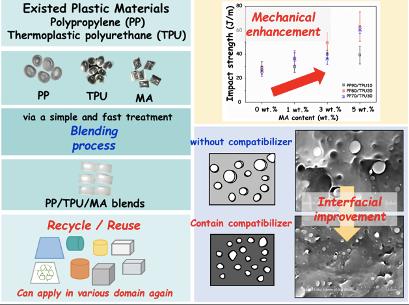
Recycling plastic faces several challenges, one of which is recycling different types of plastics together, because they have varying properties, each of which need to be addressed accordingly. Separating and treating each type of plastic adds to the cost of recycling plastic, which reduces the incentive to do so, despite the irreversible and detrimental biological cost of plastics in the environment.

Researchers Tingan LIN and Limin BAO of Shinshu University and their colleague examined the recyclability and sustainable development of thermoplastic materials. Material characteristics were also examined. A simple and fast treatment using a blending process would allow plastics to be useful again, rather than sitting in landfill. Plastics are the most used manmade material after steel and cement and they do not decompose like natural materials. This has lead to a lot of unwanted plastic in the environment. Melt or burn are the only ways to eliminate plastic waste, but cause other problems such as toxic fumes and add to global warming. Therefore, a method to melt different plastics together is urgently needed.

Polypropylene is a thermoplastics which means it is a plastic that can be heated and reshaped. It is used a lot in industry and household applications. The plastics examined in this study, thermoplastic polyurethane and polypropylene have significantly different melting points at 145 C° and 165 C°, so melting them together posed a challenge. To solve this issue, LIN et al. added an appropriate compatibilizer which acts as a go-between the plastics, which successfully enabled them to be processed together at the same time. The quality of the plastic was not undermined.

The researchers were able to efficiently produce thermoplastic blends using the melt extrusion process and injection molded process. Only a small amount of the compatibilizer, polypropylene grafted maleic anhydride was needed to do so. This finding would allow for unwanted plastic to be economically valued again and protect wildlife and the environment from further pollution. Professor Bao hopes to continue the study of thermal behaviors to see how they affect the reusability of thermoplastic-based materials.

For more information please read their paper: Polypropylene/thermoplastic polyurethane blends: mechanical characterizations, recyclability and sustainable development of thermoplastic materials.

###

Media Contact
Hitomi Thompson
[email protected]

Related Journal Article

http://dx.doi.org/10.1016/j.jmrt.2020.03.056

Tags: Chemistry/Physics/Materials SciencesEcology/EnvironmentMaterials
Share12Tweet8Share2ShareShareShare2

Related Posts

Caddisfly Silk Gene Rapidly Evolves While Keeping Its Stickiness

Caddisfly Silk Gene Rapidly Evolves While Keeping Its Stickiness

July 9, 2026
New Research Reveals Necks Exist in Fishes and Amphibians

New Research Reveals Necks Exist in Fishes and Amphibians

July 9, 2026

New Genetic Screen Advances Understanding of Human Development

July 9, 2026

California Gray Wolves Mainly Consume Cattle, Raising Human-Wildlife Conflicts

July 9, 2026
Please login to join discussion

POPULAR NEWS

  • Detection of EDCs in Breast Milk and Infant Urine Up to Six Months Highlights Early Exposure Risks

    77 shares
    Share 31 Tweet 19
  • New Drug Candidate Developed at McMaster Shows Potential for Treating Brain Cancer

    58 shares
    Share 23 Tweet 15
  • KTU Researchers Explore Ultrasound’s Role in Enhancing Blood Flow Beyond Diagnostics

    53 shares
    Share 21 Tweet 13
  • 高齢者の骨粗鬆症治療の持続性比較

    51 shares
    Share 20 Tweet 13

About

We bring you the latest biotechnology news from best research centers and universities around the world. Check our website.

Follow us

Recent News

Scientists Discover How the Uterus Naturally Heals Itself

Cosmic Protons Used to Verify Outer Space Treaty Compliance

Smelling chocolate may ease leg day workouts, even when fasting

Subscribe to Blog via Email

Enter your email address to subscribe to this blog and receive notifications of new posts by email.

Join 83 other subscribers
  • Contact Us

Bioengineer.org © Copyright 2023 All Rights Reserved.

Welcome Back!

Login to your account below

Forgotten Password?

Retrieve your password

Please enter your username or email address to reset your password.

Log In
No Result
View All Result
  • Homepages
    • Home Page 1
    • Home Page 2
  • News
  • National
  • Business
  • Health
  • Lifestyle
  • Science

Bioengineer.org © Copyright 2023 All Rights Reserved.