• HOME
  • NEWS
  • EXPLORE
    • CAREER
      • Companies
      • Jobs
    • EVENTS
    • iGEM
      • News
      • Team
    • PHOTOS
    • VIDEO
    • WIKI
  • BLOG
  • COMMUNITY
    • FACEBOOK
    • INSTAGRAM
    • TWITTER
Tuesday, January 13, 2026
BIOENGINEER.ORG
No Result
View All Result
  • Login
  • HOME
  • NEWS
  • EXPLORE
    • CAREER
      • Companies
      • Jobs
        • Lecturer
        • PhD Studentship
        • Postdoc
        • Research Assistant
    • EVENTS
    • iGEM
      • News
      • Team
    • PHOTOS
    • VIDEO
    • WIKI
  • BLOG
  • COMMUNITY
    • FACEBOOK
    • INSTAGRAM
    • TWITTER
  • HOME
  • NEWS
  • EXPLORE
    • CAREER
      • Companies
      • Jobs
        • Lecturer
        • PhD Studentship
        • Postdoc
        • Research Assistant
    • EVENTS
    • iGEM
      • News
      • Team
    • PHOTOS
    • VIDEO
    • WIKI
  • BLOG
  • COMMUNITY
    • FACEBOOK
    • INSTAGRAM
    • TWITTER
No Result
View All Result
Bioengineer.org
No Result
View All Result
Home NEWS Science News Chemistry

Researchers have developed a first-principles quantum Monte Carlo package called TurboRVB

Bioengineer by Bioengineer
June 1, 2020
in Chemistry
Reading Time: 2 mins read
0
IMAGE
Share on FacebookShare on TwitterShare on LinkedinShare on RedditShare on Telegram

IMAGE

Credit: AIP Publishing

First-principles quantum Monte Carlo is a framework used to tackle the solution of the many-body Schrödinger equation by means of a stochastic approach. This framework is expected to be the next generation of electronic structure calculations because it can overcome some of the drawbacks in density functional theory and wavefunction-based calculations. In particular, the quantum Monte Carlo framework does not rely on exchange-correlation functionals, the algorithm is well suited for massively parallel supercomputers, and it is easily applicable to both isolated and periodic systems.

“TurboRVB” is a first-principles quantum Monte Carlo software package that was initially launched by Prof. Sandro Sorella (International School for Advanced Studies/Italy) and Dr. Michele Casula (Sorbonne University/France), and has been continuously developed by many contributors for over 20 years. Very recently, Assist. Prof. Kosuke Nakano at Japan Advanced Institute of Science and Technology (JAIST, President: Minoru Terano, located at Nomi, Ishikawa, Japan) and his collaborators have published a comprehensive review paper in The Journal of Chemical Physics [K. Nakano et al. J. Chem. Phys. 152, 204121, 2020, DOI: 10.1063/5.0005037].

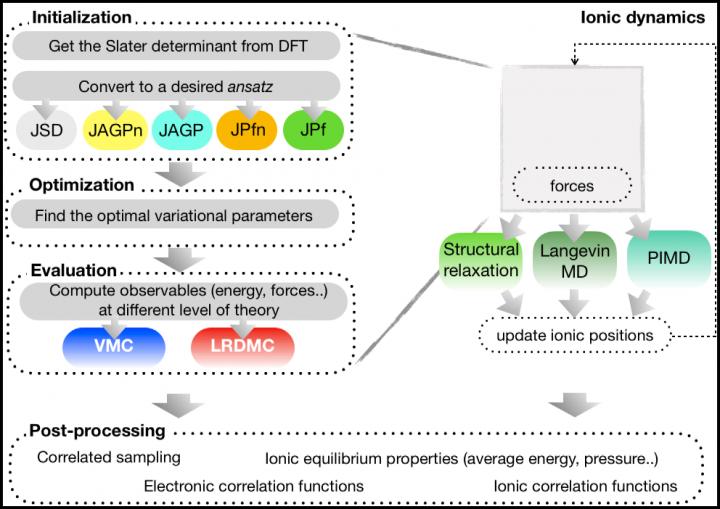
TurboRVB is distinguishable from other first-principles quantum Monte Carlo codes in the following features. (a) The code employs resonating valence bond (RVB)-type wave functions, such as the Jastrow Geminal/Jastrow Pfaffian, which include the correlation effect beyond the Jastrow-Slater wave function that is commonly used in other QMC codes. (b) Implemented state-of-art optimization algorithms, such as the stochastic reconfiguration and the linear method, help realize a stable optimization of the amplitude and nodal surface of a many-body wave function at the variational quantum Monte Carlo level. (c) The so-called lattice-regularized diffusion Monte Carlo method is implemented in the code, which provides a numerically stable diffusion quantum Monte Carlo calculation. (d) The implementation of an adjoint algorithmic differentiation allows us to compute derivatives of many-body wave functions very efficiently and to perform structural optimizations and molecular dynamics simulations.

###

The published paper describes the details of the algorithms implemented in TurboRVB and summarizes its applications to date.

TurboRVB (English)

Media Contact
Kosuke Nakano
[email protected]

Related Journal Article

http://dx.doi.org/10.1063/5.0005037

Tags: Atomic/Molecular/Particle PhysicsChemistry/Physics/Materials SciencesMaterialsMolecular Physics
Share12Tweet8Share2ShareShareShare2

Related Posts

blank

Thermal [2+2] Cycloaddition Builds Gem-Difluoro Bicycloalkanes

January 13, 2026
blank

Cobalt-Catalyzed Thioester Coupling via Siloxycarbene

January 12, 2026

Advancing Alkene Chemistry: Homologative Difunctionalization Breakthrough

January 8, 2026

Biocompatible Ligand Enables Safe In-Cell Protein Arylation

January 8, 2026
Please login to join discussion

POPULAR NEWS

  • Enhancing Spiritual Care Education in Nursing Programs

    154 shares
    Share 62 Tweet 39
  • PTSD, Depression, Anxiety in Childhood Cancer Survivors, Parents

    147 shares
    Share 59 Tweet 37
  • Robotic Ureteral Reconstruction: A Novel Approach

    72 shares
    Share 29 Tweet 18
  • Study Reveals Lipid Accumulation in ME/CFS Cells

    52 shares
    Share 21 Tweet 13

About

We bring you the latest biotechnology news from best research centers and universities around the world. Check our website.

Follow us

Recent News

Optimizing Pleurotus djamor Polysaccharides for Health Benefits

Global Sarcocystis Infection in Pigs: Trends and Predictions

Osimertinib ± Savolitinib in MET-EGFR NSCLC Trial

Subscribe to Blog via Email

Enter your email address to subscribe to this blog and receive notifications of new posts by email.

Join 71 other subscribers
  • Contact Us

Bioengineer.org © Copyright 2023 All Rights Reserved.

Welcome Back!

Login to your account below

Forgotten Password?

Retrieve your password

Please enter your username or email address to reset your password.

Log In
No Result
View All Result
  • Homepages
    • Home Page 1
    • Home Page 2
  • News
  • National
  • Business
  • Health
  • Lifestyle
  • Science

Bioengineer.org © Copyright 2023 All Rights Reserved.