• HOME
  • NEWS
  • EXPLORE
    • CAREER
      • Companies
      • Jobs
    • EVENTS
    • iGEM
      • News
      • Team
    • PHOTOS
    • VIDEO
    • WIKI
  • BLOG
  • COMMUNITY
    • FACEBOOK
    • INSTAGRAM
    • TWITTER
Saturday, February 7, 2026
BIOENGINEER.ORG
No Result
View All Result
  • Login
  • HOME
  • NEWS
  • EXPLORE
    • CAREER
      • Companies
      • Jobs
        • Lecturer
        • PhD Studentship
        • Postdoc
        • Research Assistant
    • EVENTS
    • iGEM
      • News
      • Team
    • PHOTOS
    • VIDEO
    • WIKI
  • BLOG
  • COMMUNITY
    • FACEBOOK
    • INSTAGRAM
    • TWITTER
  • HOME
  • NEWS
  • EXPLORE
    • CAREER
      • Companies
      • Jobs
        • Lecturer
        • PhD Studentship
        • Postdoc
        • Research Assistant
    • EVENTS
    • iGEM
      • News
      • Team
    • PHOTOS
    • VIDEO
    • WIKI
  • BLOG
  • COMMUNITY
    • FACEBOOK
    • INSTAGRAM
    • TWITTER
No Result
View All Result
Bioengineer.org
No Result
View All Result
Home NEWS Science News Biology

First fossil nursery of the great white shark discovered

Bioengineer by Bioengineer
May 22, 2020
in Biology
Reading Time: 2 mins read
0
IMAGE
Share on FacebookShare on TwitterShare on LinkedinShare on RedditShare on Telegram

Paleo-kindergarten ensured evolutionary success millions of years ago
IMAGE

Credit: ©Jaime Villafaña/Juergen Kriwet

The great white shark is one of the most charismatic, but also one of the most infamous sharks. Despite its importance as top predator in marine ecosystems, it is considered threatened with extinction; its very slow growth and late reproduction with only few offspring are – in addition to anthropogenic reasons – responsible for this.

Young white sharks are born in designated breeding areas, where they are protected from other predators until they are large enough not to fear competitors any more. Such nurseries are essential for maintaining stable and sustainable breeding population sizes, have a direct influence on the spatial distribution of populations and ensure the survival and evolutionary success of species. Researchers* have therefore intensified the search for such nurseries in recent years in order to mitigate current population declines of sharks by suitable protection measures. “Our knowledge about current breeding grounds of the great white shark is still very limited, however, and palaeo-nurseries are completely unknown”, explains Jaime Villafaña from the University of Vienna.

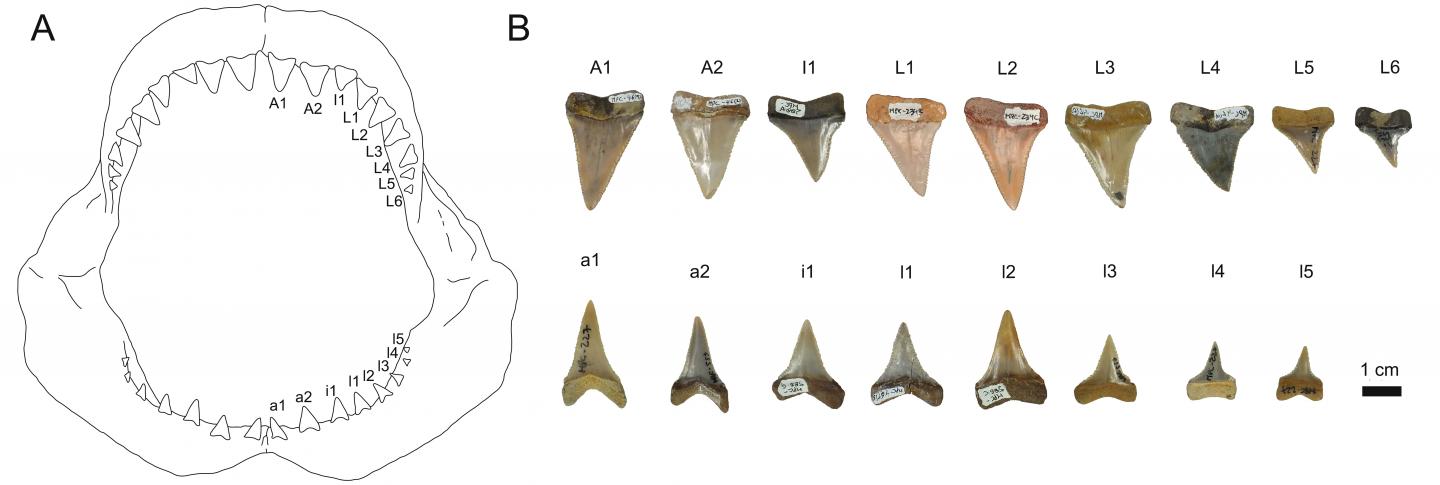
He and his colleagues analysed statistically 5 to 2 million year old fossil teeth of this fascinating shark, which were found at several sites along the Pacific coast of Chile and Peru, to reconstruct body size distribution patterns of great white shark in the past. The results show that body sizes varied considerably along the South American paleo-Pacific coast. One of these localities in northern Chile, Coquimbo, revealed the highest percentage of young sharks, the lowest percentage of “teenagers”. Sexually mature animals were completely absent.

This first undoubted paleo-nursery of the Great White Shark is of enormous importance. It comes from a time when the climate was much warmer than today, so that this time can be considered analogous to the expected global warming trends in the future. “If we understand the past, it will enable us to take appropriate protective measures today to ensure the survival of this top predator, which is of utmost importance for ecosystems,” explains palaeobiologist Jürgen Kriwet: “Our results indicate that rising sea surface temperatures will change the distribution of fish in temperate zones and shift these important breeding grounds in the future”.

This would have a direct impact on population dynamics of the great white shark and would also affect its evolutionary success in the future. “Studies of past and present nursery grounds and their response to temperature and paleo-oceanographic changes are essential to protect such ecological key species,” concluded Jürgen Kriwet.

###

Publication in Scientific Reports:

First evidence of a palaeo-nursery area of the great white shark.

Villafaña, J.A., Hernandez, S., Alvarado, A., Shimada, K., Pimiento, C., Rivadeneira, M.M. & Kriwet, J., in: Scientific Reports,

DOI: 10.1038/s41598-020-65101-1

Media Contact
Jürgen Kriwet
[email protected]

Related Journal Article

http://dx.doi.org/10.1038/s41598-020-65101-1

Tags: ArchaeologyEvolutionPaleontology
Share13Tweet8Share2ShareShareShare2

Related Posts

Florida Cane Toad: Complex Spread and Selective Evolution

Florida Cane Toad: Complex Spread and Selective Evolution

February 7, 2026
New Study Uncovers Mechanism Behind Burn Pit Particulate Matter–Induced Lung Inflammation

New Study Uncovers Mechanism Behind Burn Pit Particulate Matter–Induced Lung Inflammation

February 6, 2026

DeepBlastoid: Advancing Automated and Efficient Evaluation of Human Blastoids with Deep Learning

February 6, 2026

Navigating the Gut: The Role of Formic Acid in the Microbiome

February 6, 2026
Please login to join discussion

POPULAR NEWS

  • Robotic Ureteral Reconstruction: A Novel Approach

    Robotic Ureteral Reconstruction: A Novel Approach

    82 shares
    Share 33 Tweet 21
  • Digital Privacy: Health Data Control in Incarceration

    63 shares
    Share 25 Tweet 16
  • Study Reveals Lipid Accumulation in ME/CFS Cells

    57 shares
    Share 23 Tweet 14
  • Breakthrough in RNA Research Accelerates Medical Innovations Timeline

    53 shares
    Share 21 Tweet 13

About

We bring you the latest biotechnology news from best research centers and universities around the world. Check our website.

Follow us

Recent News

Boosting Remote Healthcare: Stepped-Wedge Trial Insights

Barriers and Boosters of Seniors’ Physical Activity in Karachi

Evaluating Pediatric Emergency Care Quality in Ethiopia

Subscribe to Blog via Email

Enter your email address to subscribe to this blog and receive notifications of new posts by email.

Join 73 other subscribers
  • Contact Us

Bioengineer.org © Copyright 2023 All Rights Reserved.

Welcome Back!

Login to your account below

Forgotten Password?

Retrieve your password

Please enter your username or email address to reset your password.

Log In
No Result
View All Result
  • Homepages
    • Home Page 1
    • Home Page 2
  • News
  • National
  • Business
  • Health
  • Lifestyle
  • Science

Bioengineer.org © Copyright 2023 All Rights Reserved.