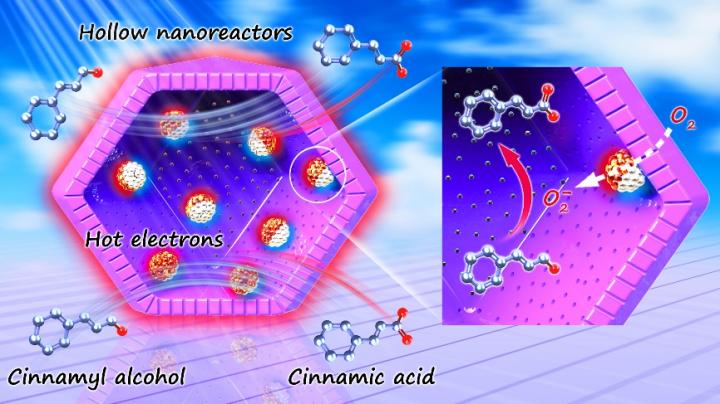
Credit: ©Science China Press
Oxidation of primary alcohols to carboxylic acids is of importance in both organic chemistry and chemical industry because the oxidation products can be used to prepare various pharmaceuticals and useful chemicals. Photocatalytic oxidation process has been considered as a sustainable technology to achieve the selective oxidation under ambient conditions with irradiation from solar light. To develop superior photocatalysts with a broad-range of light absorption and efficient electron-hole separation, surface modification with metal nanoparticles such as Au and Pt allow for the fast transfer of photoexcited electrons to the surface active sites. Therefore, bimetallic Au and Pt catalysts would be desirable by combining the advantages of both surface plasmonic resonance effect on Au and activation effect on Pt to further enhance the efficiency for catalytic oxidation under visible light irradiation.
Hollow structured materials have shown great potential in a variety of applications, including catalysis, drug release and delivery, and energy storage and conversion. High specific surface area and discrete voids afford abundant accessible surface sites and immobilization of reactive centers for catalytic reactions. More reactant molecules can be adsorbed and enriched within the hollow structure to accelerate reactions. However, it remains challenge to develop a facile and mild synthetic method to simultaneously create efficient hollow photocatalytic nanoreactor with ordered porous channels on the shell, well-controlled metal location, broad-spectrum utilization and well-controlled mass transfer and diffusion.
In a new research article published in the Beijing-based National Science Review, scientists at Dalian Institute of Chemical Physics, Chinese Academy of Sciences, University of Surrey,University of Technology Sydney and The University of Sydney demonstrated a facile synthesis of hollow-structured photocatalysts with controllable spatial location of active metals, chemical compositions and tunable shell thickness. Hollow structures can be achieved through coating SiO2 on the surface of ZIF-8 and a subsequent hydrothermal treatment. The formation mechanism of hollow structure is systematically investigated and a “adhesive-contraction” model is proposed. AuPt@HMZS nanoreactors exhibited broader absorbance region under visible light and excellent catalytic activity in cinnamyl alcohol oxidation to cinnamic acid with 99% selectivity.
AuPt@HMZS nanoreactors has the following advantages: i) Broader absorbance region under visible light; ii) Multiple light scattering can be generated within a hollow void to enhance light-harvesting process and heat generated by the photo-thermal effect is collected; iii) The uniform channels are excellent to facilitate the reactant diffusion and mass transfer; iv) A synergetic effect among plasmonic hot electron injection and electron trapping improves solar energy utilization and electron-hole separation of photocatalysts; v) The strong metal-metal interactions at the alloy interface tune the reaction performance. “The proposed strategy to build hollow structures as multifunctional micro/nanoreactors is promising for the design of high-performance and sustainable catalysts for chemical synthesis.” Prof. Jian Liu said. “It is an amazing technology for construction of micro/nanoreactors with precise spatial location of active sites” Prof. Jun Huang added.
###
This research received funding from the Dalian National Laboratory for Clean Energy (DNL) Cooperation Fund, Chinese Academy of Sciences, the Australian Research Council Discovery Projects and the SOAR Fellowship from the University of Sydney.
See the article:
Hao Tian, Jinhui Zhao, Xinyao Wang, Lizhuo Wang, Hao Liu, Guoxiu Wang, Jun Huang, Jian Liu and G Q (Max) Lu
Construction of hollow mesoporous silica nanoreactors for enhanced photo-oxidations over Au-Pt catalysts
Natl Sci Rev 2020; doi: 10.1093/nsr/nwaa080
a target=”_blank” href=”https://doi.org/10.1093/nsr/nwaa080″>https:/
The National Science Review is the first comprehensive scholarly journal released in English in China that is aimed at linking the country’s rapidly advancing community of scientists with the global frontiers of science and technology. The journal also aims to shine a worldwide spotlight on scientific research advances across China.
Media Contact
Xinyao Wang
[email protected]
Related Journal Article
http://dx.