Credit: ©Science China Press
Organic field-effect transistors (OFETs) are the heart of plastic electronics. Doping has been proven to improve the performance of OFETs effectively. There are two major ways of doping OSCs.
The first strategy is bulk doping. Bulk doping involves the solution phase blending or vapor phase co-deposition of the dopants with the host OSCs. However, bulk doping introduces structural defects and energetic disorders in the host material, which reduces the mobility of the organic semiconductors.
The second strategy is surface doping. Surface doping is achieved by the deposition of dopants on surfaces of the host OSCs. Compared with bulk doping, the dopants are not incorporated into the lattice of the host, and thus the induction of structural defects and energetic disorders by common bulk doping are eliminated.
As a result, surface doping is considered as a useful strategy for nondestructive doping of OSCs. Up to now, dopants of various structures have been applied in surface doping. However, most of the dopants are polycrystalline thin films and their thicknesses are not well controlled, Therefore, the performance improvements of OSCs are restricted.
Two-dimensional molecular crystals (2DMCs) are periodically arranged monolayer or few-layered organic molecules held together by weak interactions (e.g., hydrogen bonds, π-π interactions, van der Waals forces) in a 2D plane. They are continuous ultrathin films with long-range order.
Moreover, the thickness of the 2DMCs can be tuned at monolayer level, enabling highly controllable doping of OSCs at mono-layer precision. As a result, 2DMCs are potentially favorable materials as dopants for surface doping.
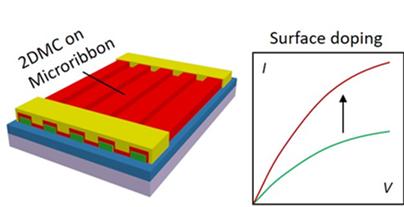
Very recently, Dr. Rongjin Li and colleagues in Tianjin University reported a highly effective and highly controllable surface doping strategy based on 1D/2D composite single crystal to boost the mobility and to modulate the threshold voltage of OFETs.
Taking advantage of the molecular scale thickness of the 2DMC dopants, tight attachment to the surface of the host OSCs is ensured and efficient doping is achieved. More importantly, the molecular scale thickness of the 2DMC with controllable layers ensures precise doping of the host material at monolayer precision.
In their study, 1D organic single-crystalline microribbons of TIPS-pentacene were adopted as an example OSC. Compared with the pristine materials, the average mobility of OFETs based on 1D/2D composite single crystals increased from 1.31 cm2/V* s to 4.71 cm2/V* s, corresponding to an increase of 260%. Meanwhile, a substantial reduction of the threshold voltage from -18.5 V to -1.8 V was achieved. The maximum mobility of 5.63 cm2/V* s was higher than the vast majority of reported mobilities for TIPS-pentacene so far as we know. Moreover, high on/off ratios of up to 108 were retained. Surface doping by 2DMCs provides a highly efficient and highly controllable strategy to modulate the optoelectronic properties of OSCs for various applications.
###
See the article: Zhang Y, Yang S, Zhu X, Zhai F, Feng Y, Feng W, Zhang X, Li R, Hu W. Highly efficient modulation of the electronic properties of organic semiconductors by surface doping with 2D molecular crystals. Sci China Chem., 2020, DOI:10.1007/s11426-020-9765-8.
http://engine.
Media Contact
Rongjin Li
[email protected]
Related Journal Article
http://dx.