• HOME
  • NEWS
  • EXPLORE
    • CAREER
      • Companies
      • Jobs
    • EVENTS
    • iGEM
      • News
      • Team
    • PHOTOS
    • VIDEO
    • WIKI
  • BLOG
  • COMMUNITY
    • FACEBOOK
    • INSTAGRAM
    • TWITTER
Saturday, February 7, 2026
BIOENGINEER.ORG
No Result
View All Result
  • Login
  • HOME
  • NEWS
  • EXPLORE
    • CAREER
      • Companies
      • Jobs
        • Lecturer
        • PhD Studentship
        • Postdoc
        • Research Assistant
    • EVENTS
    • iGEM
      • News
      • Team
    • PHOTOS
    • VIDEO
    • WIKI
  • BLOG
  • COMMUNITY
    • FACEBOOK
    • INSTAGRAM
    • TWITTER
  • HOME
  • NEWS
  • EXPLORE
    • CAREER
      • Companies
      • Jobs
        • Lecturer
        • PhD Studentship
        • Postdoc
        • Research Assistant
    • EVENTS
    • iGEM
      • News
      • Team
    • PHOTOS
    • VIDEO
    • WIKI
  • BLOG
  • COMMUNITY
    • FACEBOOK
    • INSTAGRAM
    • TWITTER
No Result
View All Result
Bioengineer.org
No Result
View All Result
Home NEWS Science News Chemistry

Scientists find a high hydrofluorocarbon emissions intensity in the Yangtze River Delta region

Bioengineer by Bioengineer
May 19, 2020
in Chemistry
Reading Time: 2 mins read
0
IMAGE
Share on FacebookShare on TwitterShare on LinkedinShare on RedditShare on Telegram

IMAGE

Credit: Bo Yao

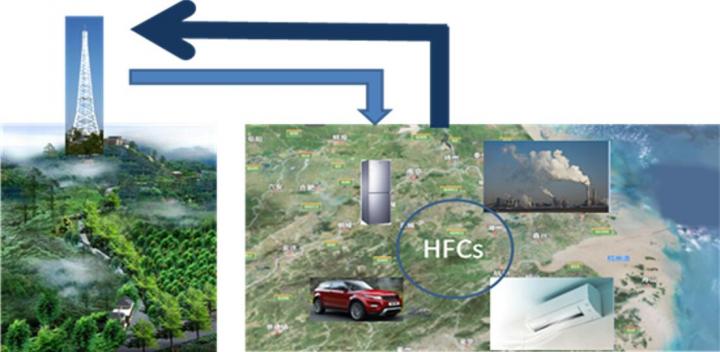
Hydrofluorocarbons (HFCs) have been widely used as substitutes for ozone-depleting substances–for example, hydrochlorofluorocarbons (HCFCs) and chlorofluorocarbons (CFCs). Though HFCs have no impact on the ozone layer, they are also long-lived potent greenhouse gases with global warming potentials as high as CFCs, meaning HFCs are regulated by both the Montreal Protocol as well as the Kyoto Protocol. China is a major consumer of HFCs around the world. How to estimate HFC emissions as accurately as possible is therefore a key issue to understand regional contributions, especially for potential emission source areas.

In a recently published study in Advances in Atmospheric Sciences, Dr. Bo Yao from the China Meteorological Administration worked with local scientists in Zhejiang Province, and together they estimated the emissions of HFCs in the Yangtze River Delta (YRD) region by a tracer ratio method for the period 2012-2016.

“The YRD region is a fast-growing region in China with rapid urbanization and industrialization,” explains Dr Yao, who is the Chief Scientist of greenhouse gases at the Meteorological Observation Center of the China Meteorological Administration. Dr Yao further explains why the YRD was selected as the target of their study: “Rapid economic growth has been partly driven by the expanding manufacturing sector, including the fluorine chemical industry, production of electronics, air conditioners, refrigerators and automobiles, which would result in a large amount of HFC emissions.”

Yao’s team chose CO as a tracer to estimate the HFC emissions. “We employed the tracer ratio method, for it is more objective than the bottom-up inventory approach and easier than the top-down method by inverse modeling,” he adds. the team found that the YRD contributes around one third of the national total HFC CO2-equivalent emissions. The emissions intensity of HFCs in this area is also higher than both national and global levels, in terms of per capita, per unit area, or per unit GDP.

Ten HFC species were studied, among which HFC-23 was found to contribute approximately two thirds of all HFC emissions in terms of CO2-equivalent emissions in the YRD. “HFC-23 is a byproduct from the fluorine industry, or very limited fluorine chemistry plants, in the YRD. If HFC-23 emissions were totally eliminated, the HFC CO2-equivalent emission in the YRD would drop down obviously, and the emissions intensity of the YRD would be lower than national and global levels. So, HFC-23 is the key chemical when considering the mitigation potential of HFCs in the YRD, or even in China as a whole,” suggests Yao.

###

Media Contact
Ms. Zheng Lin
[email protected]

Related Journal Article

http://dx.doi.org/10.1007/s00376-020-9242-3

Tags: Atmospheric ScienceChemistry/Physics/Materials SciencesClimate ChangeEarth SciencePolicy/Ethics
Share12Tweet8Share2ShareShareShare2

Related Posts

blank

Breakthrough in Environmental Cleanup: Scientists Develop Solar-Activated Biochar for Faster Remediation

February 7, 2026
blank

Cutting Costs: Making Hydrogen Fuel Cells More Affordable

February 6, 2026

Scientists Develop Hand-Held “Levitating” Time Crystals

February 6, 2026

Observing a Key Green-Energy Catalyst Dissolve Atom by Atom

February 6, 2026
Please login to join discussion

POPULAR NEWS

  • Robotic Ureteral Reconstruction: A Novel Approach

    Robotic Ureteral Reconstruction: A Novel Approach

    82 shares
    Share 33 Tweet 21
  • Digital Privacy: Health Data Control in Incarceration

    63 shares
    Share 25 Tweet 16
  • Study Reveals Lipid Accumulation in ME/CFS Cells

    57 shares
    Share 23 Tweet 14
  • Breakthrough in RNA Research Accelerates Medical Innovations Timeline

    53 shares
    Share 21 Tweet 13

About

We bring you the latest biotechnology news from best research centers and universities around the world. Check our website.

Follow us

Recent News

Improving Dementia Care with Enhanced Activity Kits

Decoding Prostate Cancer Origins via snFLARE-seq, mxFRIZNGRND

Digital Health Perspectives from Baltic Sea Experts

Subscribe to Blog via Email

Enter your email address to subscribe to this blog and receive notifications of new posts by email.

Join 73 other subscribers
  • Contact Us

Bioengineer.org © Copyright 2023 All Rights Reserved.

Welcome Back!

Login to your account below

Forgotten Password?

Retrieve your password

Please enter your username or email address to reset your password.

Log In
No Result
View All Result
  • Homepages
    • Home Page 1
    • Home Page 2
  • News
  • National
  • Business
  • Health
  • Lifestyle
  • Science

Bioengineer.org © Copyright 2023 All Rights Reserved.