• HOME
  • NEWS
  • EXPLORE
    • CAREER
      • Companies
      • Jobs
    • EVENTS
    • iGEM
      • News
      • Team
    • PHOTOS
    • VIDEO
    • WIKI
  • BLOG
  • COMMUNITY
    • FACEBOOK
    • INSTAGRAM
    • TWITTER
Saturday, February 7, 2026
BIOENGINEER.ORG
No Result
View All Result
  • Login
  • HOME
  • NEWS
  • EXPLORE
    • CAREER
      • Companies
      • Jobs
        • Lecturer
        • PhD Studentship
        • Postdoc
        • Research Assistant
    • EVENTS
    • iGEM
      • News
      • Team
    • PHOTOS
    • VIDEO
    • WIKI
  • BLOG
  • COMMUNITY
    • FACEBOOK
    • INSTAGRAM
    • TWITTER
  • HOME
  • NEWS
  • EXPLORE
    • CAREER
      • Companies
      • Jobs
        • Lecturer
        • PhD Studentship
        • Postdoc
        • Research Assistant
    • EVENTS
    • iGEM
      • News
      • Team
    • PHOTOS
    • VIDEO
    • WIKI
  • BLOG
  • COMMUNITY
    • FACEBOOK
    • INSTAGRAM
    • TWITTER
No Result
View All Result
Bioengineer.org
No Result
View All Result
Home NEWS Science News Chemistry

New comet discovered by ESA and NASA solar observatory

Bioengineer by Bioengineer
May 13, 2020
in Chemistry
Reading Time: 2 mins read
0
IMAGE
Share on FacebookShare on TwitterShare on LinkedinShare on RedditShare on Telegram

IMAGE

Credit: ESA/NASA/SOHO

In late May and early June, Earthlings may be able to glimpse Comet SWAN. The comet is currently faintly visible to the unaided eye in the Southern Hemisphere just before sunrise — providing skywatchers with a relatively rare glimpse of a comet bright enough to be seen without a telescope. But Comet SWAN’s initial discovery was made not from the ground, but via an instrument on board ESA (the European Space Agency) and NASA’s Solar and Heliospheric Observatory, or SOHO, satellite.

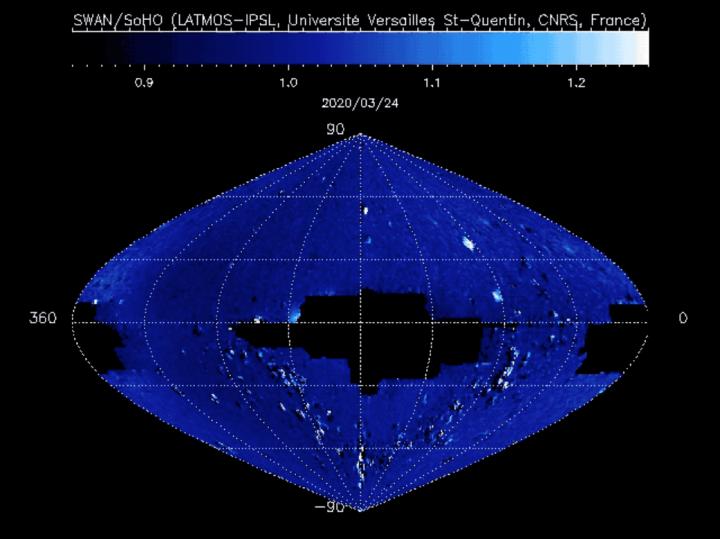
The new comet was first spotted in April 2020, by an amateur astronomer named Michael Mattiazzo using data from a SOHO instrument called Solar Wind Anisotropies, or SWAN — as seen here. The comet appears to leave the left side of the image and reappear on the right side around May 3, because of the way SWAN’s 360-degree all-sky maps are shown, much like a globe is represented by a 2D map.

SWAN maps the constantly outflowing solar wind in interplanetary space by focusing on a particular wavelength of ultraviolet light emitted by hydrogen atoms. The new comet — officially classified C/2020 F8 (SWAN) but nicknamed Comet SWAN — was spotted in the images because it’s releasing huge amounts of water, about 1.3 tons per second. As water is made of hydrogen and oxygen, this release made Comet SWAN visible to SOHO’s instruments.

Comet SWAN is the 3,932nd comet discovered using data from SOHO. Almost all of the nearly 4,000 discoveries have been made using data from SOHO’s coronagraph, an instrument that blocks out the Sun’s bright face using a metal disk to reveal the comparatively faint outer atmosphere, the corona. This is only the 12th comet discovered with the SWAN instrument since SOHO’s launch in 1995, eight of which were also discovered by Mattiazzo.

Comet SWAN makes its closest approach to Earth on May 13, at a distance of about 53 million miles. Comet SWAN’s closest approach to the Sun, called perihelion, will happen on May 27.

Though it can be very difficult to predict the behavior of comets that make such close approaches to the Sun, scientists are hopeful that Comet SWAN will remain bright enough to be seen as it continues its journey.

###

Media Contact
Sarah Frazier
[email protected]

Original Source

https://www.nasa.gov/feature/goddard/2020/new-comet-discovered-by-esa-and-nasa-solar-observatory

Tags: AstronomyAstrophysicsComets/AsteroidsSatellite Missions/ShuttlesSpace/Planetary Science
Share12Tweet8Share2ShareShareShare2

Related Posts

blank

Breakthrough in Environmental Cleanup: Scientists Develop Solar-Activated Biochar for Faster Remediation

February 7, 2026
blank

Cutting Costs: Making Hydrogen Fuel Cells More Affordable

February 6, 2026

Scientists Develop Hand-Held “Levitating” Time Crystals

February 6, 2026

Observing a Key Green-Energy Catalyst Dissolve Atom by Atom

February 6, 2026
Please login to join discussion

POPULAR NEWS

  • Robotic Ureteral Reconstruction: A Novel Approach

    Robotic Ureteral Reconstruction: A Novel Approach

    82 shares
    Share 33 Tweet 21
  • Digital Privacy: Health Data Control in Incarceration

    63 shares
    Share 25 Tweet 16
  • Study Reveals Lipid Accumulation in ME/CFS Cells

    57 shares
    Share 23 Tweet 14
  • Breakthrough in RNA Research Accelerates Medical Innovations Timeline

    53 shares
    Share 21 Tweet 13

About

We bring you the latest biotechnology news from best research centers and universities around the world. Check our website.

Follow us

Recent News

Personalized Guide to Understanding and Reducing Chemicals

Inflammasome Protein ASC Drives Pancreatic Cancer Metabolism

Phage-Antibiotic Combo Beats Resistant Peritoneal Infection

Subscribe to Blog via Email

Enter your email address to subscribe to this blog and receive notifications of new posts by email.

Join 73 other subscribers
  • Contact Us

Bioengineer.org © Copyright 2023 All Rights Reserved.

Welcome Back!

Login to your account below

Forgotten Password?

Retrieve your password

Please enter your username or email address to reset your password.

Log In
No Result
View All Result
  • Homepages
    • Home Page 1
    • Home Page 2
  • News
  • National
  • Business
  • Health
  • Lifestyle
  • Science

Bioengineer.org © Copyright 2023 All Rights Reserved.