Credit: ©Science China Press
Sound is one of the ancient physical phenomena people studied. Researcher have been exploring the mystery of sound all the time. In recent years, more and more attention has been applied to the study of near-field acoustics. Near-field evanescent wave is a common wave pattern. Its intensity decreases exponentially with distance and tends to be highly spatially confined. Because near-field evanescent wave can carry information and have a high energy density, it has a very broad application prospect in efficient communication, wireless energy transfer and so on. Among these practical applications, one of the main goals is to achieve the selective directional coupling. However, the near-field selective coupling is difficult to realize because it does not have directional properties like the far-field wave. Exploitations of near-field waves are limited due to the lack of fundamental understandings about inherent near-field symmetry and directional coupling at subwavelengths, especially for longitudinal waves.
Although it is still a difficult challenge to selectively regulate evanescent wave in subwavelength, its value is self-evident. It can not only promote our understanding the physics nature of the near-field wave, but also lead the development of richer functional devices in “sound, light, vibration, heat” and so on.
Now, most works about selective regulation of near-field waves usually base on optics by using specific incident excitation conditions (e.g., left- or right-handed light) and complex anisotropic resonance structures. However, compared with the transverse wave, the longitudinal wave lacks abundant natural polarization degrees of freedom. So, the study and exploitations of near-field longitudinal waves are severely limited. Recently, Yang Long, Hao Ge et al. from Tongji University and Nanjing University made an exciting progress. They proposed a detailed scheme to realize the selective coupling of near-field longitudinal wave based on the inherent geometric properties and symmetry analysis of evanescent wave in experiment and theory.
Symmetry is a common and interesting phenomenon in our life and plays an important role in physics. Based on symmetry, Dirac proposed that electrons have positrons and negative electrons. Symmetry not only has the geometric beauty on the surface, but also has rich physical connotations. In this work, the authors propose a scheme for the directional design of general near-field waves from the perspective of symmetry.
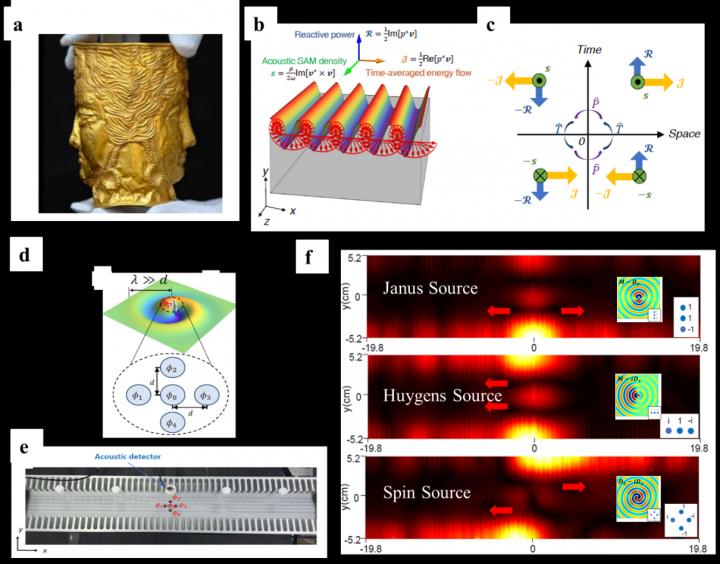
The dynamic features of near-field waves can be described by three geometrically-orthogonal physical vectors: time-averaged energy flow (Poynting vector) J, reactive power R and spin angular momentum (SAM) s.(Fig.(b)). According to the inherent geometrical properties of these quantities, the researchers obtained their different symmetries–the Poynting vector J, the reactive power R, and the SAM s are individually invariant under parity-time, time-reversal and parity transformations, respectively (Fig.(c)). Owing to the inherent geometry and symmetry of these quantities, the near-field acoustic modes carry their symmetry properties as well and the different combinations of multiple near-field waves will have different symmetries. For example, if a square and a circle are superimposed, the combined new figure will have some new symmetries.
Regarding directional coupling, in the past, one usually realise different propagation directions through spin quantity locking by using different spins and chirality, based on the quantum-like spin hall effect of waves. In 2018, the research group of Tongji University published a paper to reveal the unique spin angular momentum of longitudinal wave, and realized directional coupling based on spin quantity locking in experiment with Berkeley research group. In this new work, the authors proposed a solution to achieve near-field acoustic wave directional coupling with Janus and Huygens sources, which goes further than spin locking with acoustic spin. Janus was the god of the gate in Roman mythology. He had a face on each side of his head, so he was also known as the god of two faces (Fig.(a)). As the name suggests, the two-sided Janus source will selectively only couple with one side of the near-field pattern (in this work with the upper or lower surface), a property that is unique to the near-field. However, Huygens source is a one-way selection regardless of the far field and the near field. In this paper, it is only coupled to the left side or the right side, which is perpendicular to the direction of the Janus source.
But how can we realize these in near-field acoustics? According to the acoustic radiation theory, sound source can be regarded as the linear superposition of monopole, dipole and quadrupole. These superposition terms are usually used to excite fertile far-field acoustic wave modes. Therefore, Janus, Huygens and spin sources can be realized by different combinations of acoustic modes. Based on the above analysis, the researchers built three acoustic signal sources by placing five speakers as cross bending shape which amplitude and phase can be independently controlled (Fig.(d)). The five speakers can realize arbitrary combination of acoustic monopoles and dipoles. According to the near-field acoustic coupling theory they proposed, the three signal sources have different symmetry properties:
- 1) Acoustic Janus source is parity anti-symmetric and time symmetric.
- 2) Acoustic Huygens source is parity-time symmetric.
- 3) Acoustic spin source is parity symmetric and time anti-symmetric.
Interestingly, the three sources could be excited using the same J, R, s, respectively.
To verify the symmetry-selected directional near-field excitations in experiments, the researchers selectively activated different mode combinations of loudspeakers in the comb-like structure to realize the three sources (Fig.(e)). For a normal source, when the signal is motivated in the middle of the system, the sound will be transmitted along the all the upper and lower boundaries (total four branches). However, when the signal source has different symmetry, the selective directional transmission of sound waves is found (Fig.(f)): 1) the Janus source is selectively coupled to a unilateral (upper or lower) surface; 2) Huygens source can excite unidirectional (left or right) surface modes due to the directional transport character of the energy flow. 3) The acoustic spin source is excited diagonally.
This is in good agreement with previous theoretical predictions. In addition, when different sources are excited, the symmetry of spin angular momentum in acoustic near-field wave has been fully discussed and experimentally verified.
“This work opens a new door for the symmetry research of near-field evanescent wave, which can guide the directional design of near-field wave sources with novel properties,” Professor Jie Ren said. “In the future, it is worth applying to the directional transportation of phonon information and energy in the on-chip nano-phononic devices.”
###
See the article:
Yang Long#, Hao Ge#, Danmei Zhang, Xiangyuan Xu, Jie Ren*, Ming-Hui Lu*, Ming Bao, Hong Chen, Yan-Feng Chen
Symmetry Selective Directionality in Near-Field Acoustics
National Science Review, nwaa040,
https:/
Media Contact
Jie Ren
[email protected]
Related Journal Article
http://dx.