• HOME
  • NEWS
  • EXPLORE
    • CAREER
      • Companies
      • Jobs
    • EVENTS
    • iGEM
      • News
      • Team
    • PHOTOS
    • VIDEO
    • WIKI
  • BLOG
  • COMMUNITY
    • FACEBOOK
    • INSTAGRAM
    • TWITTER
Friday, June 26, 2026
BIOENGINEER.ORG
No Result
View All Result
  • Login
  • HOME
  • NEWS
  • EXPLORE
    • CAREER
      • Companies
      • Jobs
        • Lecturer
        • PhD Studentship
        • Postdoc
        • Research Assistant
    • EVENTS
    • iGEM
      • News
      • Team
    • PHOTOS
    • VIDEO
    • WIKI
  • BLOG
  • COMMUNITY
    • FACEBOOK
    • INSTAGRAM
    • TWITTER
  • HOME
  • NEWS
  • EXPLORE
    • CAREER
      • Companies
      • Jobs
        • Lecturer
        • PhD Studentship
        • Postdoc
        • Research Assistant
    • EVENTS
    • iGEM
      • News
      • Team
    • PHOTOS
    • VIDEO
    • WIKI
  • BLOG
  • COMMUNITY
    • FACEBOOK
    • INSTAGRAM
    • TWITTER
No Result
View All Result
Bioengineer.org
No Result
View All Result
Home NEWS Science News Chemistry

Fossil fuel-free jet propulsion with air plasmas

Bioengineer by Bioengineer
May 5, 2020
in Chemistry
Reading Time: 3 mins read
0
IMAGE
Share on FacebookShare on TwitterShare on LinkedinShare on RedditShare on Telegram

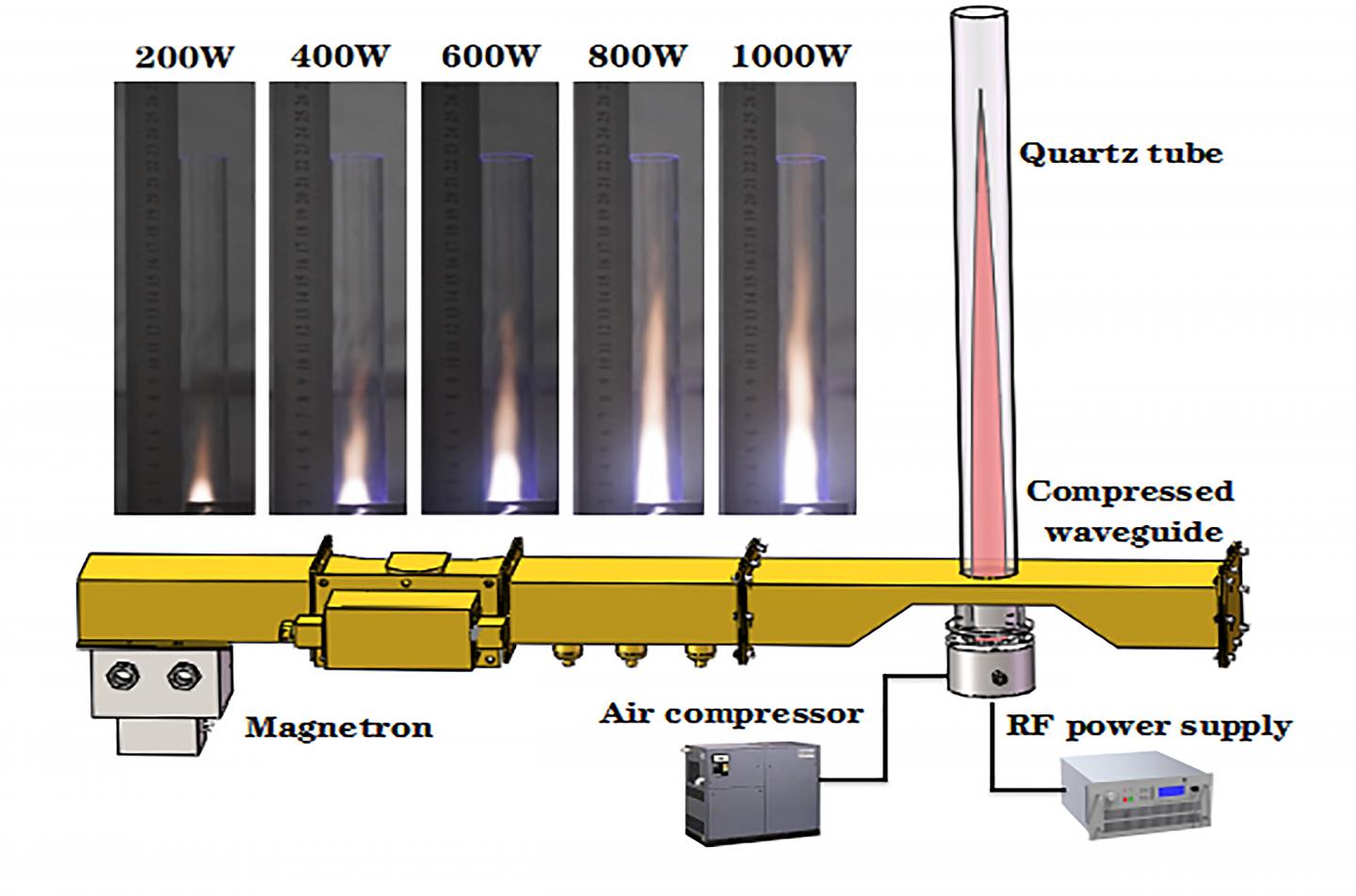
A prototype design of a plasma jet thruster can generate thrusting pressures on the same magnitude a commercial jet engine can, using only air and electricity
IMAGE

Credit: Jau Tang and Jun Li

WASHINGTON, May 5, 2020 — Humans depend on fossil fuels as their primary energy source, especially in transportation. However, fossil fuels are both unsustainable and unsafe, serving as the largest source of greenhouse gas emissions and leading to adverse respiratory effects and devastation due to global warming.

A team of researchers at the Institute of Technological Sciences at Wuhan University has demonstrated a prototype device that uses microwave air plasmas for jet propulsion. They describe the engine in the journal AIP Advances, from AIP Publishing.

“The motivation of our work is to help solve the global warming problems owing to humans’ use of fossil fuel combustion engines to power machinery, such as cars and airplanes,” said author Jau Tang, a professor at Wuhan University. “There is no need for fossil fuel with our design, and therefore, there is no carbon emission to cause greenhouse effects and global warming.”

Beyond solid, liquid and gas, plasma is the fourth state of matter, consisting of an aggregate of charged ions. It exists naturally in places like the sun’s surface and Earth’s lightning, but it can also be generated. The researchers created a plasma jet by compressing air into high pressures and using a microwave to ionize the pressurized air stream.

This method differs from previous attempts to create plasma jet thrusters in one key way. Other plasma jet thrusters, like NASA’s Dawn space probe, use xenon plasma, which cannot overcome the friction in Earth’s atmosphere, and are therefore not powerful enough for use in air transportation. Instead, the authors’ plasma jet thruster generates the high-temperature, high-pressure plasma in situ using only injected air and electricity.

The prototype plasma jet device can lift a 1-kilogram steel ball over a 24-millimeter diameter quartz tube, where the high-pressure air is converted into a plasma jet by passing through a microwave ionization chamber. To scale, the corresponding thrusting pressure is comparable to a commercial airplane jet engine.

By building a large array of these thrusters with high-power microwave sources, the prototype design can be scaled up to a full-sized jet. The authors are working on improving the efficiency of the device toward this goal.

“Our results demonstrated that such a jet engine based on microwave air plasma can be a potentially viable alternative to the conventional fossil fuel jet engine,” Tang said.

###

The article, “Jet propulsion by microwave air plasma in the atmosphere,” is authored by Dan Ye, Jun Li and Jau Tang. The article will appear in AIP Advances on May 5, 2020 (DOI: 10.1063/5.0005814). After that date, it can be accessed at http://aip.scitation.org/doi/full/10.1063/5.0005814.

ABOUT THE JOURNAL

AIP Advances is an open access journal publishing in all areas of physical sciences–applied, theoretical, and experimental. The inclusive scope of AIP Advances makes it an essential outlet for scientists across the physical sciences. See https://aip.scitation.org/journal/adv.

Media Contact
Larry Frum
[email protected]

Related Journal Article

http://dx.doi.org/10.1063/5.0005814

Tags: Chemistry/Physics/Materials SciencesClimate ChangeEarth ScienceEnergy SourcesEnergy/Fuel (non-petroleum)Technology/Engineering/Computer ScienceTransportation/Travel
Share12Tweet8Share2ShareShareShare2

Related Posts

AI and Physics Collaborate to Design Advanced Hydrogen Storage Materials

June 25, 2026

International Team Including Dresden Scientists Develops Novel Designer Proteins for Advanced Study of Living Tissue

June 25, 2026

New Study Uncovers Key Factors Driving Water Chemistry in Nanoscale Environments

June 25, 2026

Plasma Technology Extends Catalyst Lifespan in Hydrogen Production

June 24, 2026
Please login to join discussion

POPULAR NEWS

  • Saying Goodbye to PGY-6: Pediatric Fellowship Realities

    103 shares
    Share 41 Tweet 26
  • Multi-Hospital Study Reveals Long Covid Burden Is Twice as High as Current Estimates

    92 shares
    Share 36 Tweet 23
  • Detection of EDCs in Breast Milk and Infant Urine Up to Six Months Highlights Early Exposure Risks

    77 shares
    Share 31 Tweet 19
  • New Drug Candidate Developed at McMaster Shows Potential for Treating Brain Cancer

    58 shares
    Share 23 Tweet 15

About

We bring you the latest biotechnology news from best research centers and universities around the world. Check our website.

Follow us

Recent News

Tracking Lanthanide-Labeled Microplastics in Plants

POSTECH Researchers Slash Cost of Reconstituted Cell-Free Systems by 95%

AI and Physics Collaborate to Design Advanced Hydrogen Storage Materials

Subscribe to Blog via Email

Success! An email was just sent to confirm your subscription. Please find the email now and click 'Confirm' to start subscribing.

Join 82 other subscribers
  • Contact Us

Bioengineer.org © Copyright 2023 All Rights Reserved.

Welcome Back!

Login to your account below

Forgotten Password?

Retrieve your password

Please enter your username or email address to reset your password.

Log In
No Result
View All Result
  • Homepages
    • Home Page 1
    • Home Page 2
  • News
  • National
  • Business
  • Health
  • Lifestyle
  • Science

Bioengineer.org © Copyright 2023 All Rights Reserved.